Normal view

There are new articles available, click to refresh the page.
Before yesterdayMain stream

Jerusalem Delivered: 9 Armida’s Garden

By: hoakley
23 March 2026 at 20:30

The crusaders led by Godfrey of Bouillon desperately need Rinaldo back if they are to resume their assault on Jerusalem. Guelph’s party, notably the knights Charles (Carlo) and Ubaldo, have gone in search of him. But Rinaldo has been lured into a trap by the sorceress Armida, who intended to kill him. At the last moment, though, she falls in love with him and abducts him in her chariot.

That flies the couple to the distant, deserted and enchanted Fortunate Isles, where she lives in her garden that is perpetually in Spring. The wizard explains this to Charles and Ubaldo, to aid them in their mission to rescue the knight.

teniersmagiciandiscoverscarlosubaldo
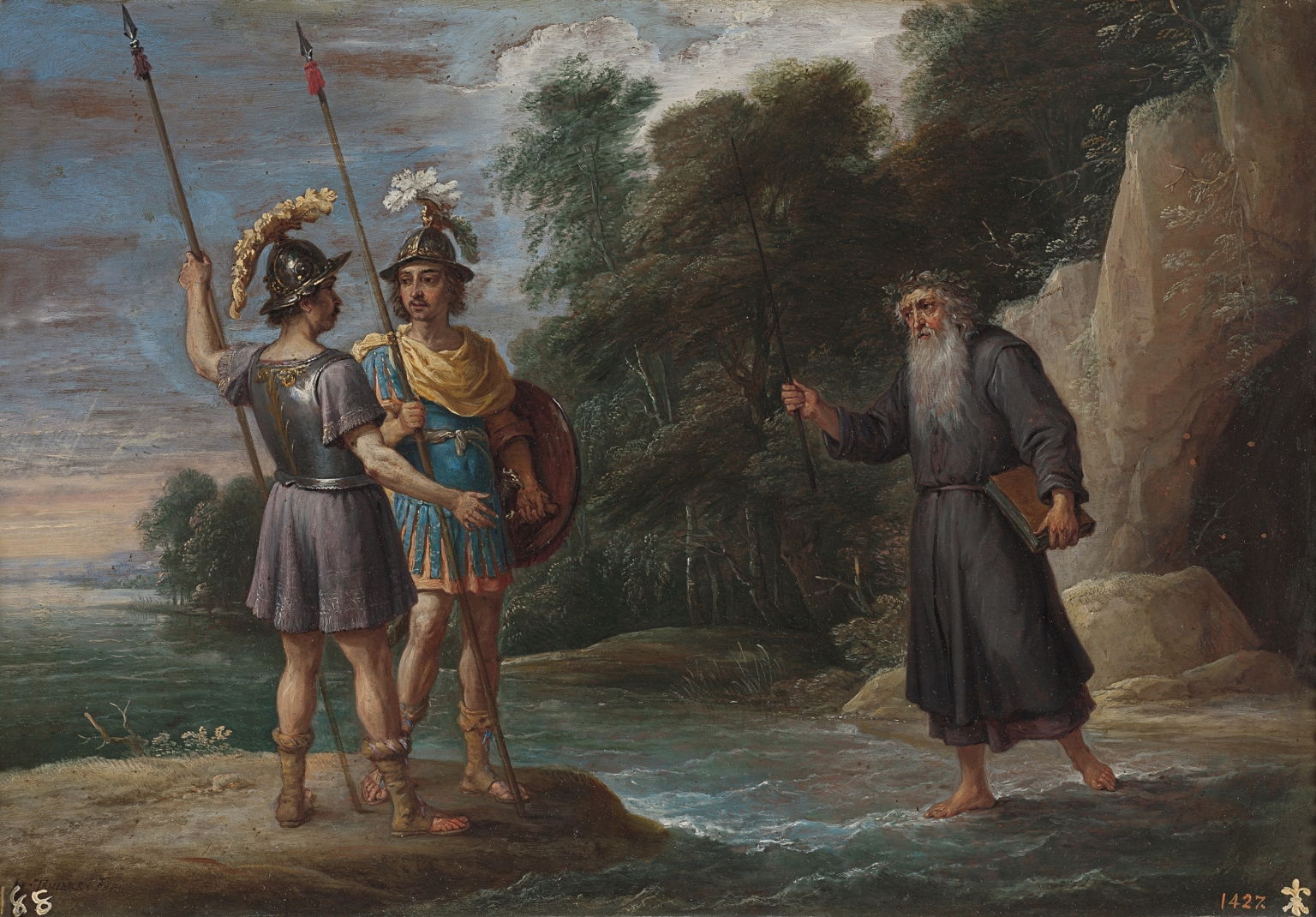
David Teniers the Younger (1610–1690), The Magician Shows Carlos and Ubaldo the Whereabouts of Rinaldo (The search for Rinaldo) (1628-30), oil on copper, 27 x 39 cm , Museo Nacional del Prado, Madrid, Spain. Wikimedia Commons.

David Teniers the Younger’s The Magician Shows Carlos and Ubaldo the Whereabouts of Rinaldo (The search for Rinaldo) from 1628-30 is a small oil on copper painting in his series telling this section of Tasso’s epic. Here the wizard despatches the two knights to the Fortunate Isles.

At the start of canto fifteen, Charles and Ubaldo set off to retrace their steps with the wizard as their guide. The river takes them gently down to the sea, where a ship awaits. They board, and sail at miraculous speed past Ascalon and the mouths of the River Nile, westward through the Mediterranean, and through the Pillars of Hercules into the Atlantic Ocean. They eventually approach the Fortunate Isles, pull into a harbour, and the two knights disembark.

They spend the night at the foot of the mountain they have to climb to reach Armida’s garden with the captive Rinaldo. They set off at dawn, only to encounter their first obstacle: a fearsome dragon blocking their passage up the mountain. Charles draws his sword ready to slay the dragon, but Ubaldo waves a golden wand, a gift of the wizard, which drives it away.

poussincompanionsrinaldo
Nicolas Poussin (1594–1665), The Companions of Rinaldo (c 1633-4), oil on canvas, 119 x 101 cm, The Metropolitan Museum of Art, New York, NY. Wikimedia Commons.

Poussin’s The Companions of Rinaldo (c 1633-4) shows the two knights confronting this dragon. Charles stands in the centre with his sword ready, but Ubaldo behind him leaves his weapon in its scabbard and brandishes his golden wand instead. In the background at the left is the magic ship in which they sailed, and standing in its prow is the maiden who steered it.

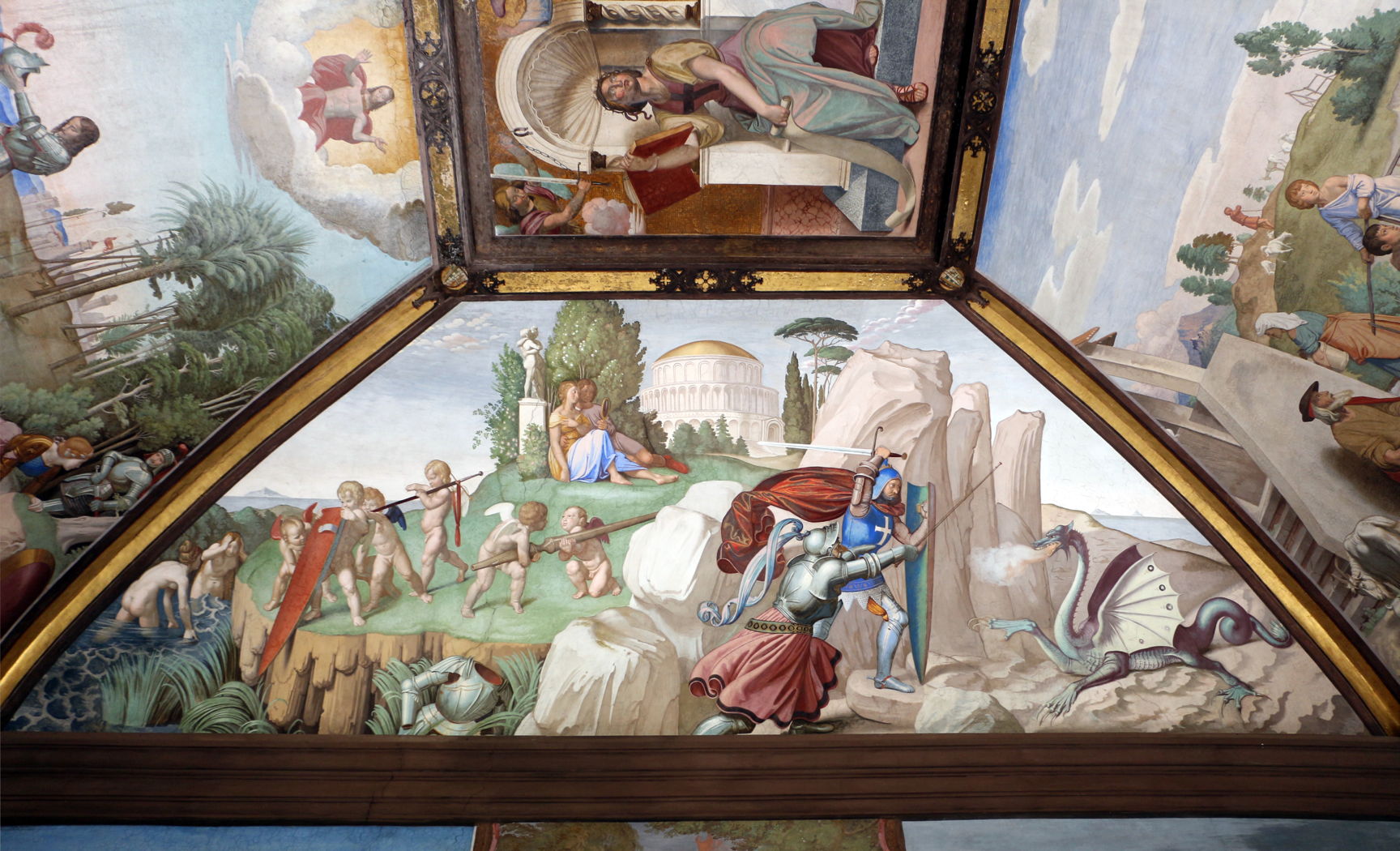
overbeckubaldocarloliberaterinaldo
Johann Friedrich Overbeck (1789-1869), Ubaldo and Carlo free Rinaldo from Armida’s Castle (1819-27), fresco, dimensions not known, Casa Massimo, Rome, Italy. Image by Sailko, via Wikimedia Commons.

Johann Friedrich Overbeck’s fresco of Ubaldo and Carlo free Rinaldo from Armida’s Castle from 1819-27, in the Casa Massimo, Rome, shows an interesting composite scene. To the right of centre, Charles and Ubaldo wield their sword and wand, and in the distance are Armida and Rinaldo in the garden on the summit. Amorini are playing with Rinaldo’s weapons, and his empty suit of armour has been cast into the undergrowth.

Next the pair have to face a lion, which is similarly dismissed with a wave of the wand. After that comes an army of animals they disperse readily, and Charles and Ubaldo are on the ascent towards the stretch of snow and ice they must cross before reaching Armida’s eternal Spring. Once up at the top, the two knights pause from their strenuous climb, slaking their thirst in a mountain stream. Grassy banks either side of the stream have a fine banquet laid out on them, and there are two naked young women cavorting in the water.

tenierscarlosubaldoislands
David Teniers the Younger (1610–1690), Carlos and Ubaldo in The Fortunate Isles (1628-30), oil on copper, 27 x 39 cm, Museo Nacional del Prado, Madrid, Spain. Wikimedia Commons.

David Teniers the Younger’s Carlos and Ubaldo in The Fortunate Isles (1628-30) shows this moment, with the banquet laid out on a clean white tablecloth rather than grass. Surrounded by trees and standing proud on the skyline is Armida’s palace, their destination.

delafossedanishwarriors
Charles-Alexandre Coëssin de la Fosse (1829–1910), Danish Warriors in the Garden of Armida (1848), others detail unknown, but believed to be oil on canvas and the original in colour. By Salon 1913, via Wikimedia Commons.

I only have this monochrome image of Charles-Alexandre Coëssin de la Fosse’s painting of Danish Warriors in the Garden of Armida from 1848. The two knights are dallying rather longer than their mission had intended.

Once Charles and Ubaldo can tear themselves away from these nymphs, they press on to the circular outer wall of the palace, which opens the sixteenth canto as they enter Armida’s garden.

mullergardenofarmida
Édouard Muller (1823-1876), The Garden of Armida (1854), block-printed wallpaper, 386.1 x 335.3 cm, Philadelphia Museum of Art, Philadelphia, PA. Wikimedia Commons.

In the eighteenth and nineteenth centuries, Armida’s garden appeared on all manner of products. This wallpaper designed by Édouard Muller in 1854 is now in the Philadelphia Museum of Art, while smaller images appeared on coffee cups and much else.

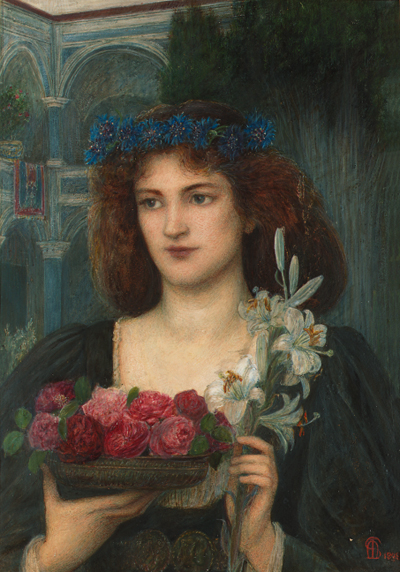
Tasso gives a brief description of the garden with its figs, apples and grape vines. Birds sing, and the wind murmurs softly. One bird speaks to the two knights, telling of the chaste and modest rose flower that springs virgin from its green leaves.

stillmanrosefromarmidasgarden
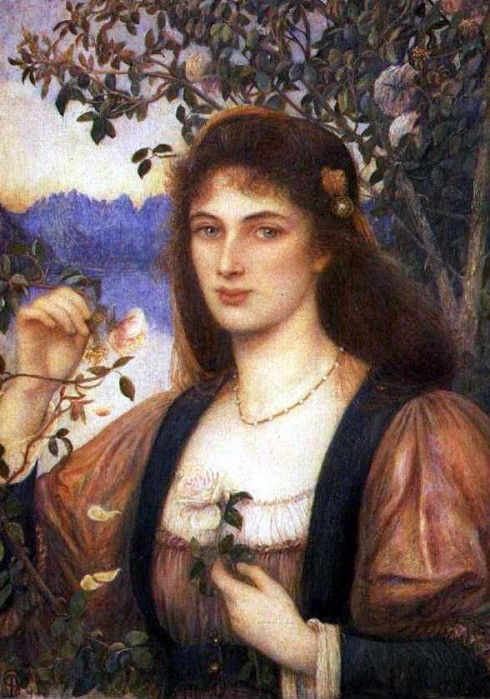
Marie Spartali Stillman (1844–1927), A Rose in Armida’s Garden (1894), watercolour and graphite on paper, 64.8 x 43.2 cm, Private collection. Wikimedia Commons.

This passage about the rose was the inspiration for Marie Spartali Stillman’s exquisite watercolour of A Rose in Armida’s Garden from 1894, given by the artist as a wedding gift to a family friend.

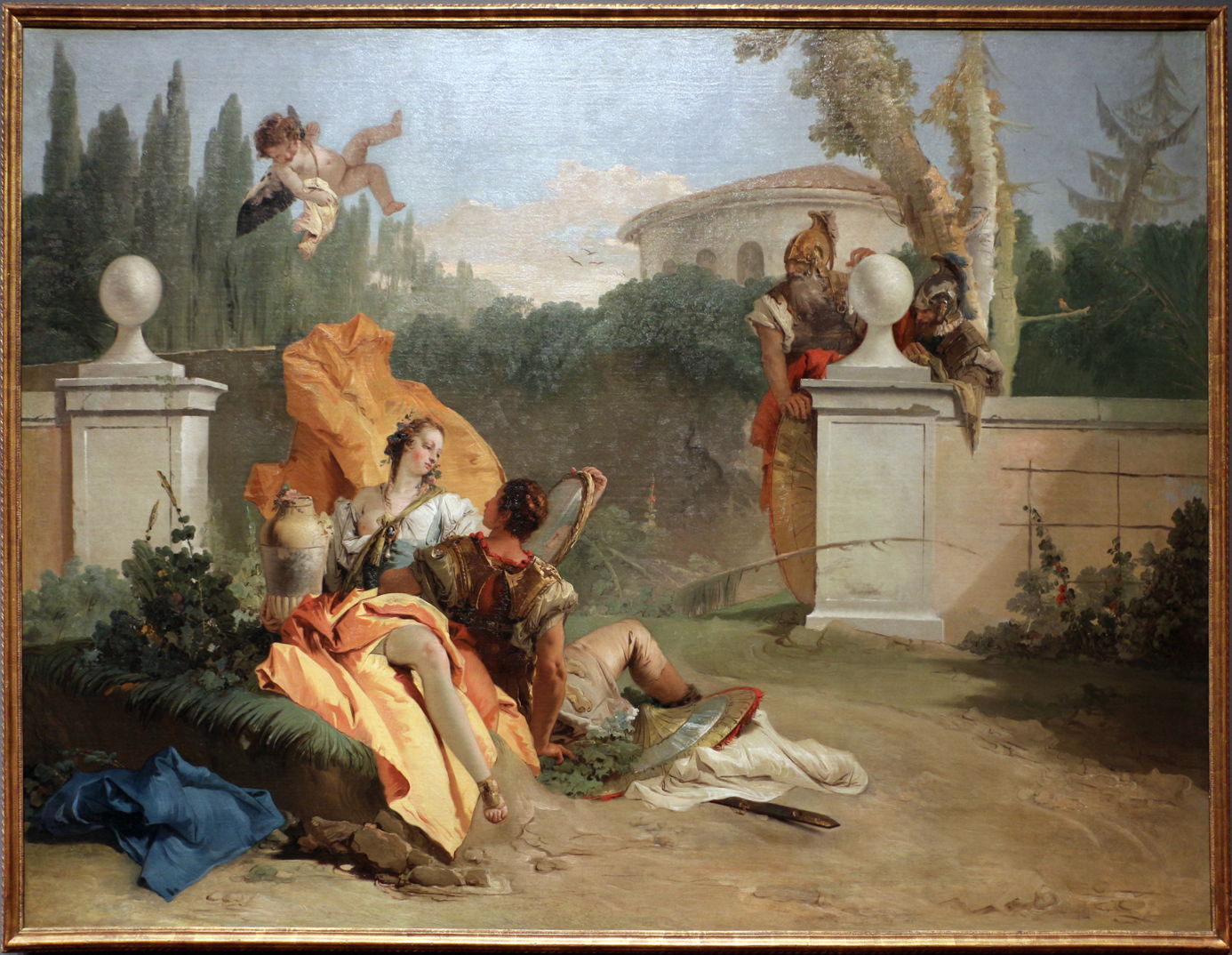
Charles and Ubaldo then peer through the leaves and spot a loving couple, who they presume to be Rinaldo and Armida. The knight’s head rests in Armida’s lap. He then stands up and takes a crystal glass hanging at his side. Armida uses this as a mirror to adjust her hair, telling Rinaldo to keep looking into her eyes.

tiepolorinaldoarmidagarden
Giovanni Battista Tiepolo (1696–1770), Rinaldo and Armida in Her Garden (1742-45), oil on canvas, 187 x 260 cm, The Art Institute of Chicago, Chicago, IL. Image by Sailko, via Wikimedia Commons.

Tiepolo paints this clearly in his Rinaldo and Armida in Her Garden from 1742-45, now in The Art Institute of Chicago. It was originally hung in a special room dedicated to Tasso’s epic in the Palazzo Corner a San Polo in Venice, where it belonged to the noble Serbelloni family.

kauffmannrinarm
Angelica Kauffman (1741–1807), Rinaldo and Armida (1771), oil on canvas, 130.8 x 153 cm, Yale Center for British Art, New Haven, CT. Wikimedia Commons.

In Angelica Kauffman’s Rinaldo and Armida from 1771, the crystal glass is ready at Armida’s feet, and she is busy distracting him by sprinkling flowers over his head.

hayezrinaldoarmida
Francesco Hayez (1791–1881), Rinaldo and Armida (1812-13), oil on canvas, dimensions not known, Gallerie dell’Accademia, Venice, Italy. Wikimedia Commons.

Francesco Hayez shows a variation in his Rinaldo and Armida from 1812-13. Anticipating the next part of Tasso’s narrative, instead of Rinaldo wearing the crystal glass at his side, his circular shield rests on the ground next to Armida. Charles and Ubaldo are shown peering from behind a tree trunk, safely in the distance.

Armida then kisses Rinaldo goodbye and leaves. Charles and Ubaldo see their opportunity and step out from the bushes, dressed in full armour. Ubaldo holds a highly polished shield up so that Rinaldo can see himself for what he has become, a woman’s dandy, not a warrior knight.

References

Wikipedia on Jerusalem Delivered.
Wikipedia on Torquato Tasso.

Project Gutenberg (free) English translation (Fairfax 1600).

Librivox audiobook of the Fairfax (1600) English translation (free).

Thomas Asbridge (2004) The First Crusade, A New History, Free Press, ISBN 978 0 7432 2084 2.
Anthony M Esolen, translator (2000) Torquato Tasso, Jerusalem Delivered, Gerusalemme Liberata, Johns Hopkins UP. ISBN 978 0 801 863233. A superb modern translation into English verse.
John France (1994) Victory in the East, a Military History of the First Crusade, Cambridge UP. ISBN 978 0 521 589871.
Joanthan Riley-Smith, ed (1995) The Oxford Illustrated History of the Crusades, Oxford UP. ISBN 978 0 192 854285.
Jonathan Riley-Smith (2014) The Crusades, A History, 3rd edn., Bloomsbury. ISBN 978 1 4725 1351 9.
Johathan Unglaub (2006) Poussin and the Poetics of Painting, Pictorial Narrative and the Legacy of Tasso, Cambridge UP. ISBN 978 0 521 833677.

Jerusalem Delivered: 1 A forgotten epic

By: hoakley
26 January 2026 at 20:30

In almost every collection of paintings from before 1900, you’ll come across works bearing mystifying titles like Tancred Baptizing Clorinda. Those names don’t come from mythology, nor are they Biblical. I suspect that most just abandon trying to read that painting, and pass on by.

tintorettodtancredbaptisingclorinda
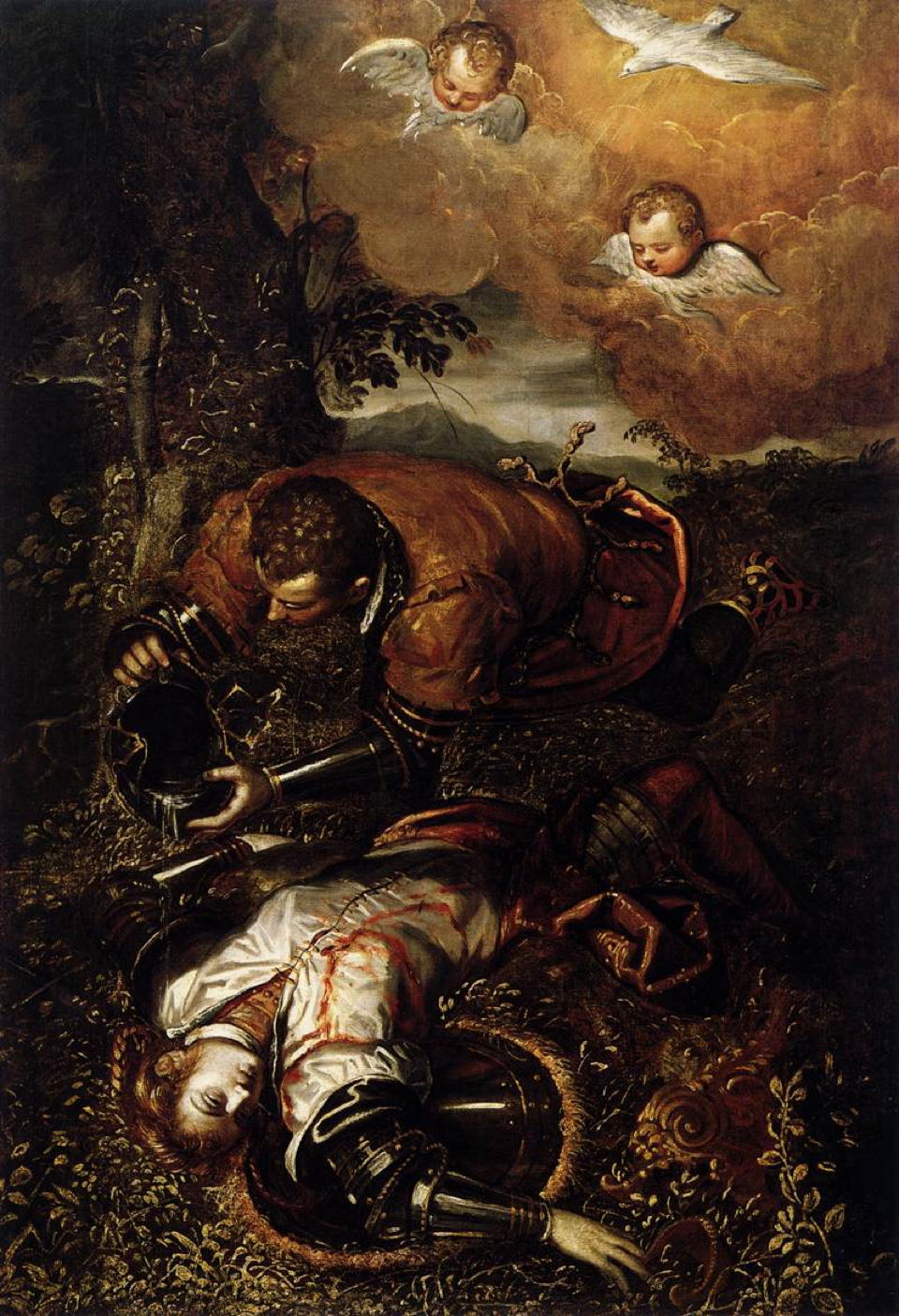
Domenico Tintoretto (1560–1635), Tancred Baptizing Clorinda (c 1585), oil on canvas, 168 x 115 cm, Museum of Fine Arts, Houston, TX. Wikimedia Commons.

In about 1585, Domenico Tintoretto, son of the famous Jacopo, painted just that, Tancred Baptizing Clorinda. Tancred was a fictional prince who fell in love with a pagan female warrior, Clorinda, but later mortally wounded her, and at her request baptised her just before she died.

They are among the leading figures in what was, until about 1900, one of the most widely-read epic poems in the western world: Torquato Tasso’s Gerusalemme LiberataJerusalem Delivered. Being so well known and loved, it was the basis for hundreds, perhaps thousands, of paintings, many by the masters. After Ovid’s Metamorphoses, it has probably been the source for more narrative paintings than any other literary work, apart from the Bible.

poussinwhole
Nicolas Poussin (1594–1665), Rinaldo and Armida (c 1630), oil on canvas, 82.2 x 109.2 cm, Dulwich Picture Gallery. Wikimedia Commons.

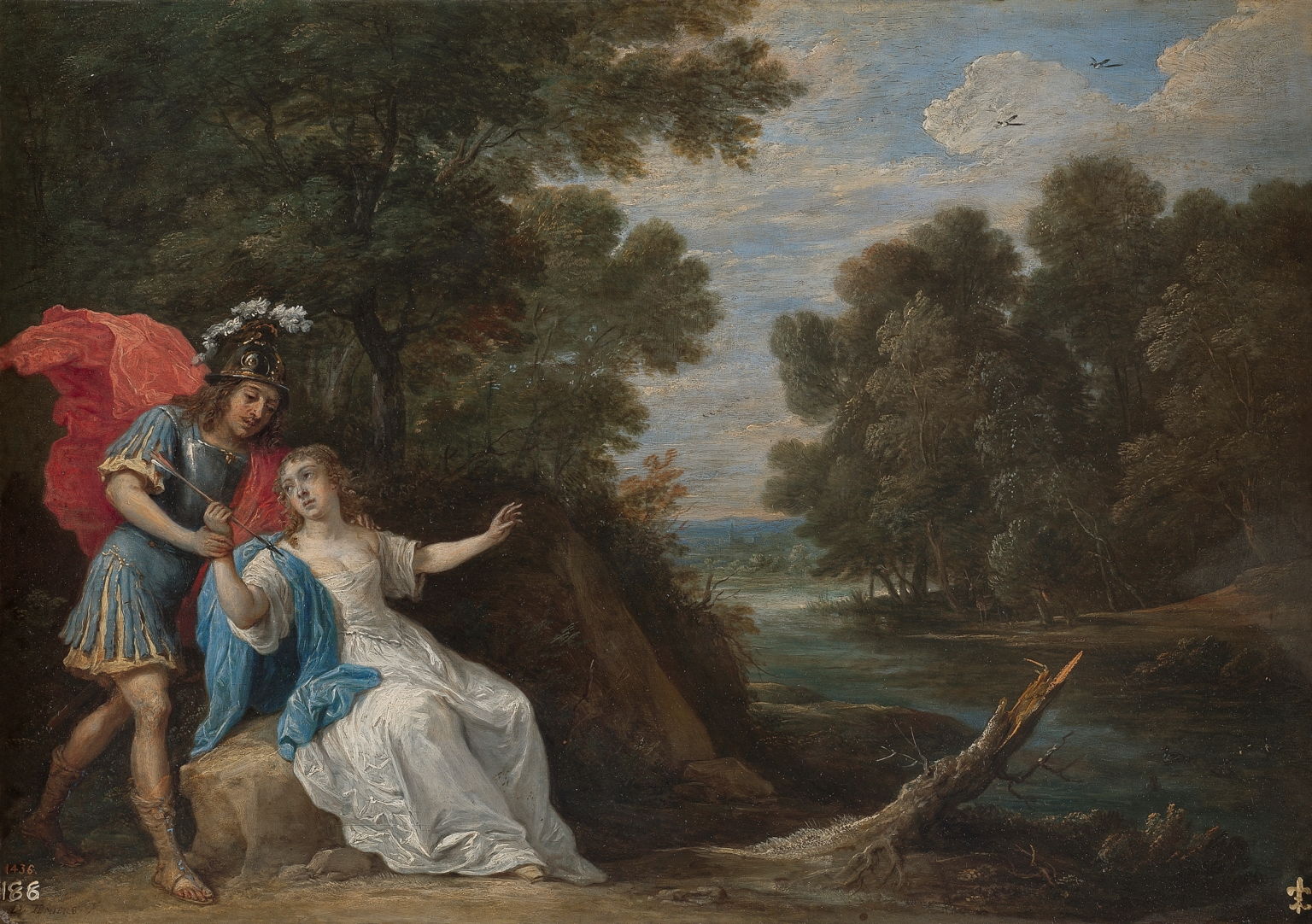
One of the greatest of the narrative artists to paint stories from this epic is Nicolas Poussin, whose Rinaldo and Armida from about 1630 remains one of the most brilliant narrative paintings ever made. Contemporary accounts of Poussin’s life record that his copy of Tasso’s epic was almost worn out through repeated use.

Unless you’re a scholar of Italian Renaissance literature, all you’ll see here is a pretty young woman on the one hand about to murder a sleeping knight with a dagger, and on the other hand caressing his brow.

The sleeping knight is Rinaldo, the greatest of Tasso’s Christian knights, who has stopped to rest near the ford of the Orontes. On hearing a woman singing, he goes to the river, where he catches sight of Armida swimming naked. Armida, though, has an evil aim. As a ‘Saracen’ witch, she has been secretly following Rinaldo, intending to murder him with her dagger. Having revealed herself to him, she sings and lulls him into an enchanted sleep so that she can thrust her dagger home.

Just as she’s about to do this, she falls in love with him instead, and this is the instant, the twist or peripeteia (Aristotle’s term), shown here. A winged amorino, lacking the bow and arrows of a true Cupid, restrains her right arm bearing her weapon. Her facial expression and left hand reveal her new intent to enchant and abduct Rinaldo in her chariot, so he can become infatuated with her, and forget his mission of war.

tiepolorinaldoarmidagarden
Giovanni Battista Tiepolo (1696–1770), Rinaldo and Armida in Her Garden (1742-45), oil on canvas, 187 x 260 cm, The Art Institute of Chicago, Chicago, IL. Image by Sailko, via Wikimedia Commons.

This couple are central to the complex intertwined threads within Jerusalem Delivered. Tiepolo was another artist who became obsessed with its stories and painted them on many occasions. This example shows Rinaldo and Armida in Her Garden (1742-45), and is now in The Art Institute of Chicago. It was originally hung in a special room dedicated to this epic in the Palazzo Corner a San Polo in Venice, where it belonged to the noble Serbelloni family.

overbeckubaldocarloliberaterinaldo
Johann Friedrich Overbeck (1789-1869), Ubaldo and Carlo free Rinaldo from Armida’s Castle (1819-27), fresco, dimensions not known, Casa Massimo, Rome, Italy. Image by Sailko, via Wikimedia Commons.

Johann Friedrich Overbeck worked for eight years painting this magnificent fresco of Ubaldo and Carlo free Rinaldo from Armida’s Castle (1819-27) in another room dedicated to the epic, in Rome’s Casa Massimo.

stillmanrosefromarmidasgarden
Marie Spartali Stillman (1844–1927), A Rose in Armida’s Garden (1894), watercolour and graphite on paper, 64.8 x 43.2 cm, Private collection. Wikimedia Commons.

For over three centuries, artists retold Tasso’s stories. Marie Spartali Stillman painted A Rose in Armida’s Garden as late as 1894. More of an aesthetic portrait than the depictions of others before her, Stillman gave this to a family friend for their wedding.

colliergardenofarmida
John Collier (1850–1934), The Garden of Armida (1899), oil on canvas, 262 x 178 cm, Private collection. WikiArt.

In 1899, John Collier tried his interpretation of The Garden of Armida in contemporary setting and dress. Although it wasn’t a success, Collier was one of the few who tried to adapt Tasso for the twentieth century.

mullergardenofarmida
Édouard Muller (1823-1876), The Garden of Armida (1854), block-printed wallpaper, 386.1 x 335.3 cm, Philadelphia Museum of Art, Philadelphia, PA. Wikimedia Commons.

Images inspired by the epic appeared in some of the most surprising places. This wallpaper designed by Édouard Muller in 1854 shows yet again The Garden of Armida, and is now in the Philadelphia Museum of Art. Smaller images were to be found on coffee cups and all manner of other objects.

Jerusalem Delivered is set in the midst of the First Crusade, which for many today makes it even more difficult to access. It’s a curious fact that most Europeans and North Americans are more familiar with the history, figures, and mythology of classical Rome, than with the crusades that dominated much of European society in mediaeval times and later.

teniersarmidainbattle
David Teniers the Younger (1610–1690), Armida in the Battle Against the Saracens (1628-30), oil on copper, 27 x 39 cm, Museo Nacional del Prado, Madrid, Spain. Wikimedia Commons.

David Teniers the Younger shows this clearly in this oil on copper painting of Armida in the Battle Against the Saracens from 1628-30. Armed as an archer, the ‘Saracen’ witch rides on a chariot into battle outside a large city. It’s a painting that makes no sense at all without knowing Tasso’s epic, a bit of background about the First Crusade, and the fact that the city is Jerusalem.

Next week I set the scene for this new series by looking at paintings of that First Crusade, summarising its real history, and introducing some of the characters Tasso wrote into his poetry. I hope that you’ll join me then in the town of Clermont, France, in late 1095.

References

Wikipedia on Jerusalem Delivered.
Wikipedia on Torquato Tasso.

Project Gutenberg (free) English translation (Fairfax 1600).

Librivox audiobook of the Fairfax (1600) English translation (free).

Anthony M Esolen, translator (2000) Torquato Tasso, Jerusalem Delivered, Gerusalemme Liberata, Johns Hopkins UP. ISBN 978 0 801 863233. A superb modern translation into English verse.
Johathan Unglaub (2006) Poussin and the Poetics of Painting, Pictorial Narrative and the Legacy of Tasso, Cambridge UP. ISBN 978 0 521 833677.

Painted stories of the Decameron: Overview and contents

By: hoakley
19 January 2026 at 20:30

Boccaccio’s Decameron is set in Florence at the height of the Black Death or plague of 1348. A group of seven young women and three young men have fled the piles of corpses in the city and taken refuge in a mansion in the surrounding country. To pass the time while they wait for the epidemic to abate, they agree to tell one another stories, ten each day, for ten ‘working’ days over a fortnight.

This series retells six of those that are well-known in their paintings, with a bonus at the end.

postiglionedecameron
Salvatore Postiglione (1861–1906), Scene of the Narration of the Decameron (date not known), oil on canvas, 100 x 151 cm, location not known. Wikimedia Commons.

Introduction

Day 4, Story 1

Told by Fiammetta about those whose love ended unhappily.

meighismunda
Bernardino Mei (1612-1676), Ghismunda (1650-59), oil on canvas, 66.5 x 47.5 cm, Pinacoteca nazionale di Siena, Siena, Italy. Wikimedia Commons.

Bernardino Mei’s Ghismunda from 1650-59 captures the resolute response of Ghismonda, as she stands squeezing her lover’s heart in her hand, tears still on her face.

A father’s revenge

Day 4, Story 5

Told by Filomena about those whose love ended unhappily.

millaisisabella
John Everett Millais (1829–1896), Isabella (Lorenzo and Isabella) (1848-49), oil on canvas, 103 x 142.8 cm, Walker Art Gallery, Liverpool, England. Wikimedia Commons.

John Everett Millais’ Isabella (Lorenzo and Isabella) from 1848-49 is based on Keats’ poetic retelling, and one of the earliest Pre-Raphaelite paintings.

Set at an imaginary family meal, it shows Lisabetta and her lover Lorenzo, with her three brothers. Lorenzo is sharing a blood orange with Lisabetta, white roses and passion flowers climbing from behind their heads. The dog, a surrogate for Lorenzo, is being petted by Lisabetta, but one of her brothers aims a kick at it. Other symbols are shown of the plot to kill Lorenzo: a brother staring at a glass of red wine, spilt salt on the table, and a hawk pecking at a white feather. The pot of basil is already on the balcony, awaiting Lorenzo’s head.

The pot of basil

Day 5, Story 1

Told by Panfilo about the adventures of lovers who survived calamities or misfortunes and reached a state of happiness.

leightoncymoniphigenia
Frederic, Lord Leighton (1830-1896), Cymon and Iphigenia (1884), oil on canvas, 218.4 x 390 cm, Art Gallery of New South Wales, Sydney, Australia. Wikimedia Commons.

Lord Leighton’s Cymon and Iphigenia from 1884 shows Iphigenia stretched out languidly in her sleep, in the last warm light of the day; behind her the full moon is just starting to rise. Cymon stands in shadow on the right, idly scratching his left knee, gazing intently at Iphigenia. But there is much more to Boccaccio’s story than that.

Abducted brides

Day 5, Story 8

Told by Filomena about the adventures of lovers who survived calamities or misfortunes and reached a state of happiness.

botticellinastagiodeglionesti3
Sandro Botticelli (1445–1510), The Story of Nastagio Degli Onesti III (1482-83), tempera on panel, 84 x 142 cm, Museo Nacional del Prado, Madrid, Spain. Wikimedia Commons.

The third painting in Botticelli’s series of four shows a breakfast banquet at which the ghost of a dead woman is attacked by dogs, and is about to be caught and killed in front of Nastagio’s guests. Nastagio used this ghostly spectacle to persuade the woman he loved to stop spurning his advances.

Nastagio degli Onesti’s breakfast

Day 10, Story 5

Told by Emilia about those who have performed liberal or munificent deeds in the cause of love, or for other reasons.

stillmanenchantedgardenmesseransaldo
Marie Spartali Stillman (1844–1927), The Enchanted Garden of Messer Ansaldo (1889), watercolour and gouache on paper mounted on panel, 72.4 × 102.9 cm, Private collection. Image courtesy of Julian Hartnoll, Pre‑Raphaelite Inc., via Wikimedia Commons.

Marie Spartali Stillman’s The Enchanted Garden of Messer Ansaldo from 1889 shows Madonna Dianora visiting the magical garden set up by Messer Ansaldo with its flowers and fruit, in the midst of snow during harsh January weather.

Ansaldo’s enchanted garden

Day 10, Story 10

Told by Dioneo about those who have performed liberal or munificent deeds in the cause of love, or for other reasons.

This is a re-telling of the folk story of Griselda.

anonstorygriselda2
Master of the Griselda Legend (fl 1490-1500), The Story of Griselda, Part 2: Exile (1494), oil and tempera on wood, 61.6 x 154.3 cm, The National Gallery, London. Wikimedia Commons.

The second panel of a series of three is set in the grand surroundings of the house of Gualtieri, Griselda’s husband. At the left edge, Griselda’s infant is taken from her to be killed. In the centre, she is shown a forged Papal dispensation dissolving her marriage, then to the right she is removing her fine clothes prior to leaving Gualtieri’s house. At the far right she is barefoot, wearing just her shift, returning to her father’s house to work as a shepherdess.

Griselda’s suffering

101st Story, Day 4, Introduction

A bonus, the hundred and first story is buried in Filostrato’s introduction to the fourth day. This is the best-known of all the stories in the Decameron as it has made its way into the French language, through one of La Fontaine’s fables.

lancretbrotherphilippesgeese
Nicolas Lancret (1690–1743), Brother Philippe’s Geese (c 1736), oil on copper, 27..3 x 35.2 cm, The Metropolitan Museum of Art (Purchase, Walter and Leonore Annenberg and The Annenberg Foundation Gift, 2004), New York, NY. Courtesy of The Metropolitan Museum of Art.

In about 1736, Nicolas Lancret painted this tale in oil on copper, as one of a pair, among a larger group of his paintings of La Fontaine’s fables.

Brother Philippe’s Geese

❌
❌