During her first visit to the White House, Prime Minister Sanae Takaichi drew praise from President Trump. But the war in the Middle East will test their relationship.
Before the Renaissance paintings were often decorated with precious metals, most commonly gold leaf in the process of gilding. Although this practice largely died out by 1500, it was revived in the nineteenth century and reached new heights in Gustav Klimt’s Golden Phase, shortly before the First World War.
Margarito d’Arezzo (fl c 1250-1290), The Virgin and Child Enthroned, with Scenes of the Nativity and the Lives of the Saints (c 1263-4), egg tempera on wood, 92.1 x 183.1 cm, The National Gallery, London. Wikimedia Commons.
Earliest European examples of egg tempera, such as Margarito d’Arezzo’s The Virgin and Child Enthroned, with Scenes of the Nativity and the Lives of the Saints from the middle of the thirteenth century, often incorporate extensive gilding, although today they might appear ‘primitive’.
Artist not known, The Wilton Diptych (c 1395-9), egg tempera on panel, each panel 53 x 37 cm, The National Gallery, London. Wikimedia Commons.
One of the most exquisitely worked examples of gilding was crafted by an unknown artist, most probably in France towards the end of the fourteenth century. Known as The Wilton Diptych it’s one of the greatest masterpieces in London’s National Gallery.
This painting was a luxury object intended from the outset for the personal devotions of a monarch, or someone of close rank and stature. Its interior shows on the left, King Richard II (its most probable owner) kneeling as he is presented by three saints, Saint John the Baptist (carrying the Lamb of God), Saint Edward the Confessor (holding the ring he gave to Saint John the Evangelist), and Saint Edmund (holding an arrow from his martyrdom). On the right is the Virgin Mary holding the Christ Child with a throng of eleven angels, one of whom bears the standard of the Cross of Saint John.
It was painted on two small panels of oak wood using egg tempera, in a workshop clearly experienced at making such works. Each panel is made of one wider board and a narrower strip. The two parts of a panel were joined by a craftsman using simple butt joints and were glued together with such care that the joins are almost invisible. They started off about 2.5 cm (1 inch) thick, and were then carved down to form an integral frame with a recessed painting surface. The two panels are hinged together using gilded iron fittings, so that the completed diptych could be folded shut for portability.
To prepare the panels for painting, the bare wood was first covered with a thin layer of parchment, and over that a single layer of gesso was applied. This was composed, as was traditional, of natural chalk and animal-derived glue. The gesso extended over the frame mouldings to prepare them for gilding.
Much of the surface of the panels was then to be gilded. Those areas were first marked out with incisions into the gesso ground, then covered with a thin layer of red bole (clay) containing animal-derived glue. The gold leaf was then applied with dilute glue in water, and after a couple of hours the leaf was burnished into place. These gilded areas were then patterned using a range of different punches. The resulting effect is of a jewelled surface, with intricate reflected patterns from different sections of the gilding.
Artist not known, The Wilton Diptych (detail) (c 1395-9), egg tempera on panel, each panel 53 x 37 cm, The National Gallery, London. Image by Sailko, via Wikimedia Commons.
Some details used a different technique known as mordant gilding, in which a binding medium is applied to give low relief, and the gold leaf applied onto that without burnishing. The optical properties of unburnished and burnished gold generate additional surface effects.
Artist not known, The Wilton Diptych (detail) (c 1395-9), egg tempera on panel, each panel 53 x 37 cm, The National Gallery, London. Image by Sailko, via Wikimedia Commons.Masaccio (1401–1428), Triptych of San Giovenale (1422), egg tempera on wood, 108 x 65 cm, 88 x 44 cm, Cascia di Reggello, Reggello, Italy. Photo by Sailko, via Wikimedia Commons.
Every figure in Masaccio’s early Triptych of San Giovenale from 1422 has been awarded a halo of gold leaf. Its central panel shows the Virgin Mary and infant Christ, with two angels in attendance. As is traditional, Mary is shown wearing a deep ultramarine blue cloak. The left panel shows Saints Bartholomew and Blaise, and the right panel Saints Juvenal (patron of the commissioning church) and Anthony Abbot.
Gilding had no role in the realism that came with the Renaissance, and it wasn’t until the middle of the nineteenth century that some artists revived the technique.
Jules Bastien-Lepage (1848–1884), The Annunciation to the Shepherds (1875), oil on canvas, 147.9 x 115.2 cm, National Gallery of Victoria, Melbourne. Wikimedia Commons.
Jules Bastien-Lepage’s early Annunciation to the Shepherds from 1875 builds on tradition, complete with its gilded angel, who could have stepped out from an early Renaissance work. That combines with the rural realism of the shepherds, with their bare and filthy feet in a timeless image.
Edward Burne-Jones (1833–1898), Perseus and the Graiae (1875-8), silver and gold leaf, gesso and oil on oak, 170.2 x 153.2 cm, National Museum of Wales, Cardiff, Wales. Wikimedia Commons.
At about the same time, Edward Burne-Jones was applying silver and gold leaf to the summary inscription for his series on the myths of Perseus. Below the Latin words, he shows Perseus with the three Graiae (or Graeae). He has just intercepted and seized their single, shared eye, which he holds in his right hand, in order to force them to take him to the sea nymphs or Hesperides, to obtain the kibisis to contain Medusa’s head.
In Austria, Gustav Klimt had trained and worked not just as an artist, but as a craftsman too, and worked with other craftsmen to present his paintings in his distinctive style.
Gustav Klimt (1862–1918), Pallas Athena (1898), oil on canvas, 75 × 75 cm, Historisches Museum der Stadt Wien, Vienna, Austria. Wikimedia Commons.
His painting of Pallas Athena (1898) is one of his first incorporating gold. Despite her modern appearance, Klimt remains true to tradition by showing her attributes, including the aegis of Medusa’s head over her upper chest, a spear and helmet.
Gustav Klimt (1862–1918), Judith I (1901), oil on canvas, 84 × 42 cm, Österreichische Galerie Belvedere, Vienna, Austria. Wikimedia Commons.
His empowering portraits of women increasingly used gilding to great effect. In Judith I (1901), he portrays a woman of power, whose pleasure results from her successful manipulation of the enemy general, Holofernes, and her subsequent beheading of him, a popular theme in the art of women such as Artemisia Gentileschi. Klimt leaves the ambiguity of her ecstasy, playing on the developing link between eroticism and death.
Gustav Klimt (1862–1918), Beethoven Frieze (‘The Hostile Powers’) (1902), casein, stucco, gold leaf, on mortar, 217 x 639 cm, Österreichische Galerie Belvedere, Vienna, Austria. Wikimedia Commons.
In 1902, the fourteenth exhibition of the Vienna Secession centred on Max Klinger’s Beethoven Sculpture. To raise funds to retain it in Vienna, members of the Secession contributed works to exhibit there. Klimt’s was a frieze of 24 metres in length, the Beethoven Frieze. The section shown above is that of The Hostile Powers, unusually painted using casein paints onto mortar, with added stucco, gold leaf, and other materials.
Gustav Klimt (1862–1918), Portrait of Adele Bloch-Bauer I (1907), oil, silver and gold on canvas, 140 x 140 cm, Private collection. Wikimedia Commons.
Inspired by the early Byzantine mosaic showing the Empress Theodora, in the Basilica San Vitale in Ravenna, Italy, the peak of Klimt’s Golden Phase is unique in art. Much of the surface of his first Portrait of Adele Bloch-Bauer is encrusted with gold and silver, and decorated with symbols of eyes, flowers, whorls, ellipses divided into halves, and rich textures worked into the gold leaf. To accomplish this involved a great deal of craftsmanship, using the same techniques as those for the Wilton Diptych, and took long days handling delicate leaves of precious metal.
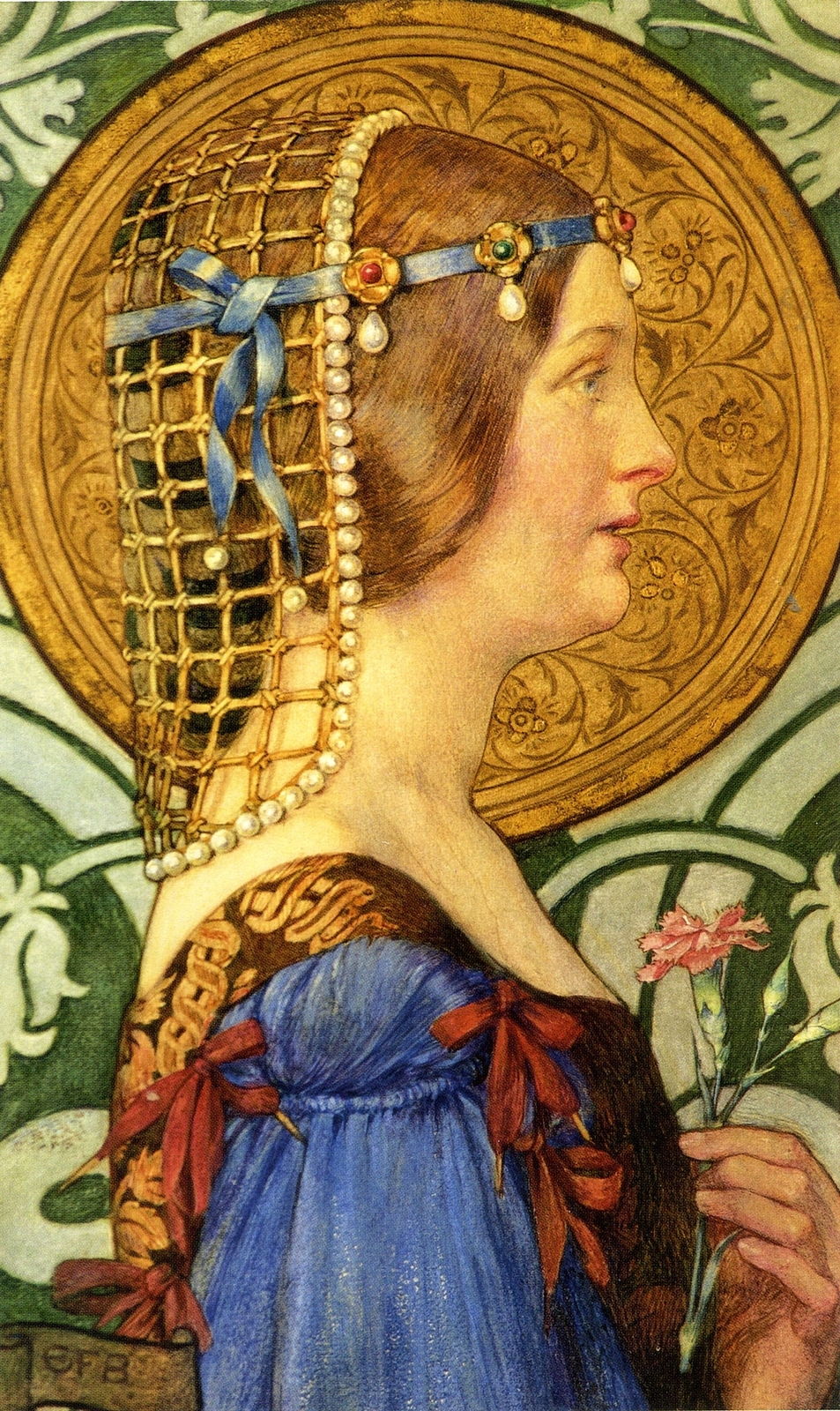
Although seldom if ever used by others of the Pre-Raphaelite movement, Eleanor Fortescue-Brickdale, the last of them, is unusual for combining it with watercolour.
Eleanor Fortescue-Brickdale (1872–1945), If One Could Have That Little Head of Hers (1910), watercolour, bodycolour and gold, 31.8 x 19 cm, Russell-Cotes Art Gallery and Museum, Bournemouth, England. Wikimedia Commons.
Fortescue-Brickdale’s If One Could Have That Little Head of Hers from 1910 also has a curious title that appears to be a quotation. The woman shown is presumably a saint, judging by her large gold halo, but is in early Renaissance dress.
It’s time to head off for a weekend away from the January gloom in Granada, Andalusia, southern Spain, where we’ll visit the Alhambra. It’s one of the oldest, grandest, most fascinating and beautiful palaces in Europe.
It started as one of many hill forts used by the Romans in a series of campaigns to control a succession of tribal revolts, and stamp the Empire’s presence close to North Africa. It was rebuilt in 889 CE, but nothing palatial became of it until around 1250, when the ruling Nasrid emir started to turn it into something much grander.
At that time, much of the south of the Iberian peninsula wasn’t ruled by people from Europe to the north, but by Muslim dynasties who had swept up from the south. The Emirate of Granada was the last substantial part of Iberia to remain under Muslim rule, and in 1333 the Sultan of Granada, Yusuf I, decided to transform the Alhambra into a royal palace. In doing so, he and his successors built one of the most exquisite expressions of Arabic Muslim art and architecture along a ridge about half a mile (0.7 km) long overlooking the city of Granada.
This plan from Openstreetmap and its contributors shows the modern site, as of 2013.
Constantin Uhde (1836–1905), Plan of the Nasrid Palaces, Alhambra (1892), illustration, further details not known. Wikimedia Commons.
Constantin Uhde’s plan of 1892 shows the layout of the Nasrid palaces:
Red is the site of the Palace of Comares and the Palaces of the Ambassadors.
Green is the Palace of the Lions.
Yellow is the Mexuar.
Blue is the Garden of Lindajar and later quarters of the Emir.
This article shows a selection of views of the palace up to 1883, and tomorrow’s sequel brings that up to the start of the First World War in 1914.
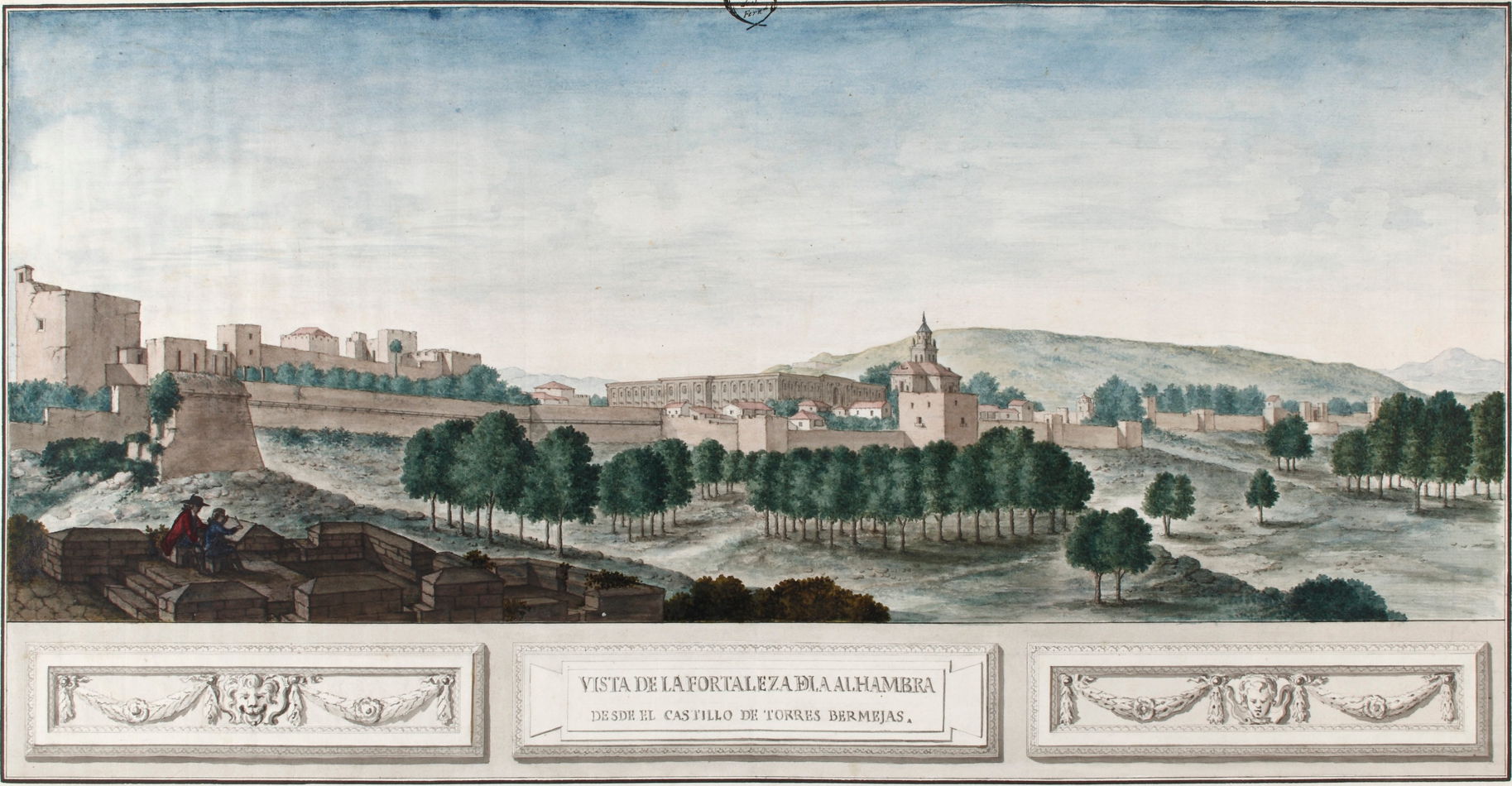
José de Hermosilla (1715-1776), View of the Alhambra from the Torres Bermejas Castle (1767), watercolour, dimensions not known, Real Academia de Bellas Artes de San Fernando, Madrid, Spain. Wikimedia Commons.
Early paintings of the Alhambra were mainly topographic views, painted in watercolour during the eighteenth century, such as José de Hermosilla’s View of the Alhambra from the Torres Bermejas Castle of 1767. These are similar to views of landmarks being produced in Britain at the time.
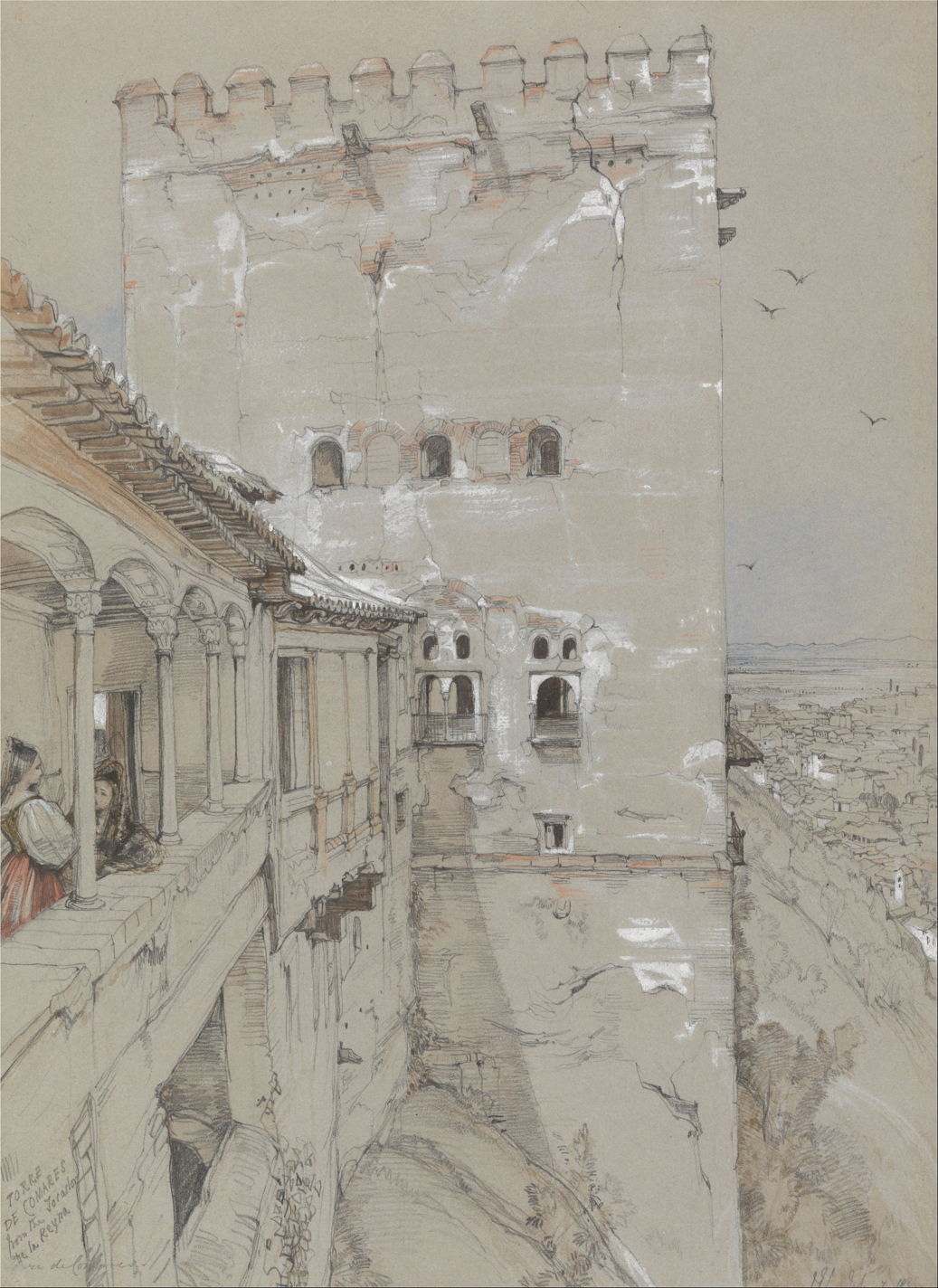
John Frederick Lewis (1805–1876), The Torre de Comares, Alhambra (1835), graphite, watercolour, white gouache and scratching out on medium, slightly textured, gray wove paper, 37.1 x 27 cm, Yale Center for British Art, New Haven, CT. Wikimedia Commons.
Others, like John Frederick Lewis in 1835, came to record details of the remains of the Alhambra’s buildings, as in The Torre de Comares, Alhambra, drawn carefully in graphite and only slightly highlighted and coloured with watercolour and gouache.
While every seriously aspiring landscape painter was flocking to paint en plein air in the Roman Campagna in the early nineteenth century, the Alhambra seems not to have been included in the circuit.
David Roberts (1796–1864), Alhambra and Albaicin (date not known), further details not known. Wikimedia Commons.
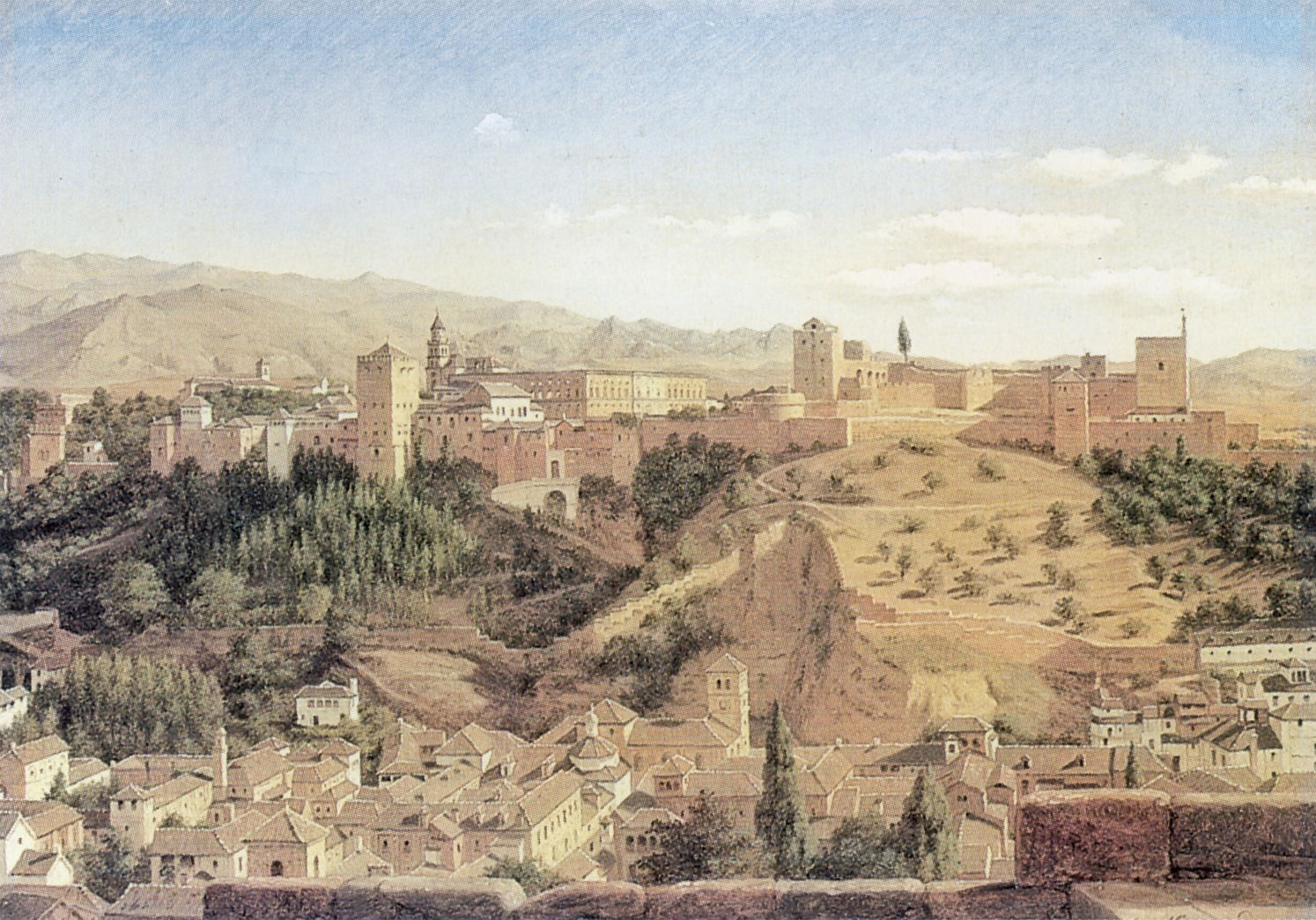
It was the vogue for Orientalist views in the middle of the nineteenth century that first attracted artists to paint the Alhambra in oils. This is David Roberts’ undated view of Alhambra and Albaicin. Roberts is much better-known for his sketches turned into prints from multiple tours of Egypt and the ‘near east’ made between 1838-40. This work probably originated in sketches made when he visited Spain in 1832, and would have then been painted in this form back in Britain after about 1833, and turned into a print by 1837.
Achille Zo (1826–1901), Patio in the Alhambra (1860), media and dimensions not known, Musée des beaux-arts de Pau, Pau, France. Wikimedia Commons.
Achille Zo was a Basque painter who specialised in views of Spain during the 1860s, such as this Patio in the Alhambra from 1860. These were well received at the Salon in Paris, earning him a gold medal in 1868, following which he too turned to Orientalism.
Franz von Lenbach (1836–1904), The Alhambra in Granada (1868), oil on canvas, 72.1 × 91.5 cm, Sammlung Schack, Bayerische Staatsgemäldesammlungen, Munich, Germany. Wikimedia Commons.
It was the fine collection of paintings of the Prado in Madrid that attracted many great artists to Spain. In 1867, Franz von Lenbach and a student of his travelled to Madrid to copy the masters there for his patron Baron Adolf von Schack. The following year, he painted two works in Granada: The Alhambra in Granada (1868) is a magnificent sketch including the backdrop of the distant mountains, and appears to have been painted in front of the motif.
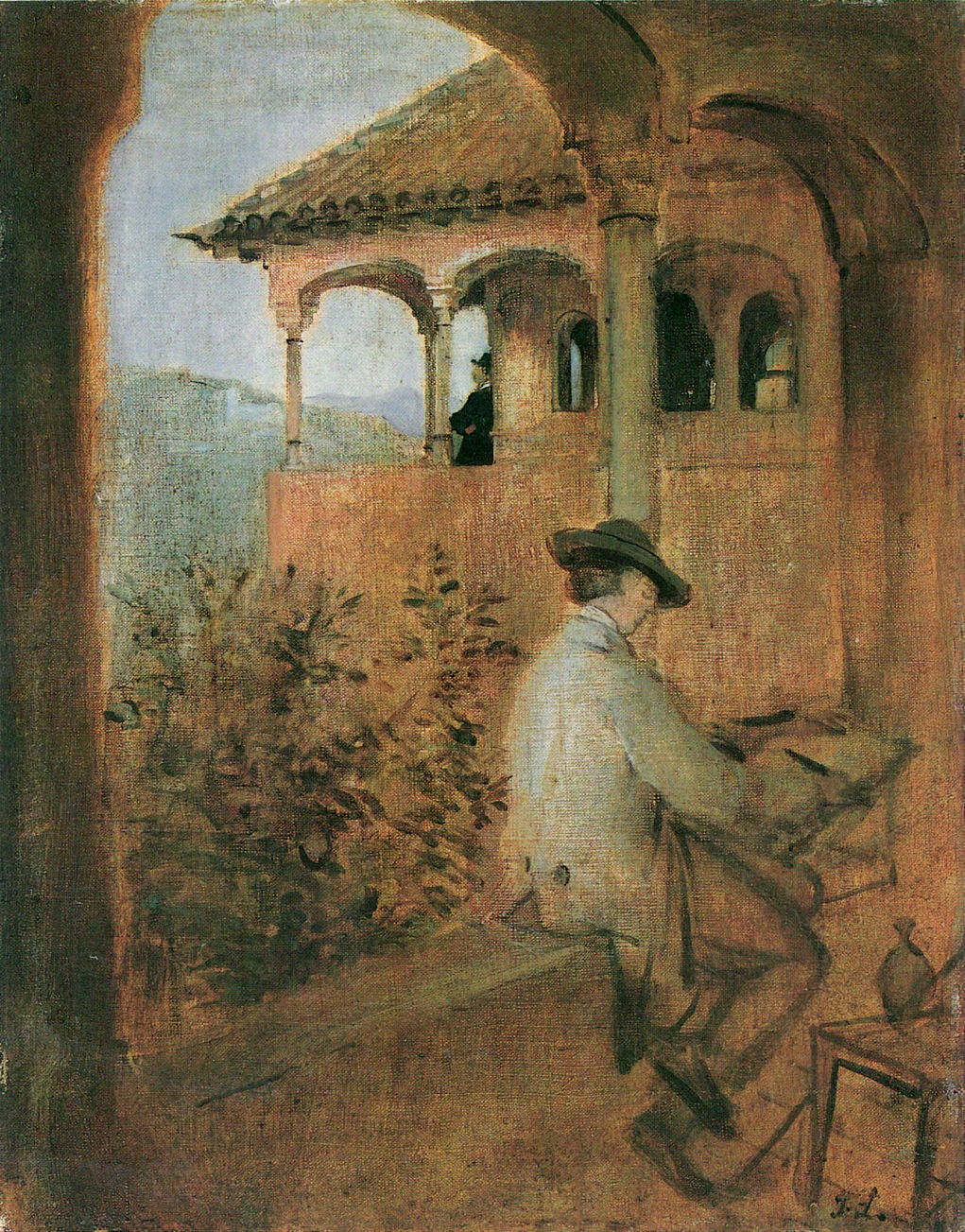
Franz von Lenbach (1836–1904), Tocador de la Reina (Queen’s Dressing Room) in the Alhambra (1868), oil on canvas, 33.1 × 26.2 cm, Sammlung Schack, Bayerische Staatsgemäldesammlungen, Munich, Germany. Wikimedia Commons.
Von Lenbach’s Tocador de la Reina shows the exterior of the Queen’s Dressing Room in the palaces, with his student sketching.
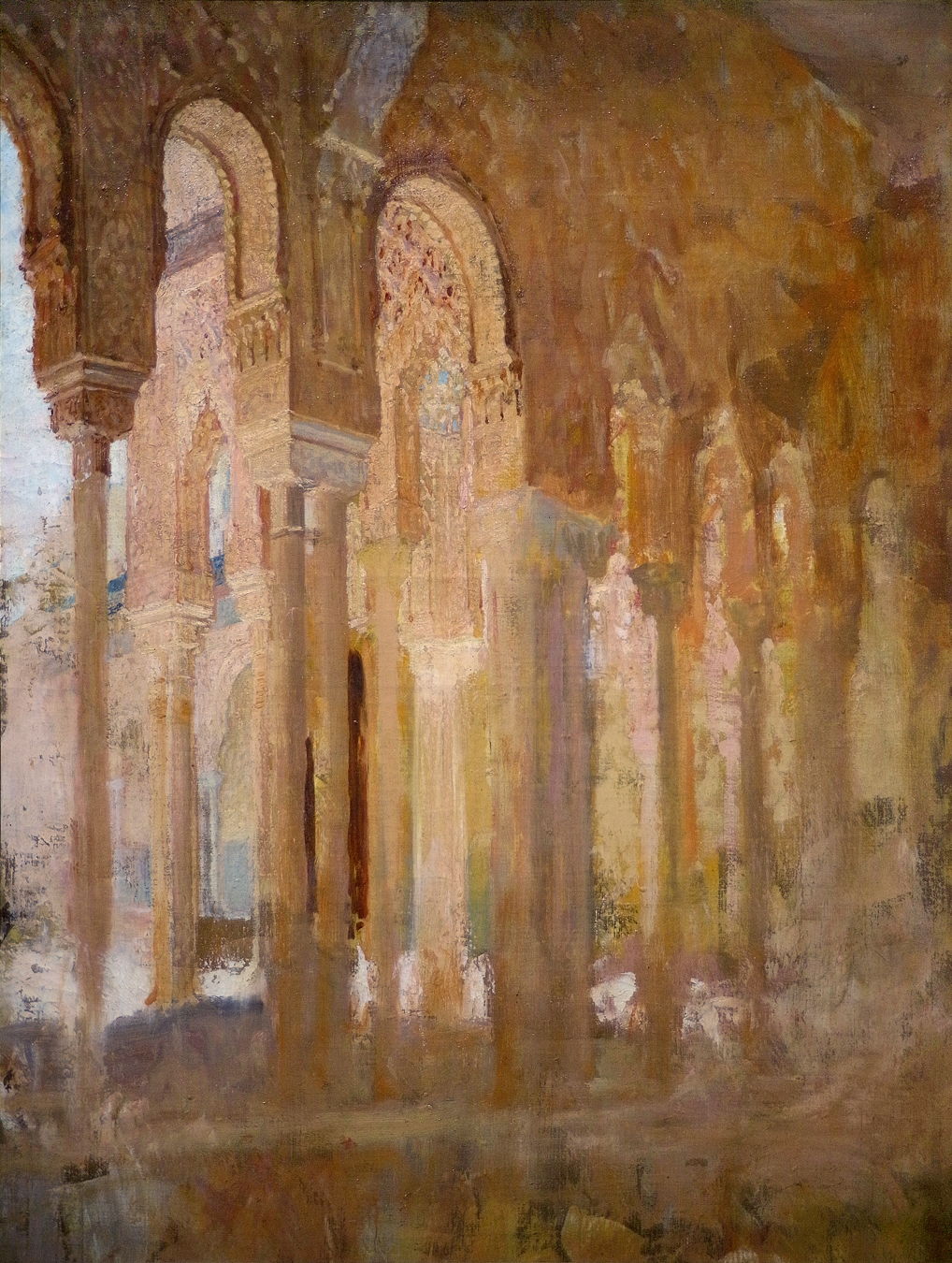
Henri Regnault (1843–1871), Colonnade of the Court of the Lions at the Alhambra (1869), oil on canvas, dimensions not known, Musée des Augustins de Toulouse, Toulouse, France. Wikimedia Commons.
Just two years before he was killed in the Franco-Prussian War, Henri Regnault toured Spain, and when he was in Granada he painted this view of the Colonnade of the Court of the Lions at the Alhambra (1869). I suspect this is unfinished, and he intended to complete the detail in its lower half.
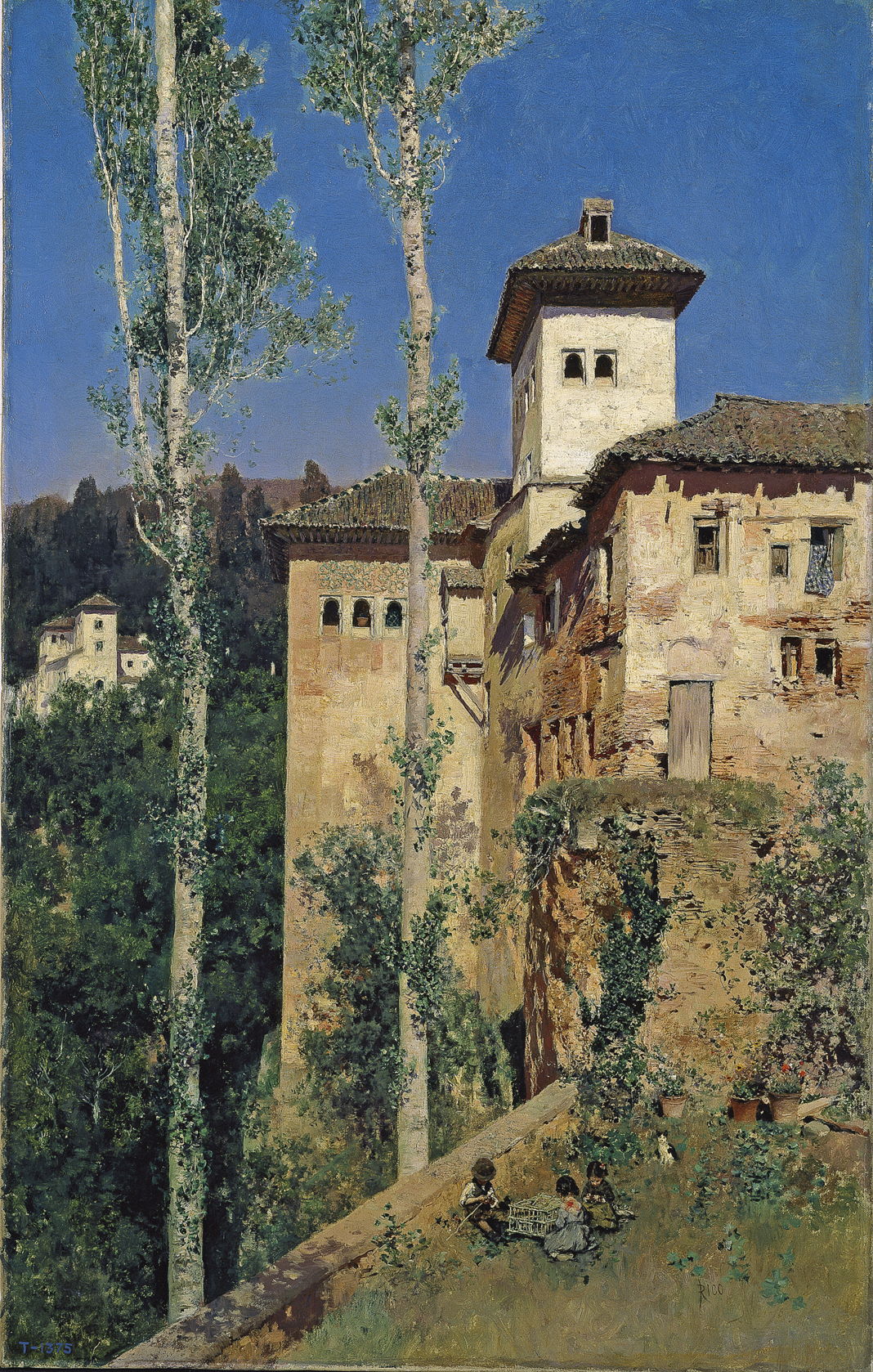
Martín Rico y Ortega (1833–1908), La Torre de las Damas en la Alhambra de Granada (The Tower of the Ladies in the Alhambra) (1871-72), oil on canvas, 62.5 x 39 cm, Museo Nacional del Prado, Madrid, Spain. Wikimedia Commons.
Martín Rico was one of the most important painters in Spain at this time. Influenced mainly by the Barbizon school, he painted this finely-detailed view of The Tower of the Ladies in the Alhambra in 1871-72. It captures the dilapidation the Alhambra had fallen into before more recent work to restore it to its former glory.
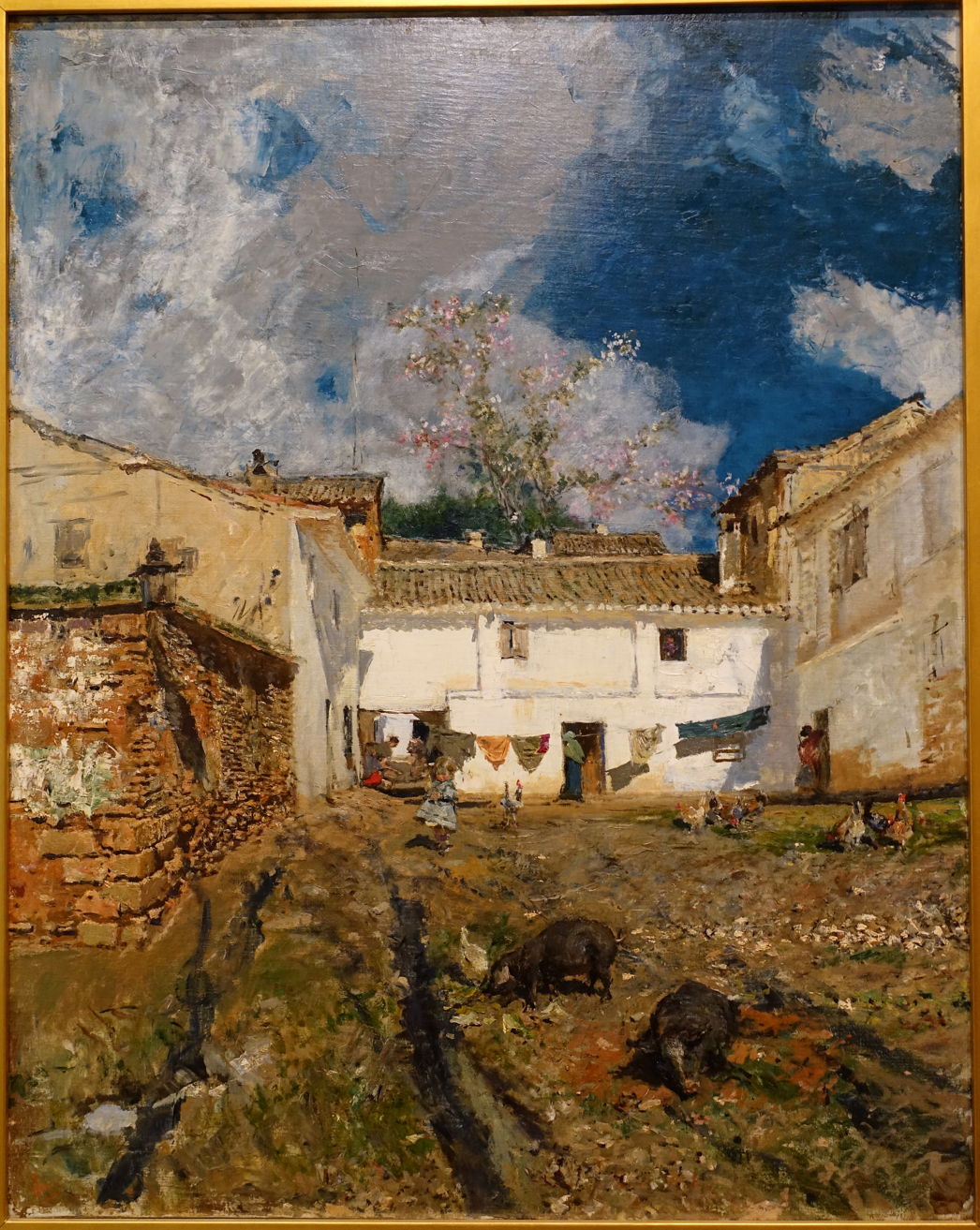
Marià Fortuny (1838–1874), Courtyard at Alhambra (Patio in Granada) (1873), oil on canvas, 111.4 x 88.9 cm, The Fogg Art Museum, Harvard University, Cambridge, MA. Wikimedia Commons.
If Marià Fortuny’s more Impressionist view of a Courtyard at Alhambra (Patio in Granada) from 1873 is to be believed, some parts of the Alhambra had been turned into smallholdings, with free-ranging chickens.
Heinrich Hansen (1821-1890), Granada with the Alhambra in the Nineteenth Century (date not known), further details not known. Image by Sir Gawain, via Wikimedia Commons.
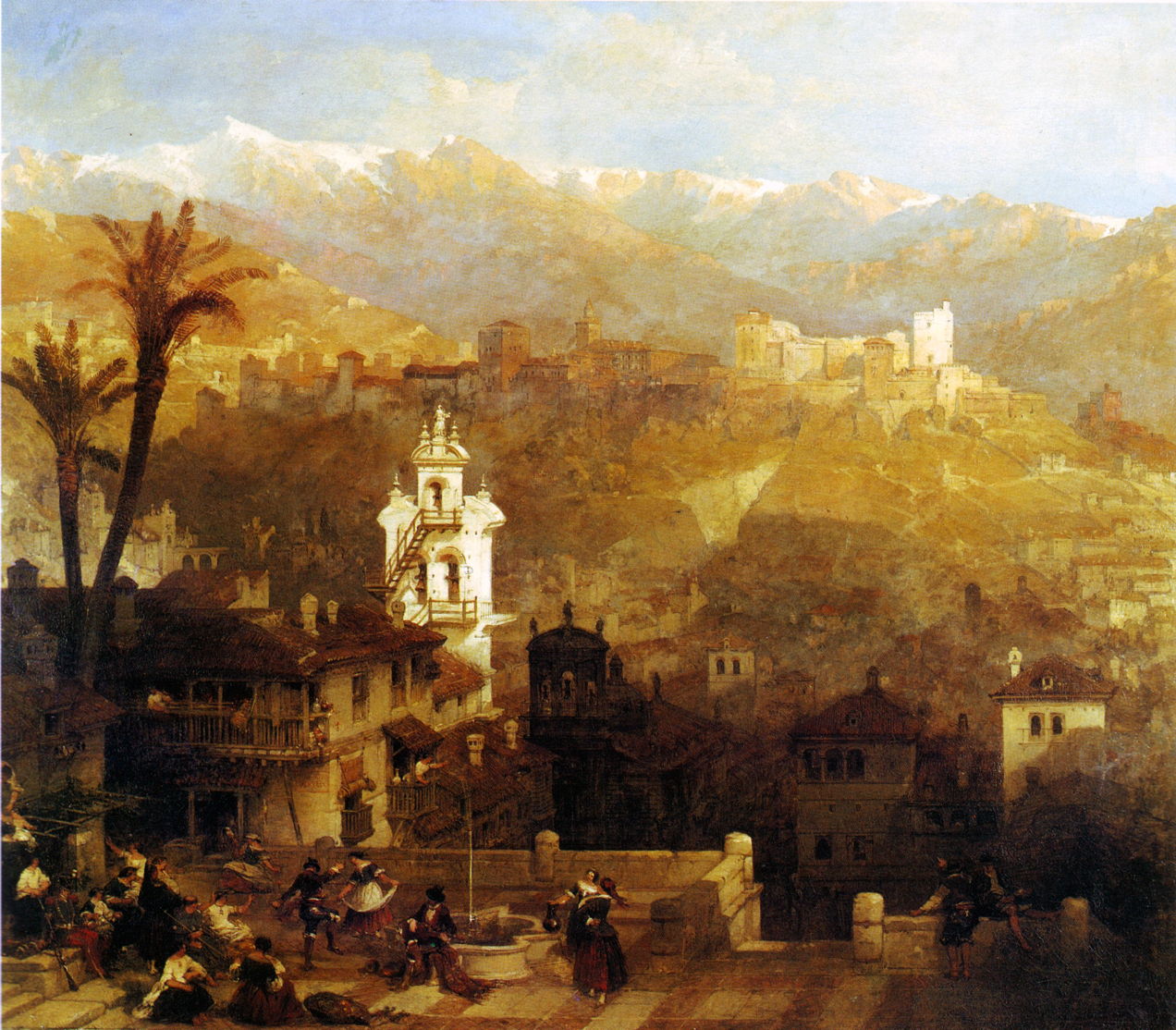
More distant views of the ridge, such as Heinrich Hansen’s undated painting of Granada with the Alhambra in the Nineteenth Century, show its imposing grandeur.
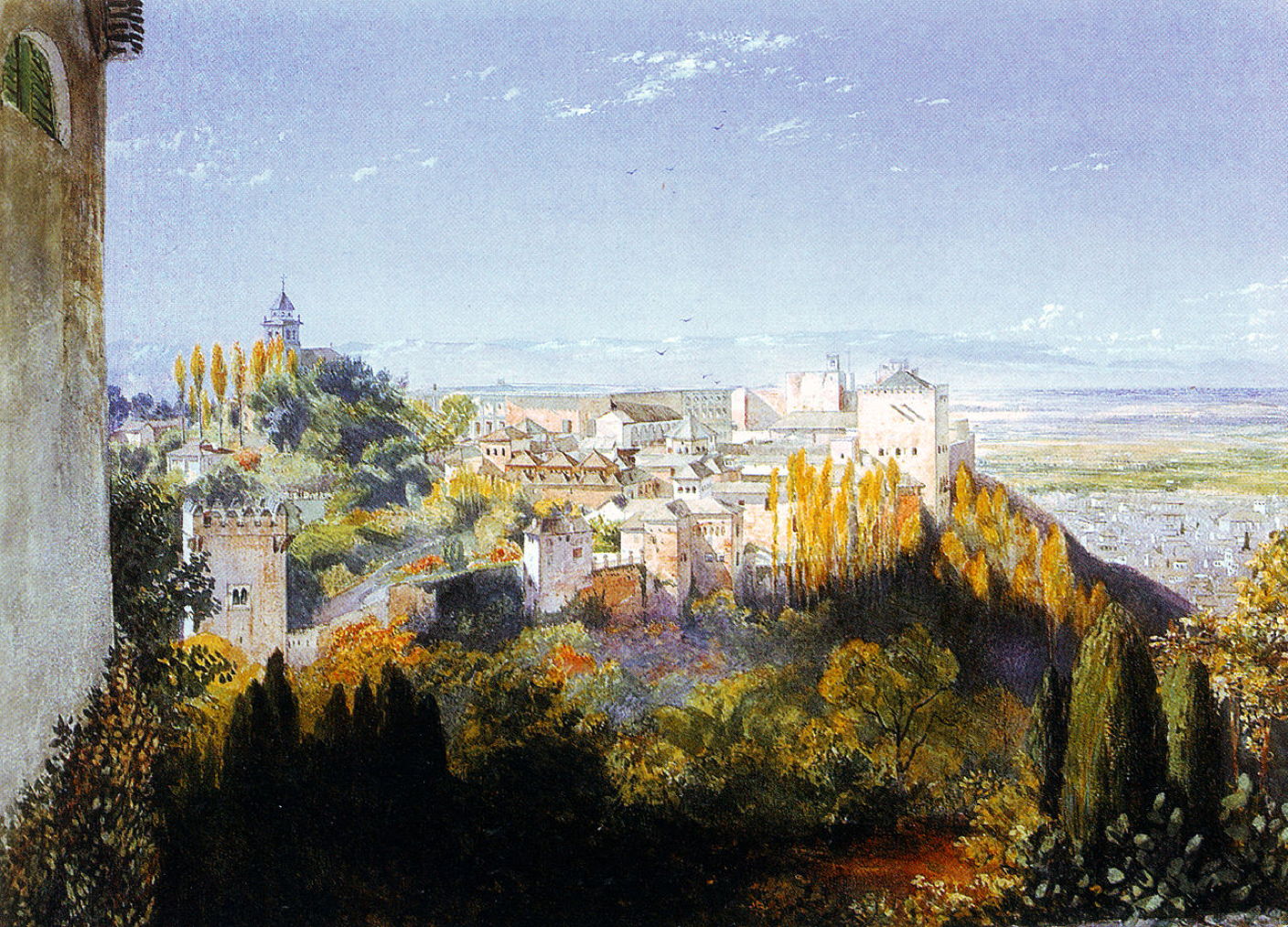
John Haynes Williams (1836-1908), Albaicin from the Alhambra (date not known), further details not known. Wikimedia Commons.
John Haynes Williams (or Haynes-Williams) recognised the merits of views painted from the Alhambra as a high point, in his undated Albaicin from the Alhambra.
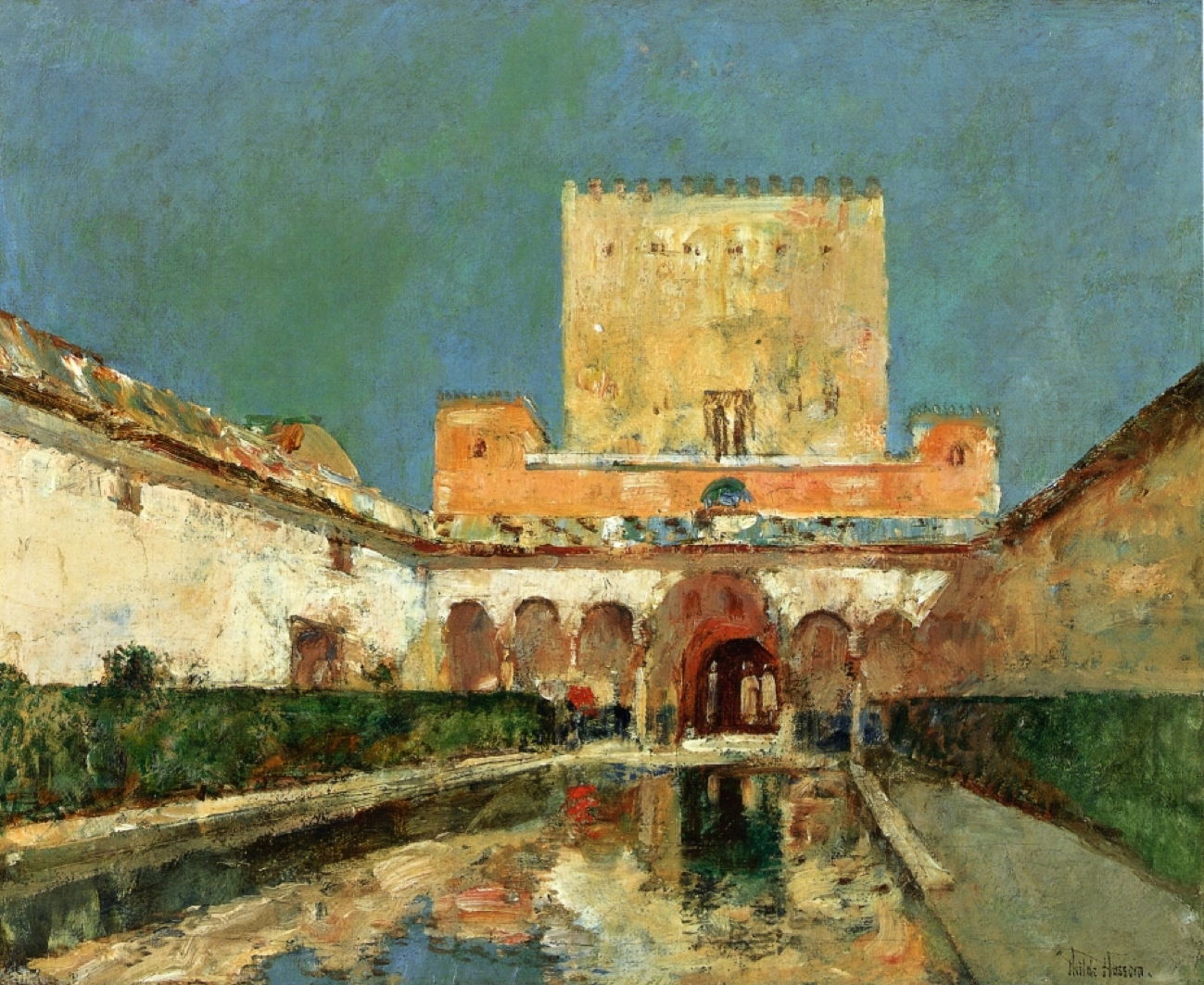
Childe Hassam (1859–1935), The Alhambra (1883), oil on canvas, 33 x 40.6 cm, Private Collection. Wikimedia Commons.
The late nineteenth century saw new visitors to copy masters at the Prado: those Americans who came to study painting in France and Germany. Among then, Childe Hassam visited during the summer of 1883, with his friend Edmund H Garrett, and sketch this view of The Alhambra then. This shows the Palace of the Ambassadors, and remains one of the most frequently painted parts of the site.
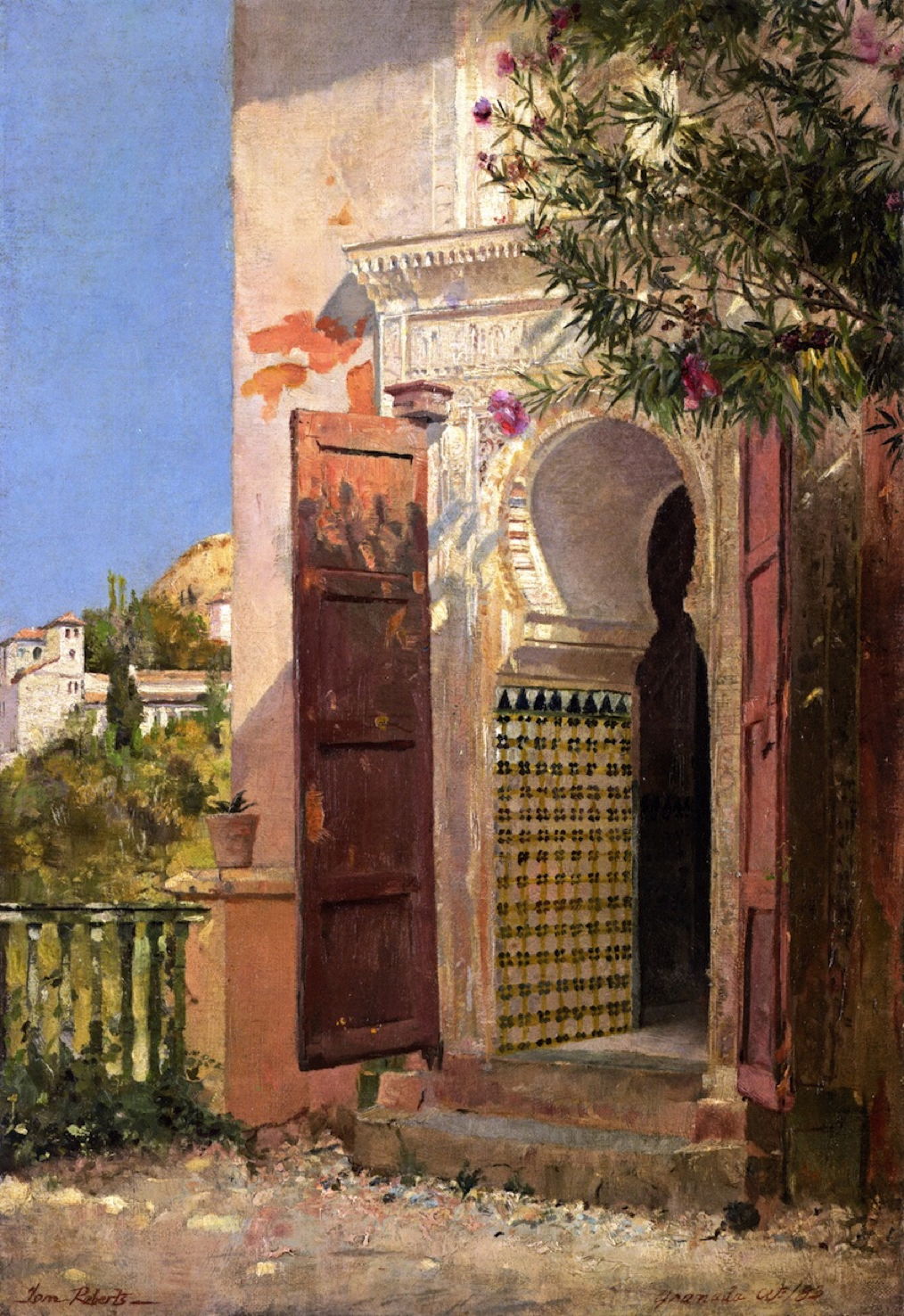
Tom Roberts (1856–1931), A Moorish Doorway, Alhambra (1883), further details not known. Wikimedia Commons.
From even further afield, the Anglo-Australian Tom Roberts visited Granada when he was in Spain in 1883, when he painted this detailed realist view of A Moorish Doorway, Alhambra. Roberts had migrated with his family in 1869, returned to Britain to study at the Royal Academy Schools from 1881, then went to Spain with the Australian John Peter Russell. He returned to Australia in 1884, becoming one of the early Australian Impressionists.

 Login
Login