Today, The New York Review of Books has published a 10,000-word essay by Ai Xiaoming, one of China’s foremost public intellectuals. Echoing Hayek’s Road to Serfdom, “The Road to Miaoxi” is a plea against unfettered state power, which she sees as increasing in China–and in fact around the world.
It comes in the form of a travelogue retracing the passion of the late Niu Lihua, whose memoir Broken Dreams at Miaoxi describe his twenty-year path of sorrows from labor camp to labor camp in western Sichuan province.
During her travels by car and foot, Ai uncovers the physical remnants of these camps, and reflects on how they were implemented–the lack of rule of law and the overconcentration of state power.
The exercise took weeks of time, making me appreciate the work put into translating by professional Chinese-English translators like Michael Berry at UCLA–not just the literal translation but the interpretation needed so it makes sense for a new audience.
For that, I owe the editing staff at the Review a huge amount of thanks. They found inconsistencies, unclear points, and inelegant phrasing throughout the work. This is an online essay and people sometimes still think that online means some sort of slapdash “blogpost.” In fact, this was more carefully and attentively edited than most print articles I’ve written, for any publication.
The article is behind a paywall but you can access it by creating an account and enjoying one free article, or you can write me for a PDF. It will also be unlocked on the Asia Society’s Chinafile NYRB archive in a month, as part of an agreement with the Review. However, I’d encourage readers to try the NYRB site first–even just registering for a free trial helps the Review, which is a unique, family-run journal. Work like this involves a paid staff and it should be supported in any way possible!
In another era, Perry Link and Wu Dazhi’s biography of Liu Xiaobo would have been reviewed widely and my review–which appeared a year after the book was published–would have been embarrassingly late. But many societies around the world are focused inward, obsessed with populist concerns, and so this tour-de-force biography was essentially not reviewed in the mainstream press at all. A pity, because it gives us the prequel to Xi’s China–a time of bold efforts to build civil society in China and bold people like the Nobel Peace Prize laureate Liu Xiaobo. Read the review here.
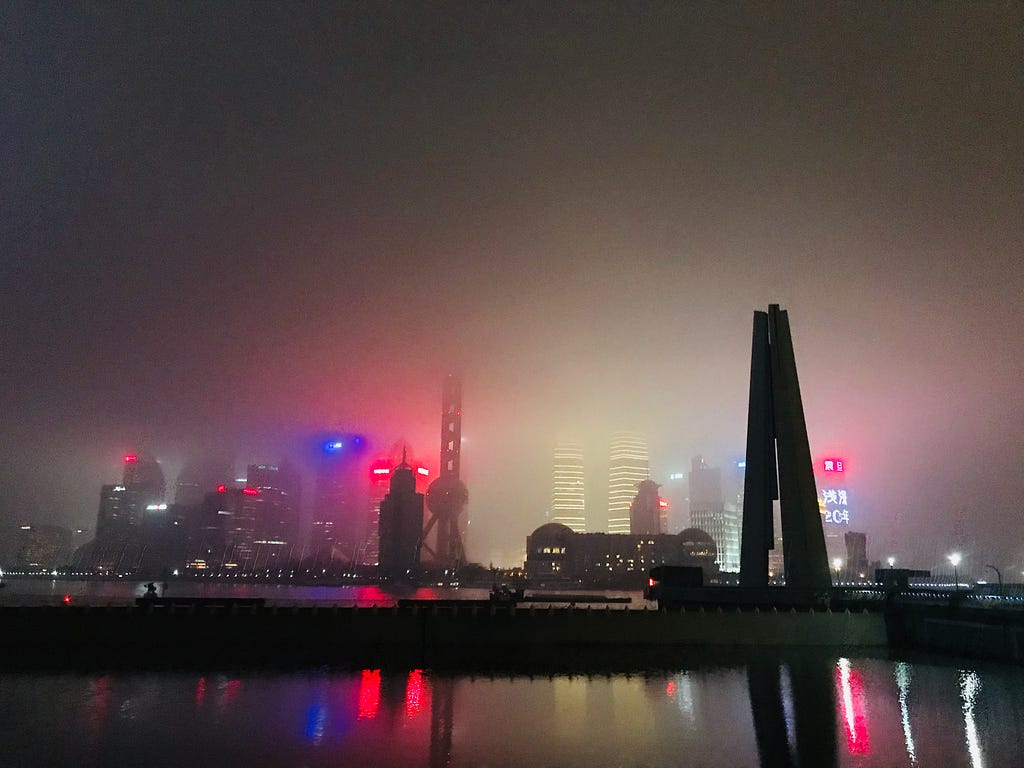
The most powerful authoritarian government in the world has locked down its most economic productive city over a month ago. It has since mobilised Shanghai municipal government, Chinese army, local volunteers, and ordered other provinces to send help to Shanghai. Yet, despite all the effort (at least seen on the news), Shanghainese are starving, literally. Many hospitals are closed to non-COVID patients, many with long term diseases are therefore unable to sustain treatment, resulting in unnecessary casualties. Everyday there are reports of citizens, civil servants, medical staff and other people sustaining the fallout. Local government overwhelmed, logistics broken down, people committing suicides, and until very recently, infected children regardless of age being separated from their non-infected parents. It is difficult to state the seriousness of the situation in Shanghai. It is more than dire, it is hopelessness.
The United States is the proceeding global power after the collapse of the United Kingdom. Both countries share the common law system, and has intertwined origins. For those not familiar with the terms ‘civil law’ and ‘common law’, they refer to different systems of laws where the major difference is court judgements in common law jurisdictions typically hold precedent value, meaning case outcomes for similar situations tend to be similar, whereas judgements in civil law jurisdiction typically do not hold precedent value. This means that in civil law, the law is the law as interpreted by different courts each time, while in common law, the law is the law as created and evolved through court judgements. Court cases in common law can be more important than the law itself, as it provides additional meaning. The US Supreme Court famously ruled same-sex marriage to be constitutionally protected when the US constitution said nothing about same-sex marriage.
Common law provides more flexibility for the society and freedom for the individual. While most civil law countries require a mandatory national ID, Hong Kong and Singapore are the only common law ones requiring so. However, as technology and how the world is shaped continues to progress, the common law system in its current form fails to keep up with its time.
Employment laws are unable to address the issues of remote work, since the assumption was employment had to be performed at the work site. Hong Kong recently faced such a dilemma of the validity of treatment prescribed by a physician licensed in Hong Kong while being physically outside of Hong Kong to a patient in Hong Kong. Where do one country end and another began? Once I step on a Cathay flight taking off from New York, Hong Kong laws apply and I can get my wine legally before 21. Laws are created based on assumptions from past experiences, and as such is unable to fulfil their original intentions when the underlying assumption has shifted dramatically.
The fundamental issue hindering arguments for a planned economy is justified in criticism towards the current legal system. Information is asymmetrical for different stakeholders and even if it is perfectly shared, there is latency which means circumstances on the ground would have changed by the time a decision comes from the top, and thus no longer reflects the actual needs. Government and firms are in direct contrast with each other. While government acts with authorisation of law, companies act without prohibition of law.
Despite all the criticisms Chinese legal system gets (often quite rightly so), there are lessons that can be learnt. Chinese cities and counties are empowered to make regulations that have legal force to govern themselves as they see fit. This is contradictory to the usual image that China as a unitary state, which will perhaps be explored in a future article. Back to the point, what China has done is essentially employing different cities to test out different regulations in action, before compiling lessons learnt in all of them and create a single uniform law. This is a very pragmatic approach and allows for a very efficient legal system, one that is both needed to support the tremendous growth and to govern a country of over a billion. Shanghai in 2022 shows what could happen if a government is not as efficient as the market, which is (almost) always. Similar results can be expected from laws that fail to keep up with the times.
In a globalised world dominated by multinational firms, companies choose the government they work with instead of the other way around. Venue shopping on a global scale. It is a world where some companies are more powerful than many countries, and while becoming entirely subordinate to the will of private firms is not something any country would wish for, it is increasingly the reality. While seemingly different on the surface, the government and firms actually have a lot in common. Government is just as concerned about the bottom line as companies are, except the word for it is “GDP”. Shareholders the citizens, board of directors the cabinet, and share price the Human Development Index (HDI). Whatever you call it, the fundamentals do not change. Trust in the future keep shareholders from selling and citizens from emigrating, good management keep employees from quitting and citizens from “laying down” (躺平 tang ping, a Chinese social trend similar to the “anti-work” sentiment), and satisfactory growth keep the seat at the highest office, and revolutions at bay. Dollars keep companies coming and governments running. Firms and governments are not that different after all. As such, it is even more surprising to see the lack of communication and cooperation between them, to the point of viewing each other as enemies. Given interaction is long term, this cannot be simply explained by calling it a Prisoner’s dilemma but rather long term game theory applies, to an extent. The problem is the government’s priority changes every few years once someone new is elected, rendering prior co-ooperation meaningless. Singapore provides clues in the way out, maintaining consistent governing standards over decades. While it is certainly not perfect, it is most definitely better than the United States’ system offers. “Checks and balances”, more like “Clogged and barely functions”.
“Empires … are little more than sandcastles. Only the tides are forever”. — Inspector Kido, Man in the High Castle
Hong Kong is a Special Administrative Region (SAR) of People’s Republic of China. SAR is an administrative division of China, a singular, centralised state.
Behind that sentence, Hong Kong hides its true self of being a quasi-state. To understand what Hong Kong truly is, we must look at what Hong Kong truly regard itself and act as.
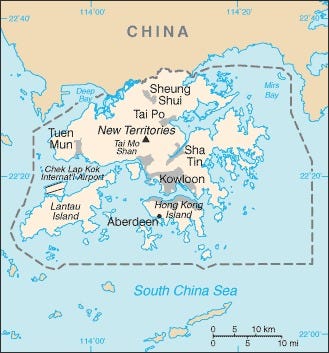
Let’s start with the basics. This is the map of Hong Kong, a city with 7.5 million people. It has its own immigration, customs, and basically all other control within its borders. For example, if one is travelling from Shenzhen here, to Hong Kong, during the pandemic, one might be subject to 14 days of quarantine.
Map of Hong Kong with borders
Have you been noticing the change from simply ‘Country’ on many selections to ‘Country/Region’? Yes, it is done to conform to China’s pressure, as they do not like to view Hong Kong as an independent, national entity separate from the rest of China. However, that is (with a few exceptions) the reality. All this time, all the Hong Kong and Chinese government has been doing, is simply concealing the fact by changing words, technicalities, and the fine prints.
Chapter 1: Hong Kong’s domestic matters
Hong Kong, within its own borders, have near full agency. It’s status is conferred by Article 31 of the Chinese Constitution which allows for the establishment of SARs when necessary, with specific laws that apply on a case-by-case basis. For Hong Kong, that law is the Basic Law of Hong Kong, passed by the Chinese Parliament. It is a Chinese domestic law, created because of an international treaty with the UK that serves as the de facto constitution for Hong Kong. Although under Chinese sovereignty (which will be discussed later), Hong Kong is therefore not subject to much of the laws that apply in Beijing, including the Chinese Constitution (in practice).
The Basic Law of Hong Kong is the foundational document for Hong Kong, much like other constitutions. Laws that go against the Basic Law will be declared unconstitutional by Hong Kong courts and made invalid. Basic Law prescribes the ’One country, Two systems’ formula for Hong Kong, allows for continuance of its capitalist system and way of life until at least 2047 as guaranteed by the Sino-British Agreement.
One of the things prescribed is Hong Kong’s citizenship. As part of the word changing, it is not called citizens rather than ‘Permanent Residents’. In actuality, the two statues are very similar. Only Hong Kong permanent residents (HKPR) may vote in elections, regardless of their nationality. A Chinese national without permanent residency have to apply for visas to enter Hong Kong, oh sorry, I meant ‘entry permits’. Few differences still matter when its comes to nationality. Only a HKPR with Chinese nationality as per Chinese nationality laws may obtain a Hong Kong passport which labels the bearer as a Chinese citizen, but it cannot be used at the airport in Beijing as although technically it is a type of Chinese passports, that is only the technicalities. Only a HKPR with Chinese nationality may never lose their HKPR status, a foreign (non-Chinese) HKPR may lose their HKPR after a continuous period of 3 years’ absence from Hong Kong, after which they will be given the ‘right to land’ allowing them essentially all prior rights, just without suffrage. Chinese HKPR and non-Chinese HKPR votes weigh the same, but non-Chinese HKPR have limited seats in Hong Kong’s parliament (‘Legislative Council’). One can argue that this is unfair treatment, but one can also argue that many other countries have protections for their ‘indigenous population’. Chinese Hong Kong residents (whether permanent or not) and non-Chinese HKPR who cannot obtain any other foreign travel document can apply for a ‘Hong Kong Document of Identity for Visa Purposes’, which have less rights than a full Hong Kong passport including visa-free access. However, the bearer of these two documents are considered to be Hongkongers by U.S., with the same nationality code entered on the visa issued (HNK). In effect, Hong Kong’s citizenship scheme gives preferences and protections to Chinese nationals without tipping the balance too much.
As a recent story about how Hong Kong thinks in the ‘city-state’ mentality, it is from neighbouring Shenzhen, where residents angrily discovered that Hong Kong is planning to build a mass cemetry near the border. For Hong Kong, the location is perfect as it is far away from any of its population, but across the river, there is a flourishing business and leisure district. To this protest from Shenzhen residents, Hong Kong’s president/prime minister (‘Chief Executive’) basically just shrugged, and said ‘too bad, that is a they problem’.
Chapter 2: Hong Kong’s foreign relations
Hong Kong has signed a wide range of treaties and conventions, and participates in many international organisations under the name ‘Hong Kong, China’, from the WTO, APEC, IMF, Universal Postal Union and much more. A Hongkonger even once chaired the WHO, however this is not well known as she was officially a member of the Chinese delegation. According to the Hong Kong government, she participates in 39 international organisations that are full sovereign states only, either as less-than-full members or as part of the Chinese delegation, and 54 organizations not limited to soverign states.
As part of international diplomatic practice, Hong Kong maintains an order of precedence. Note the lack of any Chinese government officials on the list, as they are treated as special guests when visiting HKSAR, like any other foreign dignitary. The CIA World Fact book lists the Chinese President Xi Jinping as Hong Kong’s head of state and Hong Kong’s Chief Executive Carrie Lam as Head of Government. In most cases, Head of State is more of a ceremonial role and Head of Government is one that has the real power. For example, the Queen is the Head of State of the UK, Canada, Australia, New Zealand, and her other Commonwealth Realms but the actual power is exercised by Prime Ministers, the Heads of Governments. In effect, the CIA considers the Chinese President to be important in Hong Kong’s politics but not exercising much direct influence, which is true.
Various foreign Consulate-Generals are accredited to Hong Kong, and despite their official classification as Constulates, they are in actuality treated as Embassies by many of the sending states. For example, the U.S. Consulate in Hong Kong is not subject to the control of the U.S. Embassy in Beijing, and report directly to the Department of State like what any other embassy would do.
Hong Kong also has representations outside of its borders, called Hong Kong Economic and Trade Offices (HKETO), a name similar to what Taiwan’s foreign representations call themselves, ‘Taipei Economic and Cultural Office’. In reality, HKETO’s and Taiwan’s representation perform like any other embassy or consulates. They communicate with foreign governments, help citizens in need (for example, repatriation flights such as during COVID-19), and issue passports and visas (though only some of the HKETOs perform this function as Hong Kong government decided it was not worth the money). Hong Kong has 5 main offices (with sub-units) in Mainland China, 1 in Taiwan, and 11 elsewhere in the world. They are typically granted diplomatic privileges by special legislation of the host country (as done in Germany) and represents the interest of Hong Kong. Bangkok office has been the latest one opened in 2019, and Hong Kong is prepared to open one in Dubai after talks and signing an agreement with the UAE.
Signing of the Hong Kong-UAE Agreement on Investments
As a counter part of the Hong Kong offices in Mainland China, the Beijing government has several offices in Hong Kong, including the ‘Office of the Commissioner of the Ministry of Foreign Affairs’ which deals primarily with diplomatic matters that are not within the scope authorised by the Basic Law for Hong Kong, the ‘Liaison Office of the Central People’s Government’ which functions as an sort-of Chinese embassy that communicates with the Hong Kong government, organises receptions for guests, issues certificates with legal force recognising and authenticating Hong Kong issued degrees for use in Mainland China and more. Hong Kong SAR passport is issued by Immigration Department, Hong Kong, but for a proper Chinese passport with the red cover, that is issued to Mainland Chinese citizens by the aforementioned Office of the Commissioner, where one can also apply for Chinese visas among other functions.
I don’t know about you, but that seems to me pretty much like Hong Kong is conducting foreign relations like any other country. Gasp, how can that be possible for a ‘region’?
Chapter 3: Chinese Soverignty
Chinese sovereignty over Hong Kong is evident in several matters. The Basic Law allows for unilateral, direct application of Chinese Laws by the Chinese parliament in Hong Kong that affect foreign affairs, national defence or matters not within Hong Kong’s autonomy through amending Annex III, which was used to bring the ‘Hong Kong National Security Law’ into legal force in Hong Kong. Hong Kong’s signing of international agreements must be consented by the Chinese government, and ultimately, Chinese government has the power to unilaterally revoke Hong Kong’s status, perhaps through using the Chinese army stationed in Hong Kong. Much of the potential power is not exercised, as it is not in China’s interest to completely destroy Hong Kong.
Mainland Chinese residents wishing to travel to Hong Kong for tourism do not need a visa from the Hong Kong government, instead ‘entry endorsement’ is given by the Chinese government with legal force not found in Hong Kong’s Immigration Law (‘Immigration Ordinance’), but in the Basic Law itself which provides the constitutional right for Beijing to control the entry of Chinese citizens resident in other parts of China into Hong Kong.
Still, this does not diminish the fact that Hong Kong acts much like its own independent state on the world stage. Chinese sovereignty over Hong Kong should be interpreted as control over a foreign state like the U.S. over the 3 countries it is in Free Association with, and New Zealand over its various domains. This is consistent with that fact that Hongkongers, even those of Chinese nationality, are foreign in Mainland China. Not allowed to book into ‘domestic travellers’ only hotels (usually budget hotels), facing huge restrictions on many day-to-day matters such as opening a bank account, obtaining a phone plan, getting the national social insurance and many more. Some of the hurdles comes from the fact that many systems are designed only to support the Chinese national ID and not other documents, and some come from the fact that although Chinese government would like to emphasize that all Hong Kong Chinese compatriots are fully Chinese, and Chinese diplomatic representations have a duty to represent Hong Kong’s interest in the absence of a direct HKETO, often they only pay lip service and heavy suspicion remains. Having a passport stating you as a ‘Chinese national’ is not enough for entry to Beijing, because the passport is in fact a Hong Kong passport that Beijing thinks is just another type of Chinese passport, but for immigration purposes it is suddenly not a Chinese passport anymore. Hongkongers are only claimed as Chinese when it benefits the Chinese government, and ignored when it does not, such as when including the country wide number of COVID-19 cases.
The situation has improved in recent years, as China allowed for Hongkongers with Chinese nationality to obtain ‘Resident IDs’ that are similar to the Chinese national ID, however, differences and hurdles will remain for as long China treats Hongkongers as less-than-full citizens. Only time will tell whether this will ever be possible.
Chapter 4: Fine Prints
Not an Air Force, just the ‘government flying service’. Not a visa, just an ‘entry permit’. Not a consulate, just the ‘Economic and Trade Office’. Not a president, just a ‘Chief Executive’. Not an ambassador, just a ‘director’. Not a member state, just an ‘member economy’.
The list goes on.
Hong Kong is the master at the art of fine prints, using it to portray herself as a subnational part of China. That is true, however this is not the whole picture, far from it.
Hong Kong is a city, an administrative of China with provincial level status. It also is part of the three/four(if you include Taiwan) legal jurisdictions that make up the PRC (Mainland, Hong Kong, Macau), signing not treaties with Mainland China but rather ‘arrangements’. On the world stage, it is a separate legal entity from China in most matters, having its own seat on the table.
The hypocrisy cannot be any more stronger than the fact that Hongkongers can obtain international driving permits because Hong Kong is a party to the Convention on Road Traffic, but not Mainland Chinese because China is not a party. Oh, so can Taiwanese and Macanese citizens.
The legal fine prints build up the illusion that the closest word to describe Hong Kong would be a ‘Special Administrative Region of China’, when the closest word would instead be ‘puppet Chinese city-state’.
The fact is, Hong Kong’s government structure, mentality, society, international relations, laws, finance, and a lot of other matters are just separate from China’s, for the most part albeit similarities that exist because of the shared Chinese heritage. Even the Chinese Nationality Law applied to Hong Kong ‘directly’ through Annex III of the Basic Law was of a different version, but of course it is not called an amendment, just a different ‘interpretation’ issued by the Chinese Parliament.
Cathay Pacific, the de facto flag carrier of Hong Kong, flies no flags of either Hong Kong or China on its planes. Story was that they could not come to a decision about whether to fly the Hong Kong flag or the Chinese flag, or both at the same time, so they decided that doing nothing would be the most correct decision. It is one of the only flag carriers to fly the flag of the company, the other being neighbouring Air Macau.
Hong Kong’s state institutions are, undeniably, separate from the rest of China. With its own currency, border, government, laws, international presence, and basically all the things you would expect from a full sovereign state. In establishing this ‘Special Administrative Region’, China has in effect, gave life to this grand experiment about how far one can push the definition of a ‘country’ to, considering that officially, even despite all the common knowledge suggesting so, Hong Kong is an inalienable, and integral part of the People’s Republic, and all the differences you see here, can be simply explained by ‘One country, two systems’.
As long as everyone is willing to play by the absurdity, China is happy to let Hong Kong be herself, satisfied mostly with just the recognition that Hong Kong is Chinese. As long as SAR is added after Hong Kong to signify the non-sovereign, subnational status, China is willing to let Hong Kong join international organisations and sign international treaties, as long as you call them ‘agreements’. As long as Hong Kong opens consulates in the name of ‘Economic and Trade Offices’, as long as the name ‘Hong Kong, China’, as long as Hong Kong passports label bearer as ‘Chinese’, as long as everyone is buying into the fine prints and not questioning the facade or trying to change the situation, music keeps playing.
Even as China is turning Hong Kong more authoritarian, money will still flow, after all, the world never cared about Singapore’s less-than-democratic regime, only profit.
The horse races on, the dance goes on.
Note: ‘The horse races on, the dance goes on’ is a translation from Paramount Leader Deng Xiaoping’s quote, ‘马照跑,舞照跳’, as a promise to Hong Kong that she will keep her life style and everything will be just as the usual.
In this piece for the Council on Foreign Relations, I give my quick take on the recently concluded party congress, questioning whether Xi is really as powerful as people make him out to be, or if his omnipresence is a sign of looming weakness.

 Login
Login