Normal view

There are new articles available, click to refresh the page.
Before yesterdayMain stream

On Reflection: Conclusions and contents

By: hoakley
27 May 2026 at 19:30

This series looks at two contrasting groups of paintings featuring reflections: those of figures seen mostly in planar mirrors arranged vertically, such as that mounted on a dressing table, and those of landscapes seen reflected by a horizontal water surface like a lake. When intended to be faithful to nature, these should all adhere to the same optical principles.

Introduction

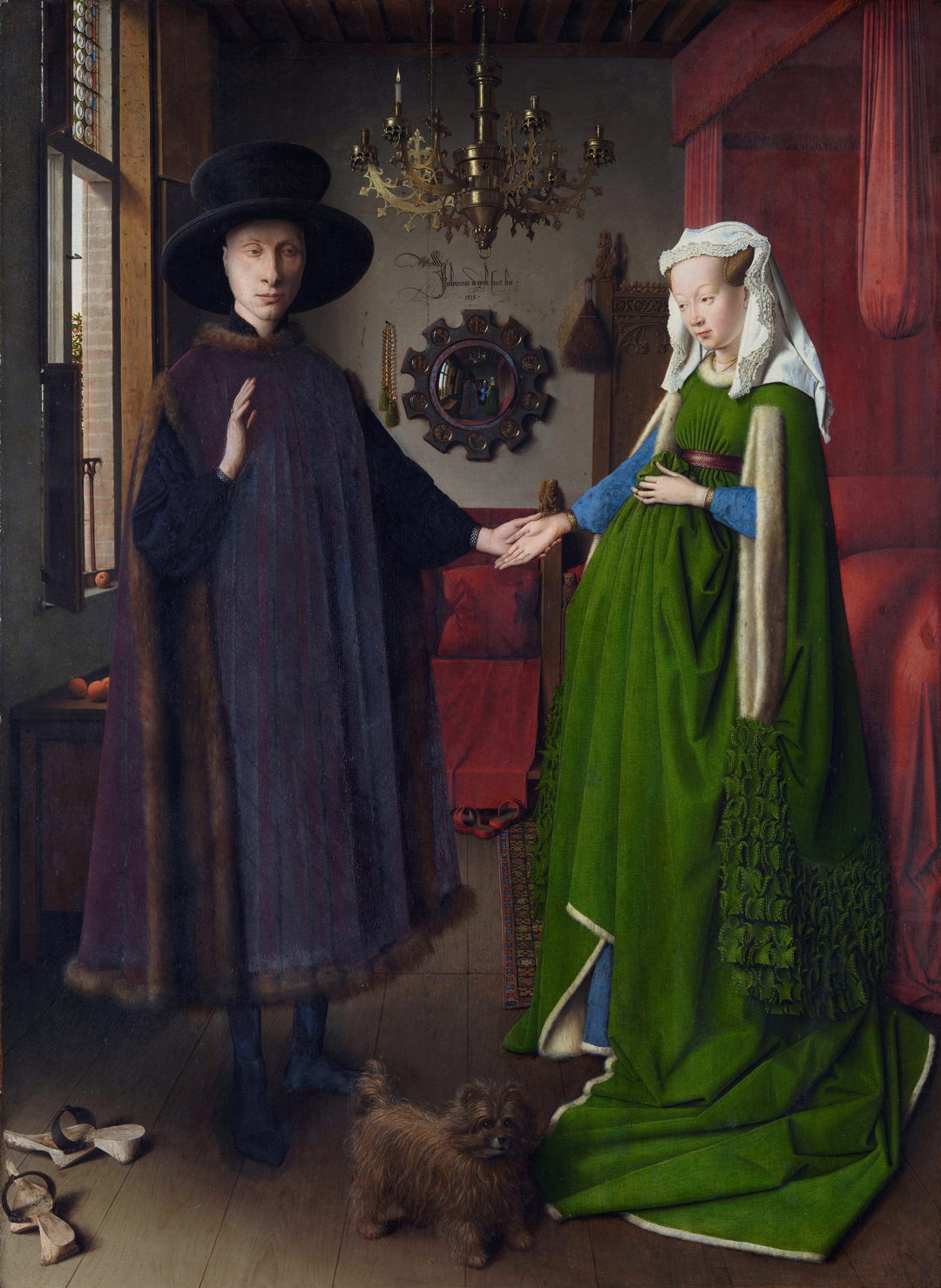
Jan van Eyck, Portrait of Giovanni(?) Arnolfini and his Wife (detail) (1434), oil on oak panel, 82.2 x 60 cm. National Gallery, London (WikiArt).
Jan van Eyck (c 1380-1441), Portrait of Giovanni(?) Arnolfini and his Wife (detail) (1434), oil on oak panel, 82.2 x 60 cm. National Gallery, London. WikiArt.

Optical effects as a theme in the Northern Renaissance, as seen in Jan van Eyck’s most famous painting The Arnolfini Wedding, completed in 1434 (above), and in the landscape behind his Madonna of Chancellor Rolin, probably painted the following year (below).

Jan van Eyck, The Madonna of Chancellor Rolin (detail) (c 1435) oil on panel, 66 x 62 cm. Musée du Louvre, Paris (WikiArt).
Jan van Eyck (c 1390–1441), The Madonna of Chancellor Rolin (detail) (c 1435) oil on panel, 66 x 62 cm. Musée du Louvre, Paris (WikiArt).

Optics

Any faithful depiction of reflections on water should show the following:

  1. a line joining any point on the original with its equivalent on the reflection will be vertical;
  2. an object behind another object in the original will also remain behind that object in the reflection, as reflections preserve depth order;
  3. the further back that an original object is from the water’s edge, the more its reflection will be cropped vertically;
  4. vertical cropping loses the lower section of the original from the reflection, and the upper section remains in the reflection;
  5. the view of each part of the original seen in the reflection will be that as seen from the points of reflection, those being lower than the observer and closer to the original;
  6. what is seen on the (observer’s) left of the original appears on the left of the reflection, and what is seen on the right remains on the right of the reflection;
  7. because the reflection is vertically inverted, what is seen at the top of the original appears at the bottom of the reflection.

Analogous principles apply to reflections in a vertical mirror.

Reflection in a vertical mirror

Selfies

Self-portraits almost invariably rely on painting the reflection seen in a plane mirror.

peetersflowersgoldcupsd1
Clara Peeters (fl 1607-1621), Still Life with Flowers and Gold Cups of Honour (detail) (1612), oil on oak, 59.5 x 49 cm, Staatliche Kunsthalle Karlsruhe, Karlsruhe, Germany. Wikimedia Commons.

The Venus Effect

Defined by Marco Bertamini, Richard Latto and Alice Spooner as occurring “every time the observer sees both an actor (eg Venus) and a mirror, not placed along the observer’s line of sight, and concludes that Venus is seeing her reflection at the same location in the mirror that the observer is seeing.” They were intrigued by “the situations in which we as observers read the scene in a certain way, but the mirror itself is used (deliberately or not) to lead us down the wrong path. More specifically, the mirror shows us something that we accept as the view available to the actor in the scene. However, the actor has a different vantage point from us and therefore the laws of optics imply that he/she cannot be seeing what we see in the mirror.”

velazquezvenus
Diego Velázquez (1599–1660), Venus at Her Mirror, The Toilet of Venus (Rokeby Venus) (1644-48) [101], oil on canvas, 122.5 x 177 cm, The National Gallery, London. Image by Diego Delso, via Wikimedia Commons.

Mirror Play

Where the artist manipulates a reflected image for an effect, whether or not that image remains faithful to optical principles.

velazquezlasmeninas
Diego Velázquez (1599–1660), Las Meninas (The Maids of Honour, Velázquez and the Royal Family) (c 1656-57) [119], oil on canvas, 318 x 276 cm, Museo Nacional del Prado, Madrid, Spain. Wikimedia Commons.

Pierre Bonnard 1899-1908

Early mirror play by Pierre Bonnard (1867-1947).
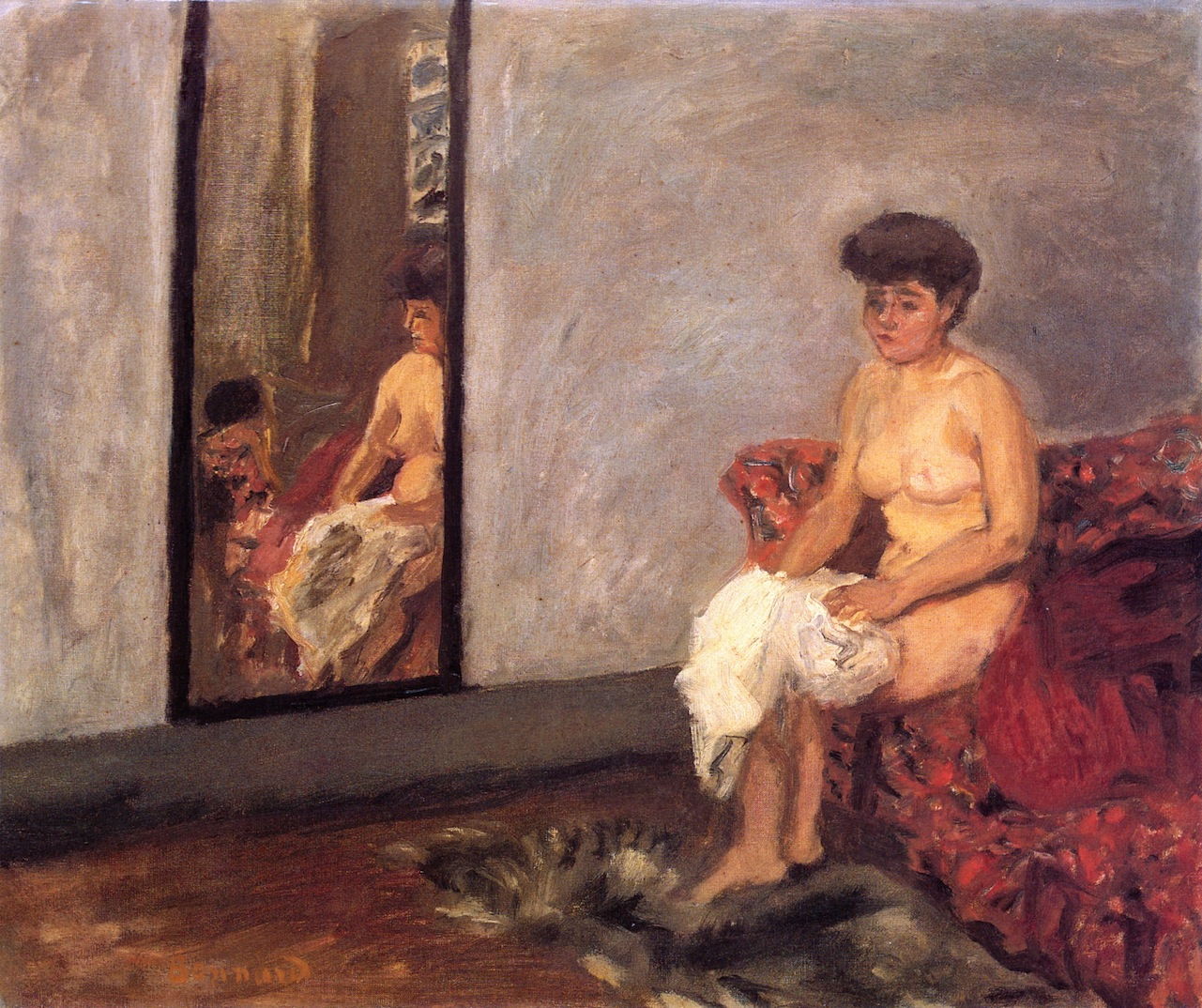
bonnardwomangettingdressed
Pierre Bonnard (1867-1947), Woman Getting Dressed (1906), oil on canvas, 42 x 58.7 cm, Private collection. The Athenaeum.

Pierre Bonnard 1909-1946

Later mirror play by Pierre Bonnard (1867-1947).

bonnardreflectiontub1909
Pierre Bonnard (1867-1947), Reflection (The Tub) (1909), media not known, 73 x 84.5 cm, Private collection. The Athenaeum.

Extending the image

Where the artist uses a reflection to show more of the motif than can be seen directly, often to add information when developing a story.

The Awakening Conscience 1853 by William Holman Hunt 1827-1910
William Holman Hunt (1827-1910), The Awakening Conscience (1851-53), oil on canvas, 76.2 x 55.9 cm, The Tate Gallery (Presented by Sir Colin and Lady Anderson through the Friends of the Tate Gallery 1976), London. © The Tate Gallery and Photographic Rights © Tate (2016), CC-BY-NC-ND 3.0 (Unported), https://www.tate.org.uk/art/artworks/hunt-the-awakening-conscience-t02075

Reflection on a horizontal water surface

Northern landscapes

Paintings by:
Albrecht Dürer (1471-1528)
Aelbert Cuyp (1620–1691)
Nicolas Poussin (1694-1665), Landscape with a Calm (c 1651)
Claude Lorrain (1604/5–1682)
Canaletto (1697–1768)
Claude-Joseph Vernet (1714–1789)
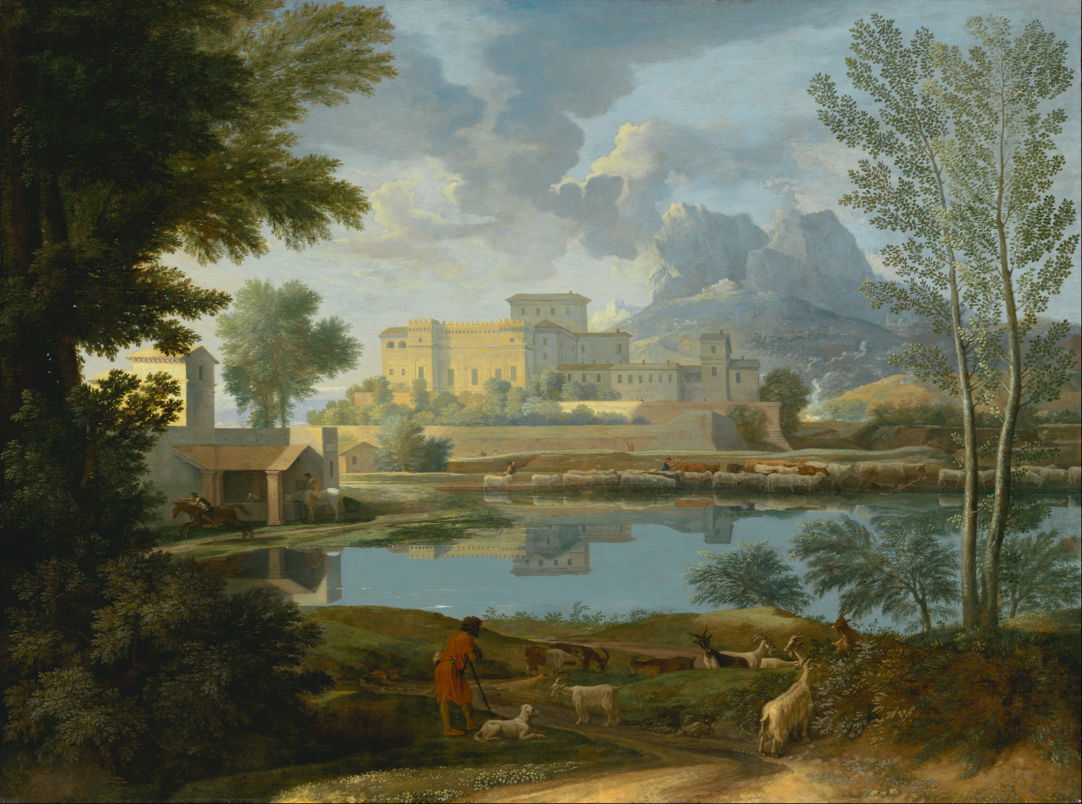
Nicolas Poussin, Landscape with a Calm (c 1651), oil on canvas, 97 x 131 cm, J. Paul Getty Museum, Los Angeles. Digital image courtesy of the Getty's Open Content Program.
Nicolas Poussin (1694-1665), Landscape with a Calm (c 1651), oil on canvas, 97 x 131 cm, J. Paul Getty Museum, Los Angeles. Digital image courtesy of the Getty’s Open Content Program.

Constable and Turner

Paintings by:
John Constable (1776–1837)
Joseph Mallord William Turner (1775–1851)
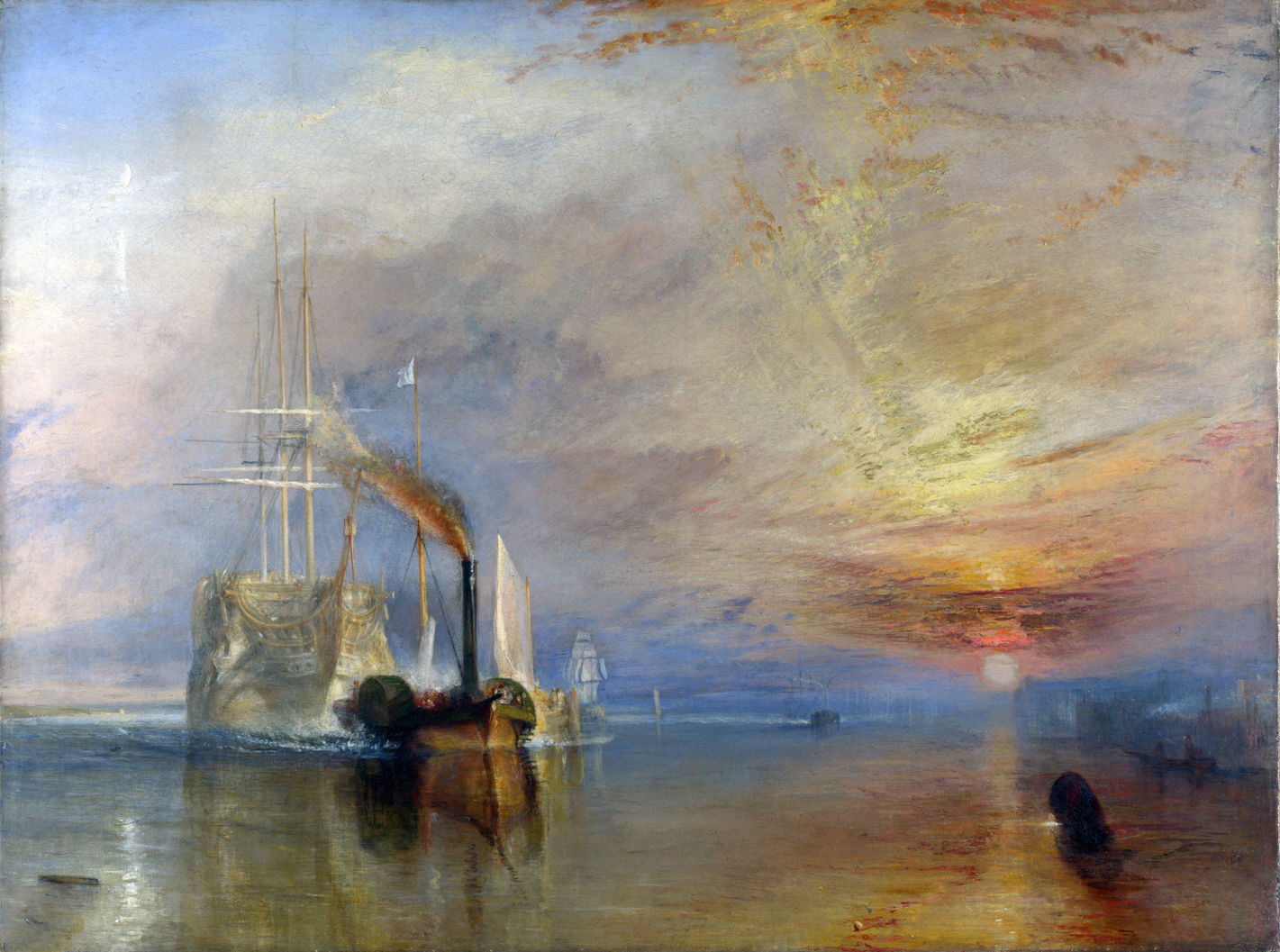
turnerfightingtemeraire
Joseph Mallord William Turner (1775–1851), The Fighting Temeraire tugged to her last Berth to be broken up (1839), oil on canvas, 90.7 × 121.6 cm, The National Gallery, London. Wikimedia Commons.

Realism in the late 19th century

Paintings by:
Gustave Caillebotte (1848–1894)
Martín Rico y Ortega (1833–1908)
Eilert Adelsteen Normann (1848–1918)
Laurits Andersen Ring (1854–1933)
Frits Thaulow (1847–1906)
Kazimierz Sichulski (1879–1942)
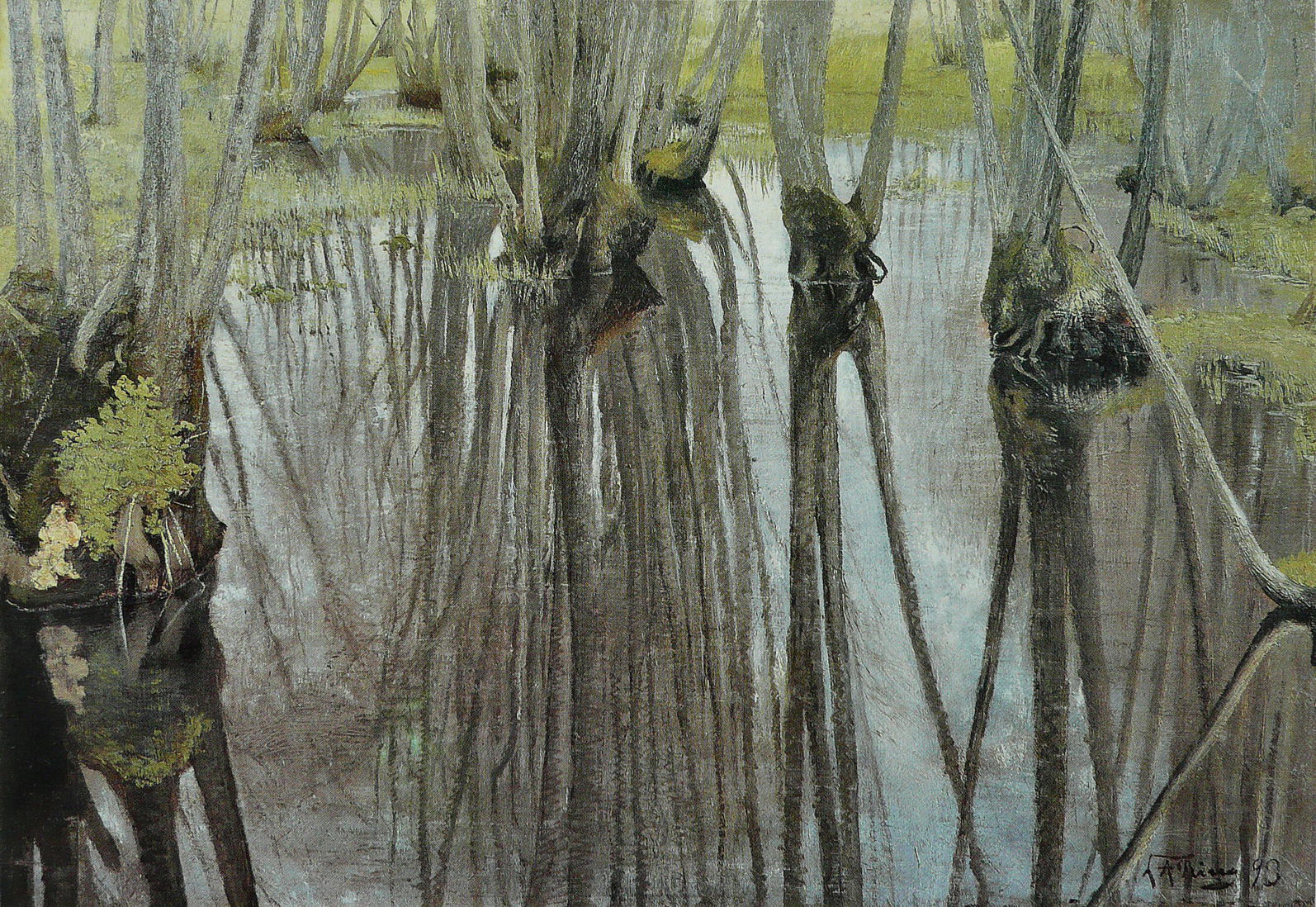
ringaldertrunks
Laurits Andersen Ring (1854–1933), Alder Trunks (1893), oil on canvas, 52.9 x 73.5 cm, Collection of Her Majesty the Queen Margrethe II, Copenhagen, Denmark. Wikimedia Commons.

Impressionism

Paintings by:
Jean-Baptiste-Camille Corot (1796-1875)
Claude Monet (1840–1926)
Alfred Sisley (1839–1899)

monetautumnonseine1873
Claude Monet (1840-1926), Autumn on the Seine, Argenteuil (1873), oil on canvas, 54.3 × 73.3 cm, High Museum of Art, Atlanta, GA. Wikimedia Commons.

Divisionism

Paintings by:
Georges Seurat (1859–1891)
Camille Pissarro (1830-1903)
Paul Signac (1863-1935)
Théo van Rysselberghe (1862-1926)
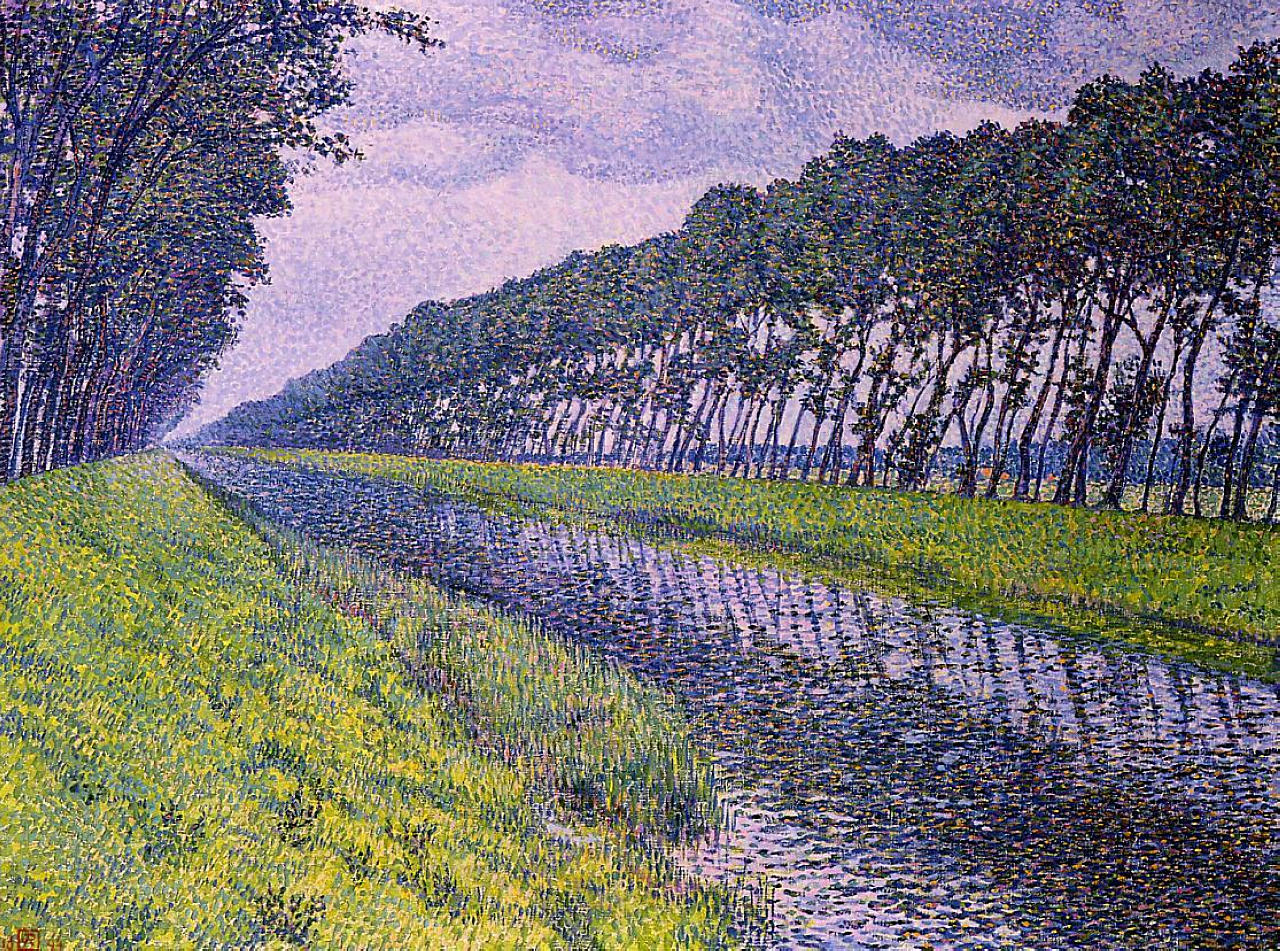
Théo van Rysselberghe (1862-1926), Canal in Flanders (1894), oil on canvas, 152.4 x 203.2 cm, Private collection. WikiArt.

Cézanne

Paintings by Paul Cézanne (1839-1906)
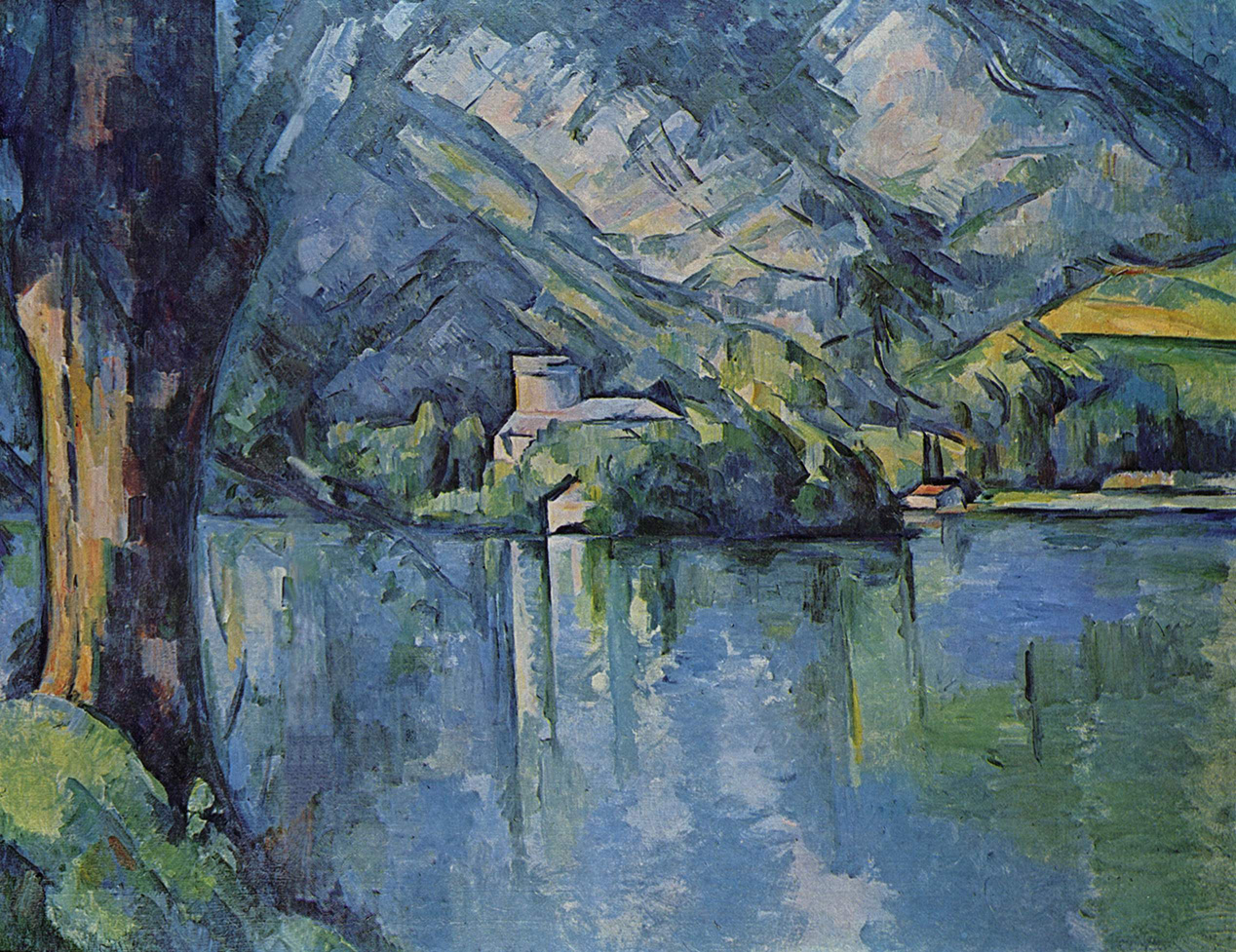
cézannelacdannecy
Paul Cézanne, Le Lac d’Annecy (Lake Annecy) (1896) (R805), oil on canvas, 65 x 81 cm, The Courtauld Gallery, London (Samuel Courtauld Trust) (P.1932.SC.60). Wikimedia Commons.

Hodler and Klimt

Paintings by:
Ferdinand Hodler (1853–1918)
Gustav Klimt (1862–1918)

hodlerrhythmiclandscapelakegeneva
Ferdinand Hodler (1853–1918), Rhythmic Landscape on Lake Geneva (1908), oil on canvas, 67 x 91 cm, Private collection. Wikimedia Commons.

References

Brook Taylor (1719) New Principles of Linear Perspective, or the Art of Designing on a Plane the Representations of All Sorts of Objects, in a more General and Simple Method than has been done before, London. (Not available online, and later editions omit much of the material on reflections.)
Cole, Rex Vicat (1921) Perspective, Seeley, Service and Co, London. (Available in various reprints, and Archive.org.)
de Piles, Roger (1708) Cours de Peinture par Principes, Paris. (Available at Archive.org.)
de Valenciennes P-H (1820) Élémens de Perspective Pratique à l’usage des artistes, 2nd edn., Paris.

On Reflection: Extending the image

By: hoakley
20 May 2026 at 19:30

Jan van Eyck’s famous double-portrait of the Arnolfini Wedding (1434) introduced mirror-play, but didn’t quite demonstrate its use to extend the scene depicted because of the small size of its reflected image. Surprisingly it appears that four centuries were to pass before reflections became more widely adopted for this purpose, although I’m sure they had already been used for it in interior decoration.

One of the earliest of my examples refers back to the Arnolfini Wedding in its use of a circular and non-planar mirror.

'Take your Son, Sir' ?1851-92 by Ford Madox Brown 1821-1893
Ford Madox Brown (1821–1893), Take your Son, Sir! (1851-52), oil on canvas, 70.5 x 38.1 cm, The Tate Gallery (Presented by Miss Emily Sargent and Mrs Ormond in memory of their brother, John S. Sargent), London. © The Tate Gallery and Photographic Rights © Tate (2016), CC-BY-NC-ND 3.0 (Unported), https://www.tate.org.uk/art/artworks/brown-take-your-son-sir-n04429

The dates and background to Ford Madox Brown’s unfinished painting Take your Son, Sir! remain unclear. It’s thought that Brown started work on this in 1851, although it shows his second wife Emma with their newborn son. Their first son, Oliver, wasn’t born until 1855, and their second, Arthur, in September 1856, suggesting that he didn’t start this until at least 1855. It’s generally held that this shows not Oliver, who lived until 1874, but Arthur, who died aged ten months in July 1857, at which time Brown abandoned the painting. The detail seen reflected in the mirror is of a contemporary living room and a man, presumably a self-portrait.

The Awakening Conscience 1853 by William Holman Hunt 1827-1910
William Holman Hunt (1827-1910), The Awakening Conscience (1851-53), oil on canvas, 76.2 x 55.9 cm, The Tate Gallery (Presented by Sir Colin and Lady Anderson through the Friends of the Tate Gallery 1976), London. © The Tate Gallery and Photographic Rights © Tate (2016), CC-BY-NC-ND 3.0 (Unported), https://www.tate.org.uk/art/artworks/hunt-the-awakening-conscience-t02075

A few years before that, William Holman Hunt’s The Awakening Conscience, painted over the period 1851-53, employs the reflection seen in a much larger mirror to add substantial detail to its unresolved narrative. This places the scene in a small if not cramped house in the leafy suburbs of London, in reality Saint John’s Wood, where this couple are clearly in an extra-marital relationship.

Solomon, Rebecca, 1832-1886; The Appointment
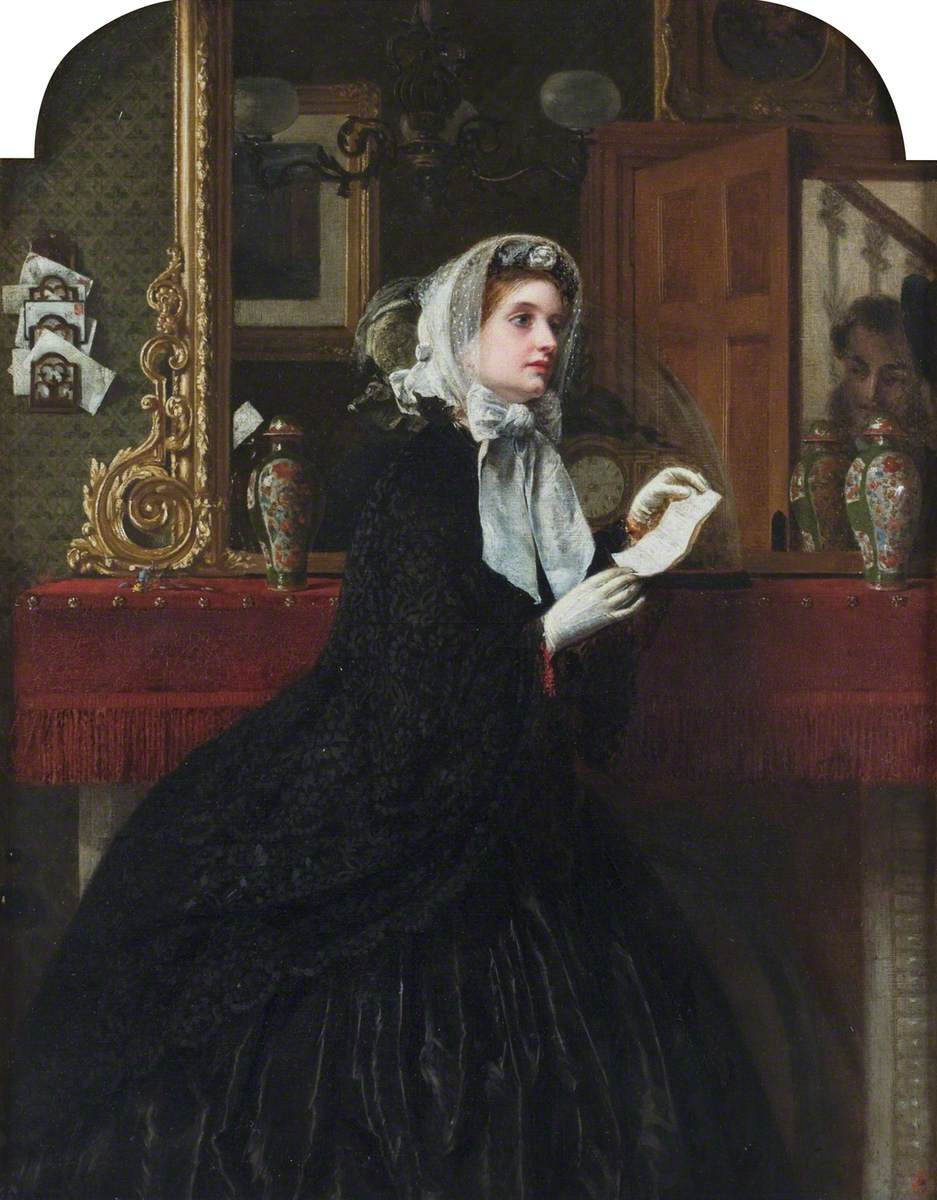
Rebecca Solomon (1832-1886), The Appointment (1861), media and dimensions not known, The Geffrye, Museum of the Home. Wikimedia Commons.

Rebecca Solomon’s Appointment (1861) is another early problem picture, with a deliberately open-ended narrative set in an interior. A beautiful woman stands in front of a mirror, and looks intently at a man, who is only seen in his reflection in the mirror, and stands in a doorway behind the viewer’s right shoulder. The woman is dressed to go out, and is holding a letter in her gloved hands.

stevensjapaneseparisian
Alfred Stevens (1823–1906), The Japanese Parisian (1872), oil on canvas, 105 × 150 cm, Musée d’art moderne et d’art contemporain, Liège. Wikimedia Commons.

In 1872 Alfred Stevens’ The Japanese Parisian filled its canvas with the reflection of the face of his model framed by floating flowers, which must be behind the viewer.

huntdolcefarniente
William Holman Hunt (1827–1910), Dolce Far Niente (1865-75), oil on canvas, 99 × 82.5 cm, Private collection. Wikimedia Commons.

Soon after William Holman Hunt had completed his Awakening Conscience above, he started work on another painting using a smaller circular mirror to extend the scene and its reading, Dolce Far Niente, which may have been started as early as 1859 but wasn’t completed until 1875. The reflection in the mirror above the woman’s head shows this to be a domestic scene, with another figure leaning over a large wooden bureau or a dressing-table, perhaps.

So far, these examples have all appeared to conform to optical principles. It was Édouard Manet who challenged those.

Édouard Manet (1832–1883), A Bar at the Folies-Bergère (1882), oil on canvas, 96 x 130 cm, The Courtauld Gallery, London. Wikimedia Commons.

His Bar at the Folies-Bergère from 1882 poses the problem of resolving the optically impossible, no matter how you try to read it. This forlorn young woman is serving at the bar in front of her, with what is presumed to be a large mirror behind showing a reflection that doesn’t match its original. Arranged on the bar are assorted bottles of beers and spirits, that on the far left bearing the artist’s signature. According to the reflection, the audience at the Folies-Bergère are watching the show under the light of a huge chandelier.

IF
John William Waterhouse (1849–1917), Circe Offering the Cup to Odysseus (1891), oil on canvas, 149 x 92 cm, Gallery Oldham, Manchester, England. Wikimedia Commons.

John William Waterhouse’s Circe Offering the Cup to Odysseus from 1891 develops the circular mirror of the Arnolfini Wedding into a key narrative device. Circe sits on her throne, holding up a krater for Ulysses to drink, with her wand in the other hand. The viewer is Ulysses, seen preparing to draw his sword in the large mirror behind the sorceress. On the left side of the mirror is his ship.

In the closing years of his career, Waterhouse returned with an even larger mirror at the centre of his story.

waterhousehalfsickshadows
John William Waterhouse (1849–1917), “I am Half Sick of Shadows” said the Lady of Shalott (1915), oil on canvas, 100 x 74 cm, Art Gallery of Ontario, Toronto, Canada. Wikimedia Commons.

His “I am Half Sick of Shadows” said the Lady of Shalott (1915) is the third and last of his paintings based on the poem The Lady of Shalott by Alfred Lord Tennyson (1809–1892), published in 1833 and 1842. This recounts part of the Arthurian legends, the tragedy of Elaine of Astolat, as retold in an Italian novella from the 1200s from which it draws its title.

The Lady of Shalott lives in a castle connected to Camelot by a river. She’s subject to a mysterious curse confining her to weaving images on her loom, and mustn’t look directly at the outside world, although she can view it using a mirror. Tennyson calls these reflected images ‘shadows of the world’, and this painting depicts the stanza from the poem:

But in her web she still delights
To weave the mirror’s magic sights,
For often thro’ the silent nights
A funeral, with plumes and lights,
And music, went to Camelot:
Or when the moon was overhead,
Came two young lovers lately wed;
‘I am half sick of shadows,’ said
The Lady of Shalott.

The circular image behind her isn’t a window, but a mirror revealing Camelot with its winding river. Although this includes her loom, the castle can’t be real, but one of “the mirror’s magic sights”.

My last example, painted just before the Second World War by Paul Nash, extends this deeper into the unconscious.

Landscape from a Dream 1936-8 by Paul Nash 1889-1946
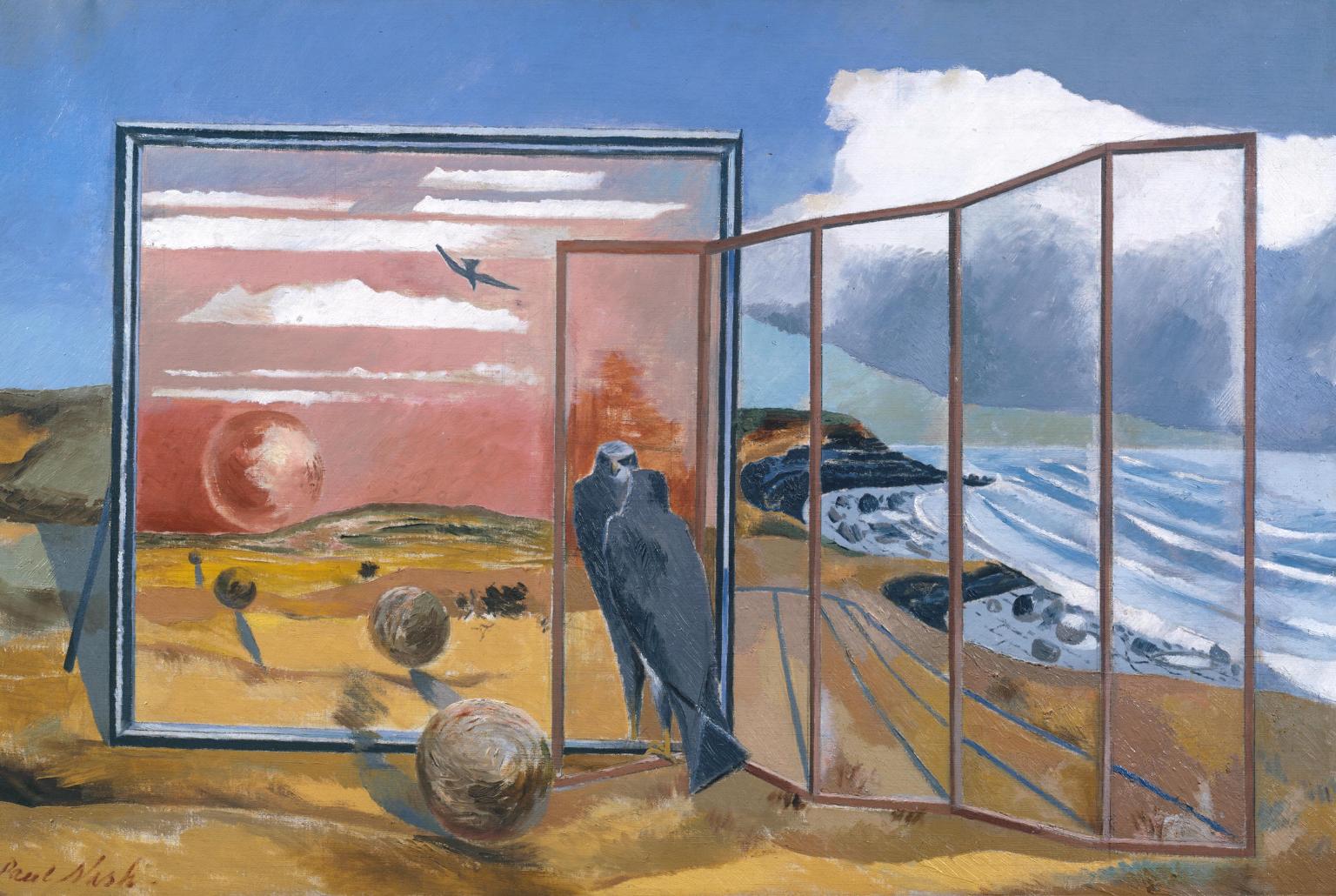
Paul Nash (1892–1946), Landscape from a Dream (1936-38), oil on canvas, 67.9 x 101.6 cm, The Tate Gallery (Presented by the Contemporary Art Society 1946), London. © The Tate Gallery and Photographic Rights © Tate (2016), CC-BY-NC-ND 3.0 (Unported), http://www.tate.org.uk/art/artworks/nash-landscape-from-a-dream-n05667

Landscape from a Dream (1936-38) was inspired by Freud’s theories of the significance of dreams as reflections of the unconscious. Nash locates this collection of incongruous objects on the Dorset coast, a landscape he associated with the praeternatural. Dominating the scene is a large framed planar mirror, almost parallel with the picture plane.

Stood at the right end of the mirror is a hawk staring at its own reflection, which Nash explained is a symbol of the material world. To the left, the mirror reflects several floating spheres, referring to the soul. The reflection shows that behind the viewer is a red sun setting in a red sky, with another hawk flying high, away from the scene. To the right of the hawk is a five-panelled screen made of glass, through which the coastal landscape can be seen: it’s a screen which doesn’t screen.

On Reflection: Pierre Bonnard 1909-1946

By: hoakley
14 May 2026 at 19:30

By the end of the first decade of the twentieth century, Pierre Bonnard was painting several scenes involving mirror play each year.

bonnardreflectiontub1909
Pierre Bonnard (1867-1947), Reflection (The Tub) (1909), media not known, 73 x 84.5 cm, Private collection. The Athenaeum.

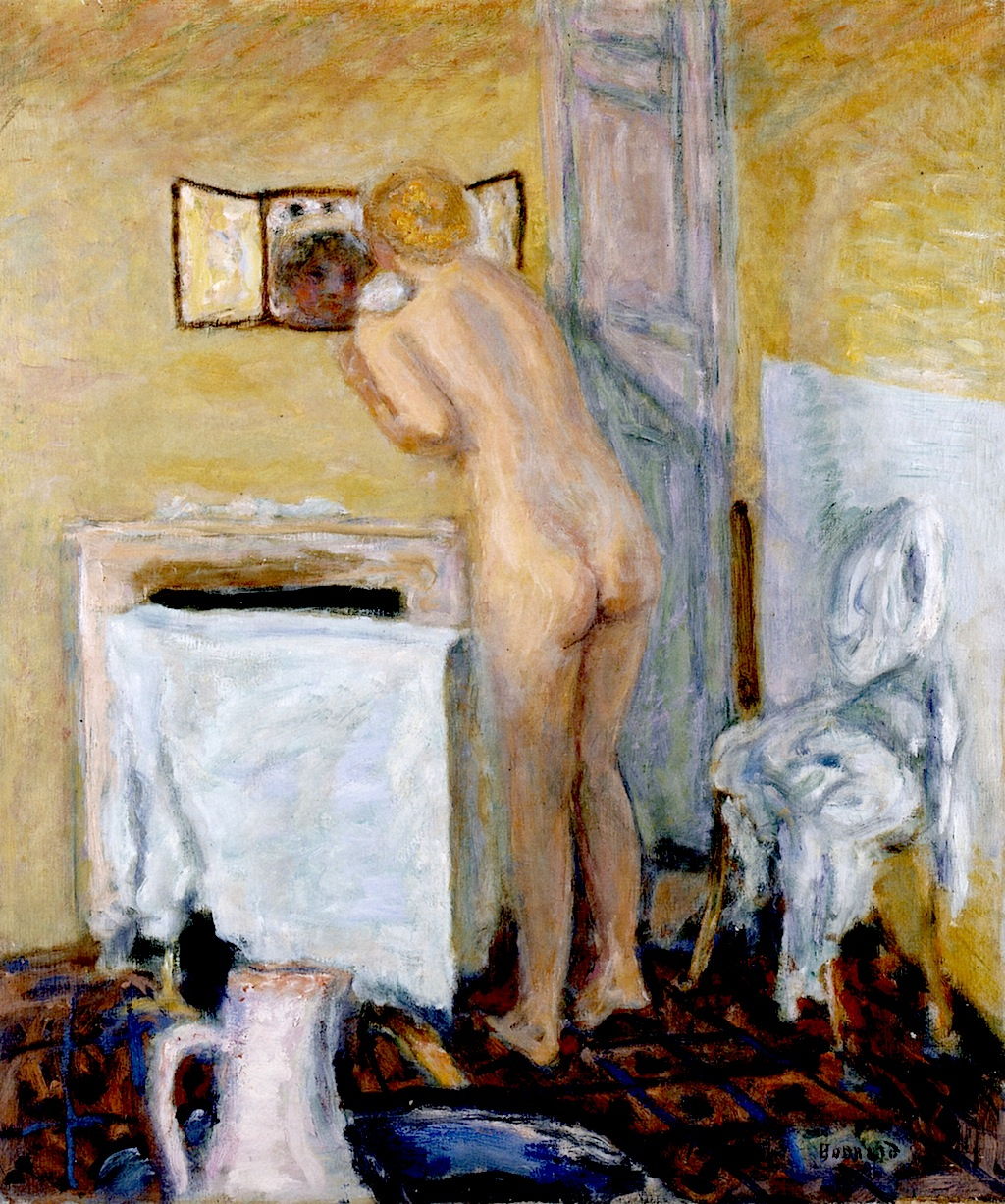
Among his intimate domestic scenes, Reflection or The Tub (1909) is one of his best pieces of mirror play. He again opts for a view from an elevated position, looking down and into an angled plane mirror in the bathroom. The reflected view almost fills his canvas, with the nude Marthe (most probably) crouching slightly in the upper left corner, as she dries herself after a bath.

The angle of view plays some odd tricks. The washing bowl on the dressing table is brought to overlie the larger shallow bathtub on the floor, for example. Some of the objects on the dressing table are shown directly, others only in the reflected image. And over on the opposite side of the room is a chair, and a coffee tray.

bonnarddressingtable1913
Pierre Bonnard (1867-1947), The Dressing Table with a Bunch of Red and Yellow Flowers (1913), oil on canvas, 125 x 110 cm, Museum of Fine Arts, Houston, TX. The Athenaeum.

The Dressing Table with a Bunch of Red and Yellow Flowers (1913) presents us with another visual riddle that we struggle to resolve. Shown in the mirror above the dressing table is a reflection of what lies behind the artist. There’s a nearly-nude figure sat in the corner, and what appears to be a bath, or a bed on which there is a large black object, possibly a dog. As ever, the artist is nowhere to be seen, unless of course that headless figure is male rather than female.

bonnardbathroommirror1914
Pierre Bonnard (1867-1947), The Bathroom Mirror (1914), oil on canvas, 72 x 88.5 cm, The Metropolitan Museum of Art, New York, NY. The Athenaeum.

The following year Bonnard moved back from the dressing table and its mirror, for The Bathroom Mirror (1914). Marthe’s reflection is now but a small image within the image, showing her sat on the side of the bed, with a bedspread matching the red floral pattern of the drapes around the dressing table. The artist has worked his usual vanishing trick for himself, and a vertical mirror at the right adds a curiously dark reflection of the room.

bonnardnudebeforemirror1915
Pierre Bonnard (1867-1947), Nude before the Mirror (Bather) (c 1915), oil on canvas, 59.4 x 50.8 cm, Private collection. The Athenaeum.

In his Nude before the Mirror (Bather) of about 1915, Bonnard inverts his mirror play with a small mirror mounted at head height. Instead of using the reflection as a picture within the picture, to reveal figures behind the position of the painter, the artist is here set well back and his model is close to the mirror, so that it frames her face. This transforms the painting by giving the figure a face, an identity, and a character, rather than just the expanse of flesh of her back.

bonnardmantlepiece1916
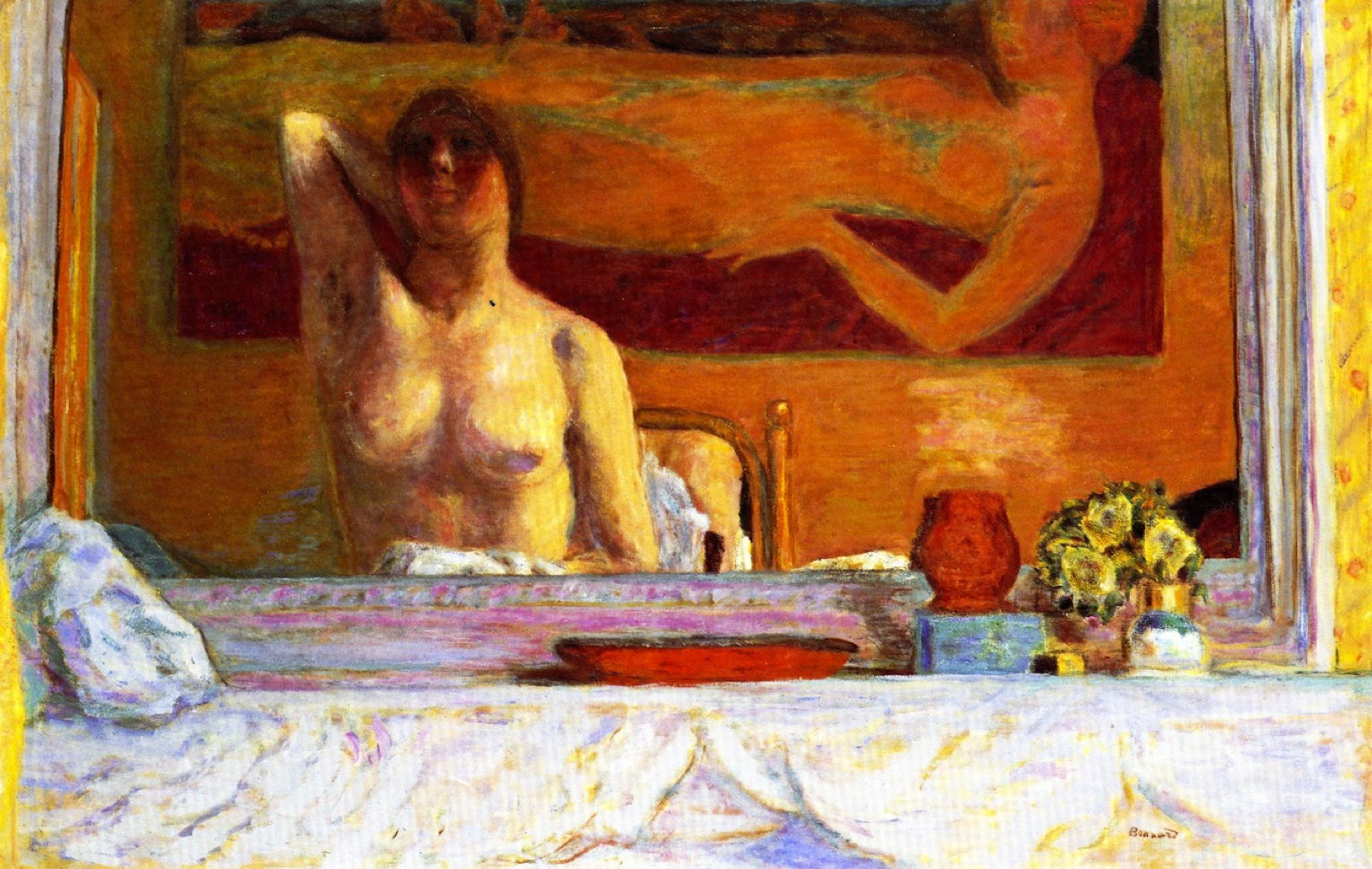
Pierre Bonnard (1867-1947), The Mantlepiece (1916), oil on canvas, 80.7 x 126.7 cm, Private collection. The Athenaeum.

The Mantlepiece (1916) is another complex piece of mirror play. Bonnard has viewed this from an unusually low position, level with the surface of the mantlepiece and looking slightly up. Behind him is his nude model, who appears slightly odd as she is both lit and viewed from below. On the wall behind them is a very long painting of a reclining nude (which certainly doesn’t look like one of Bonnard’s works), below which is a dressing table mirror. In this case, Bonnard appears to have used the reflections to bring together quite disjoint images into a single composite.

He then seems to have painted little if any mirror play for fifteen years.

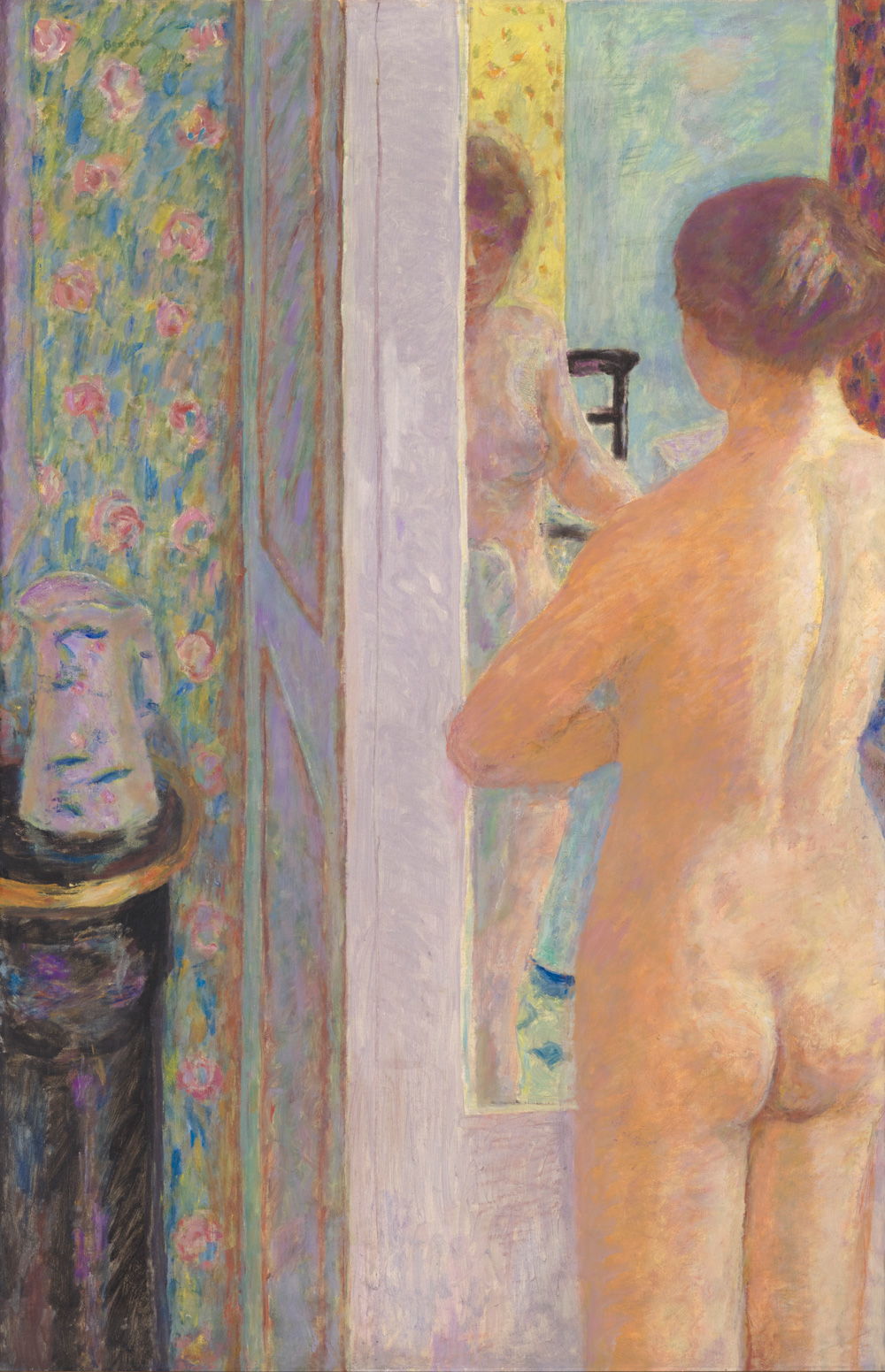
bonnardtoilette1931
Pierre Bonnard (1867-1947), The Toilette (Nude at the Mirror) (1931), oil on canvas, 154 x 104.5 cm, Galleria internazionale d’arte moderna di Ca’ Pesaro, Venice, Italy. The Athenaeum.

Of his surviving paintings from the 1930s I have been able to locate, intimate domestic scenes and nude figures again predominate. The Toilette (Nude at the Mirror) (1931) marks the return of mirror play different from his earlier practice: the nude stands in front of the mirror, but she isn’t seen in reflection at all, only directly. Instead, the mirror reinforces the verticals of the window and curtain off to the right.

bonnardnudebeforemirror
Pierre Bonnard (1867-1947), Nude before a Mirror (c 1933), oil on canvas, 152.1 x 101.9 cm, Galleria internazionale d’arte moderna di Ca’ Pesaro, Venice, Italy. The Athenaeum.

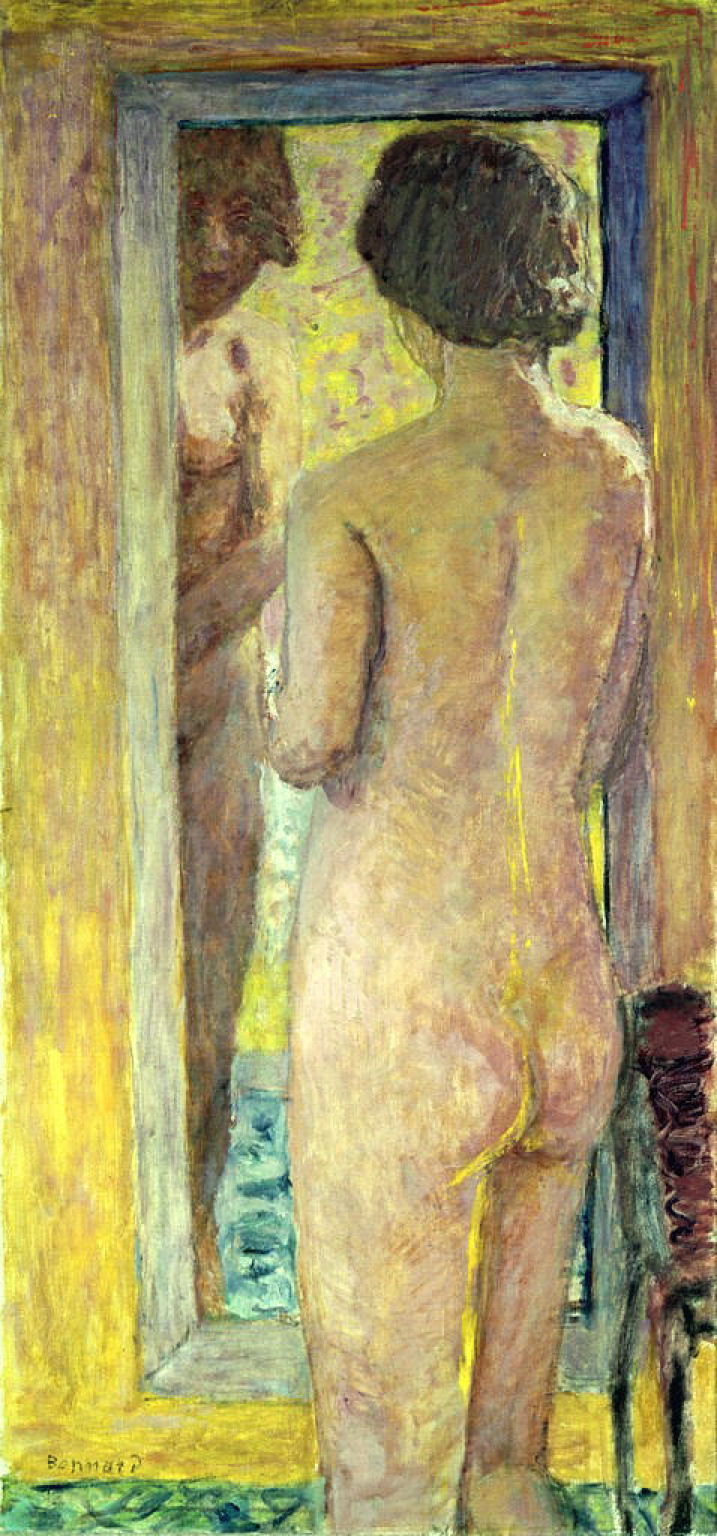
At last, in about 1933, Bonnard returns to his earlier mirror play in his Nude before a Mirror. Marthe (presumably) stands slightly to one side of a full-length mirror, the yellow light catching her back, buttock, and thigh. Instead of her head being cast down, almost obscuring her face, she looks at the mirror, and her reflection looks back at the viewer in a Venus effect.

This is, of course, optically impossible: both Marthe and the viewer are to the right of the midline of the mirror. The viewer could only see Marthe on the left side of the mirror if that mirror were angled so that its plane was parallel to Marthe’s shoulders. What Bonnard shows is really Marthe’s doppelgänger, not her reflection.

bonnardselfportraitmirror1946
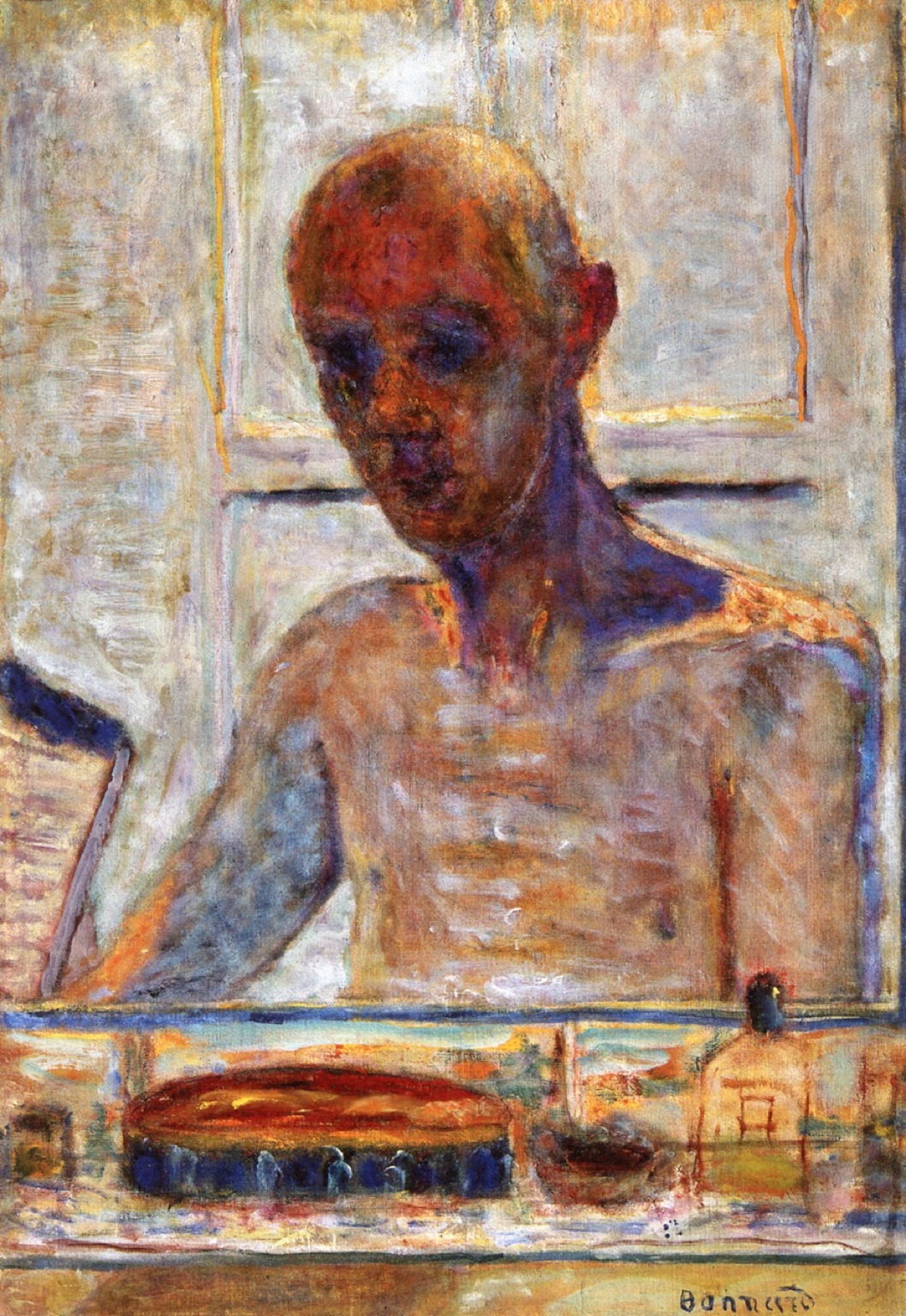
Pierre Bonnard (1867-1947), Portrait of the Artist in the Bathroom Mirror (Self-Portrait) (1939-46), oil on canvas, 73 x 51 cm, Musée National d’Art Moderne de Paris, Paris. The Athenaeum.

Late in his life, after the death of Marthe, Bonnard painted some self-portraits in a mirror, including this Portrait of the Artist in the Bathroom Mirror from between 1939-46, as he is looking increasingly frail. And those appear to be his final reflections.

On Reflection: Pierre Bonnard 1899-1908

By: hoakley
13 May 2026 at 19:30

Mirror play in paintings isn’t uncommon, but there can be few major artists who have returned to it repeatedly over a period of more than forty years, as did Pierre Bonnard. In this article and its sequel tomorrow I show a selection of his work featuring reflections in plane mirrors.

bonnardlamp1899
Pierre Bonnard (1867-1947), The Lamp (c 1899), oil on board, 54 x 70.5 cm, Flint Institute of Arts (Michigan), Flint, MI. The Athenaeum.

The Lamp, from about 1899, is one of Bonnard’s earliest paintings featuring a reflection, here a complex world in miniature seen in a spherical glass part of a lamp. The reflection shows two of the lamp’s arms, one of the bottles of wine, and the bowl of fruit on the white tablecloth.

bonnardambroisevollard
Pierre Bonnard (1867-1947), Ambroise Vollard (c 1904-05), oil on canvas, 74 x 93 cm, Kunsthaus Zurich, Zurich, Switzerland. The Athenaeum.

His portrait of Ambroise Vollard from about 1904-05 is perhaps his first use of a large planar mirror in a figurative painting. It shows some of the art dealer’s collection, including a painting on an easel. Here he uses the reflection to extend the field and scope of the painting.

bonnardinterior1905
Pierre Bonnard (1867-1947), Interior (c 1905), oil on canvas, 49.8 x 37.8 cm, Private collection. The Athenaeum.

In the early years of the twentieth century, Bonnard used mirrors and reflections in several paintings, including this Interior from about 1905. It is an unusual composition, with but a little of the woman’s back visible in the mirror; Bonnard instead shows the reflection of a chair placed in front of the mirror, and what appears to be the artist sat at a table.

His purpose in placing the chair in front of the mirror was, I think, to demonstrate that the artist’s eye is in line with the chair and with his own reflection, confirming that it is him who is sat at the table, although he doesn’t have an easel, neither is there any canvas or palette in sight.

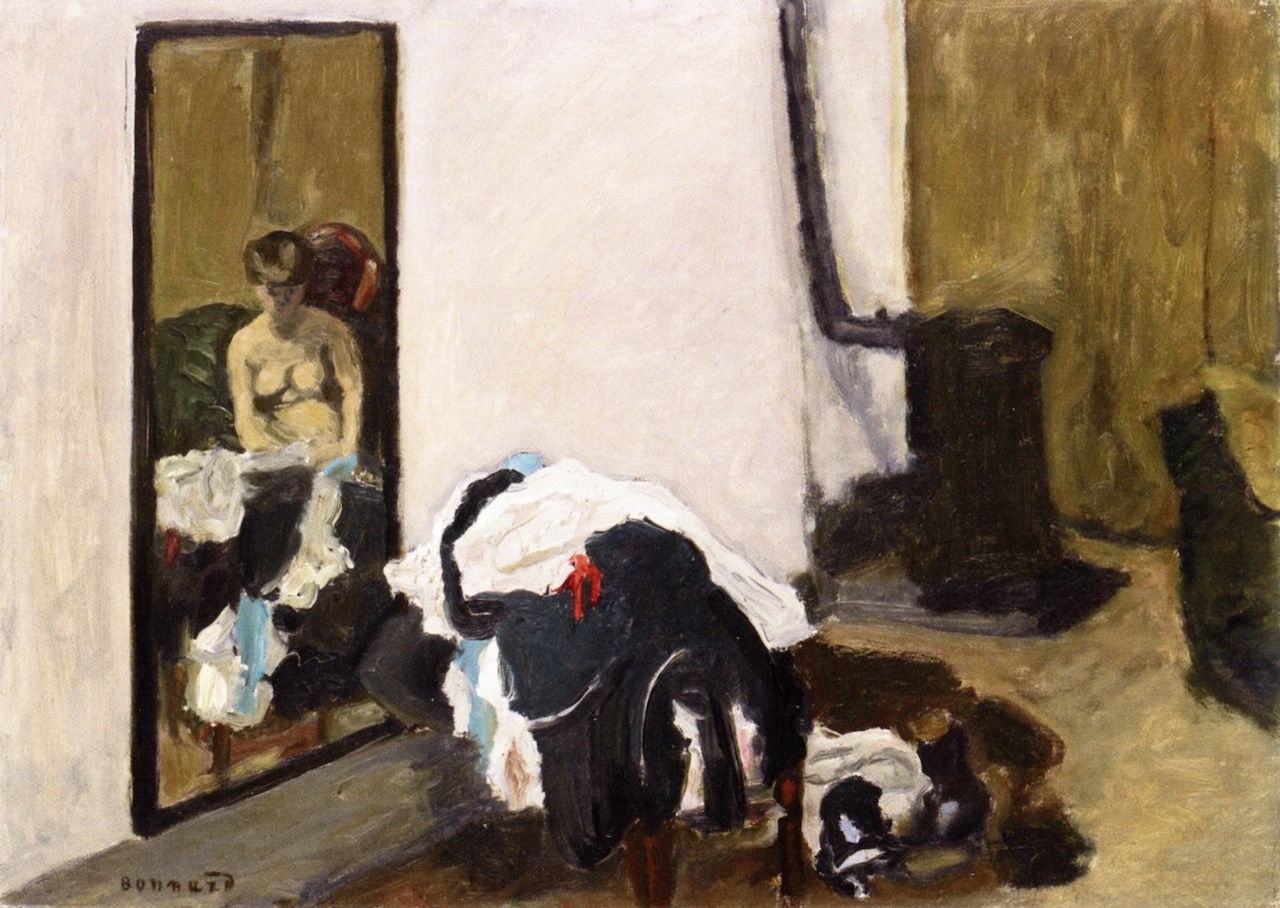
bonnardwomangettingdressed
Pierre Bonnard (1867-1947), Woman Getting Dressed (1906), oil on canvas, 42 x 58.7 cm, Private collection. The Athenaeum.

Woman Getting Dressed (1906) is a second example of Bonnard’s optical play with reflections. Dominating the centre of his canvas is a pile of women’s clothing on a low item of furniture, and a heater. A flat mirror at the left reveals the subject, who is sat beyond the right edge of the painting, getting dressed.

bonnardnuderedsofa1908
Pierre Bonnard (1867-1947), Nude Seated on a Red Sofa (1908), oil on canvas, 54 x 65 cm, Private collection. The Athenaeum.

Bonnard continued to paint figures from models. Nude Seated on a Red Sofa (1908) engages in gentle mirror-play without the sophisticated compositions of previous years.

bonnardeltocador
Pierre Bonnard (1867-1947), El Tocador (The Dressing Table) (1908), oil on panel, 52 x 45 cm, Musée d’Orsay, Paris. The Athenaeum.

His intimate visual diary of Marthe’s life was becoming the focus of his development and innovation. In El Tocador, which means The Dressing Table (1908), Marthe’s headless torso is seen only in reflection. The direct view is of the large bowl and pitcher which she used to wash herself. This opens a new chapter of scenes shown in the mirror of a dressing table.

bonnardmirrordressingroom
Pierre Bonnard (1867-1947), Mirror in the Dressing Room (1908), oil on panel, 120 x 97 cm, The Pushkin State Museum of Fine Arts, Moscow, Russia. The Athenaeum.

Mirror in the Dressing Room (1908) shows a similar dressing table and mirror, but in contrasting blue decor. A woman’s nude back and buttocks now appear in the mirror, as another woman sits at the left drinking a cup of coffee.

bonnardtoiletpink1908
Pierre Bonnard (1867-1947), The Toilet (The Toilet in Pink) (c 1908), oil on canvas, 119 x 79 cm, Musée d’Orsay, Paris. The Athenaeum.

In The Toilet, alias The Toilet in Pink, from about 1908, a nude woman stands drying herself in front of a vertical mirror. This painting sets a trend for these intimate domestic scenes to be lighter.

bonnardbathroom1908
Pierre Bonnard (1867-1947), The Bathroom (The Dressing Room with Pink Sofa) (1908), oil on canvas, 125 x 109 cm, Musées Royaux des Beaux-Arts de Belgique, Brussels, Belgium. The Athenaeum.

Of all these works painted in 1908, my favourite is The Bathroom, or The Dressing Room with Pink Sofa, which anticipates those from later in his career, when he was living in the south of France. Looking at a brightly-lit window from a slightly elevated position, Bonnard’s partner Marthe’s body is seen against that light, and the bright colours of the room. There is still some subtle mirror play, with her headless torso shown in the dressing table mirror, in which the artist is replaced by an empty chair. Its last reflection is that of the window frame in the residual water in the shallow metal bath at the left.

On Reflection: Mirror play

By: hoakley
7 May 2026 at 19:30

These days, mirror play is something you do with babies and infants, but over the last six centuries or so it has also been a feature of many paintings. It all started in the Northern Renaissance, when leading Flemish painters including the van Eycks became fascinated in depicting optical phenomena including reflections in mirrors.

vaneyckarnolfiniportrait
Jan van Eyck (c 1380/90-1441), Portrait of Giovanni Arnolfini (?) and his Wife (1434), oil on oak panel, 82 x 59.5 cm. The National Gallery, London. Wikimedia Commons.

Jan van Eyck’s most famous painting, known as The Arnolfini Wedding (or similar variations), is a remarkable exploration of optics, featuring distorted reflections in the mirror near the centre of the painting, completed in 1434. Between this newly-wed couple holding hands next to their marital bed, in the midline of the painting, is a prominent circular convex mirror. Its reflection shows a view of the room looking in the opposite direction, past the couple to another two figures, who could be the artist and another, as shown in the detail below.

Jan van Eyck, Portrait of Giovanni(?) Arnolfini and his Wife (detail) (1434), oil on oak panel, 82.2 x 60 cm. National Gallery, London (WikiArt).
Jan van Eyck (c 1380-1441), Portrait of Giovanni(?) Arnolfini and his Wife (detail) (1434), oil on oak panel, 82.2 x 60 cm. National Gallery, London. WikiArt.
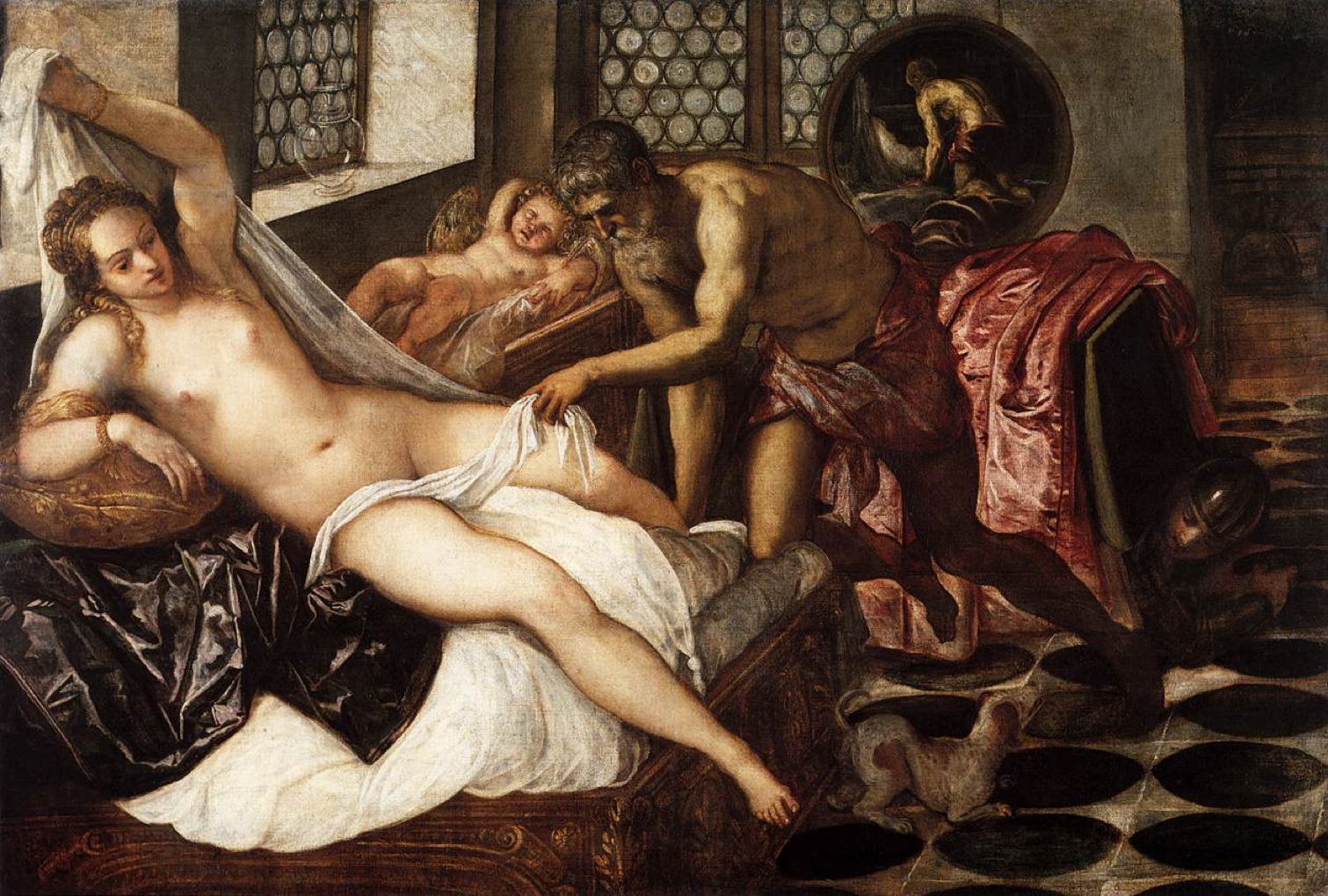
tintorettovenusmarsvulcan
Jacopo Tintoretto (c 1518-1594), Venus and Mars Surprised by Vulcan (c 1545) (E&I 36), oil on canvas, 140 x 197 cm, Alte Pinakothek, Maxvorstadt, Germany. Wikimedia Commons.

Just over a century later, in about 1545, in Venice, Tintoretto painted Venus and Mars Surprised by Vulcan. In this unusual interpretation, Vulcan is inspecting his wife, as Mars cowers under the bed at the right. A small dog is drawing attention to Mars’ hiding place, and Venus’ child, Cupid, rests in a cradle behind them. The circular mirror behind the bed reflects an image of Vulcan leaning over Venus, seen in the detail below.

tintorettovenusmarsvulcand1
Jacopo Tintoretto (c 1518-1594), Venus and Mars Surprised by Vulcan (detail) (c 1545) (E&I 36), oil on canvas, 140 x 197 cm, Alte Pinakothek, Maxvorstadt, Germany. Wikimedia Commons.

For the pioneering still life painter Clara Peeters in the early years of the seventeenth century, reflections showed her self-portrait.

peetersflowersgoldcups
Clara Peeters (fl 1607-1621), Still Life with Flowers and Gold Cups of Honour (1612), oil on oak, 59.5 x 49 cm, Staatliche Kunsthalle Karlsruhe, Karlsruhe, Germany. Wikimedia Commons.

In her still life with Flowers and Gold Cups of Honour (1612) reflections in the gold cup at the right show her in the act of painting, as seen more clearly in the detail below.

peetersflowersgoldcupsd1
Clara Peeters (fl 1607-1621), Still Life with Flowers and Gold Cups of Honour (detail) (1612), oil on oak, 59.5 x 49 cm, Staatliche Kunsthalle Karlsruhe, Karlsruhe, Germany. Wikimedia Commons.

In the middle of that century Diego Velázquez reversed the play in using a reflection to show the subjects of his painting, alongside his self-portrait.

velazquezlasmeninas
Diego Velázquez (1599–1660), Las Meninas (The Maids of Honour, Velázquez and the Royal Family) (c 1656-57) [119], oil on canvas, 318 x 276 cm, Museo Nacional del Prado, Madrid, Spain. Wikimedia Commons.

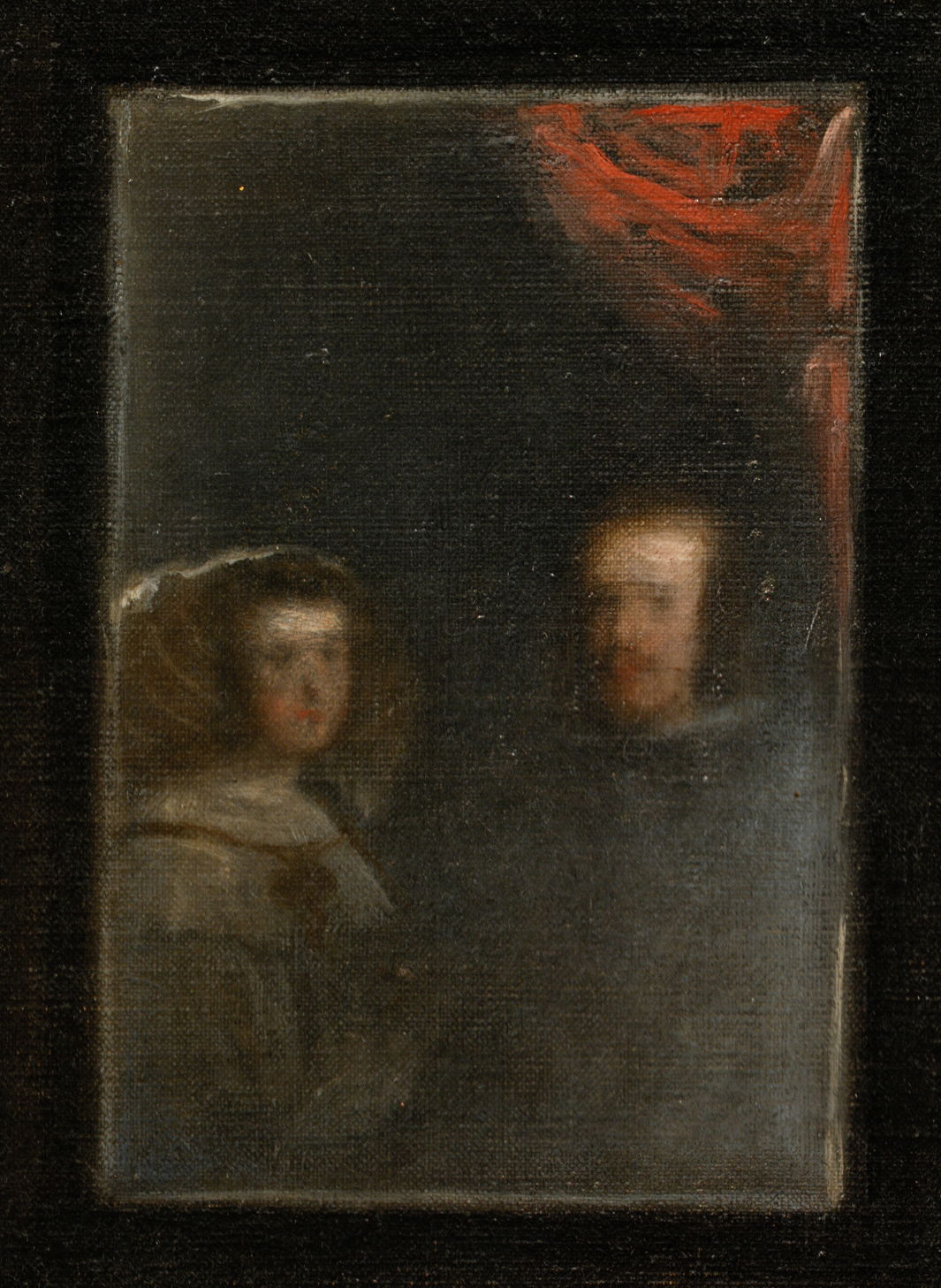
Velázquez’ Las Meninas, translated as The Maids of Honour, from about 1656-57 is a well-known example of a group portrait with mirror play. In what is overtly a depiction of eleven people and a dog in a room in the Alcázar Palace, he uses composition and gaze to tell us more. Much depends on what we believe most of the figures are looking at. Reflected in the rectangular plane mirror on the far wall are King Philip IV and his wife Queen Mariana of Austria, shown in the detail below.

velazquezlasmeninasd4
Diego Velázquez (1599–1660), Las Meninas (The Maids of Honour, Velázquez and the Royal Family) (detail) (c 1656-57) [119], oil on canvas, 318 x 276 cm, Museo Nacional del Prado, Madrid, Spain. Wikimedia Commons.

There has been dispute over whether the reflection shows the royal couple stood where the viewer is, or the mirror is reflecting their painted images on Velázquez’s canvas. How their images were generated is probably of secondary importance, as either way the gaze of most of the other figures is clearly directed not at the viewer, but at the King and Queen, who may be getting up to leave after sitting for Velázquez to paint them. In this reading, the most important people not in the painting only appear in reflection and the gaze of others.

Mirror play continued in a few more paintings up to the late nineteenth century.

vanwijnenwitchessabbath
Domenicus van Wijnen (1661–1698), The Witches’ Sabbath by Moonlight (date not known), oil on canvas, 73 x 57.5 cm, location not known. Wikimedia Commons.

Domenicus van Wijnen’s Witches’ Sabbath by Moonlight is set in a moonlit Italian landscape. This combines many of the now-classical symbols associated with ‘the dark arts’, and is taking place at an outdoor altar set up at the foot of the gallows, on which a dead body hangs. In front of the altar at the right is a soldier in armour, who is looking in a mirror at the image of another.

stevensthepsyche
Alfred Stevens (1823–1906), The Psyché (My Studio) (c 1871), oil on panel, 73.7 x 59.1 cm, Princeton University Art Museum, Princeton, NJ. Wikimedia Commons.

In about 1871, Alfred Stevens introduced a large mirror into The Psyché (My Studio). The French word psyché refers to the full-length mirror seen in this apparently informal view of Stevens’ studio, the name deriving from the legend of Cupid and Psyche. For this painting, Stevens doesn’t actually use a proper psyché, but has mounted a large mirror on his easel, perhaps to suggest that art is a reflection of life. A Japanese silk garment is draped over the mirror to limit its view to the model, breaking up her form in an unnatural way.

In the late nineteenth century mirror play became more popular, particularly in the paintings of Pierre Bonnard.

On Reflection: The Venus Effect

By: hoakley
30 April 2026 at 19:30

In 2003, the psychologists Marco Bertamini, Richard Latto and Alice Spooner published a paper in which they described a known phenomenon in the perception of paintings, and named it the Venus Effect. Their definition is: “The Venus effect occurs every time the observer sees both an actor (eg Venus) and a mirror, not placed along the observer’s line of sight, and concludes that Venus is seeing her reflection at the same location in the mirror that the observer is seeing.”

Although they dismissed optical “mistakes” as being of less interest, they were intrigued by “the situations in which we as observers read the scene in a certain way, but the mirror itself is used (deliberately or not) to lead us down the wrong path. More specifically, the mirror shows us something that we accept as the view available to the actor in the scene. However, the actor has a different vantage point
from us and therefore the laws of optics imply that he/she cannot be seeing what we see in the mirror.”

In this article, I explore what I believe to be the artist’s intention in this effect, of revealing the face of the subject of a painting in its reflection rather than in the original, a popular form of mirror play.

florisallegoryofsight
Frans Floris (1519/1520–1570), Allegory of Sight (date not known), oil on panel, 95.8 × 81.3 cm, location not known. Wikimedia Commons.

Frans Floris’s Allegory of Sight was probably painted around 1550, making it an early and quite sophisticated entry to the subject. The face of its figure is shown reflected in the only appropriate optical instrument of the day: a simple mirror, carefully angled to project most of the face. Although only a small feature, that reflection looks fiendishly difficult, given the wildly different angle between the mirror and the picture plane. In this case, what’s shown in the mirror is optically plausible, although the subject is looking at the viewer rather than the reflection.

janssenssight
Abraham Janssens (1567–1632) (attr), Sight (date not known), oil on canvas, 117 × 93 cm, location not known. Wikimedia Commons.

This painting of Sight has been attributed to Abraham Janssens, and could date to any time between about 1590 and 1632. It appears to have been inspired by Floris’s Allegory of Sight, and the reflection of the woman’s face in the mirror doesn’t appear optically correct. She does appear to be looking at her reflection, although that’s optically impossible.

vonaachendavidbathsheba
Hans von Aachen (1552–1615), David and Bathsheba (c 1612-15), oil on canvas, 138 x 105 cm, Kunsthistorisches Museum, Vienna, Austria. Wikimedia Commons.

Hans von Aachen’s David and Bathsheba of about 1612-15 introduces a figure standing behind Bathsheba, holding a mirror in front of her face with his outstretched left arm. A glance at that reflection says that something is seriously amiss: von Aachen has painted a reflection in which Bathsheba is looking to the left, although her face is actually looking to the right. No single plane mirror could ever achieve that optical impossibility.

velazquezvenus
Diego Velázquez (1599–1660), Venus at Her Mirror, The Toilet of Venus (Rokeby Venus) (1644-48) [101], oil on canvas, 122.5 x 177 cm, The National Gallery, London. Image by Diego Delso, via Wikimedia Commons.

Although often illustrated by one of Titian’s paintings of Venus, the canonical example must be Velázquez’ Venus at Her Mirror, also known as The Toilet of Venus or the Rokeby Venus, from 1644-48. It shows the goddess Venus, whose face is blurred in a false reflection in a mirror being held by her son Cupid. The theme was common, seen in paintings by Titian and Rubens, with Venus sat upright. Giorgione and others had posed her reclining and facing the viewer, making her pose here unusual. Most other paintings of Venus set her in a landscape: here she rests on luxurious even sensuous fabrics.

No matter how convincing her face might appear in the mirror, a moment spent placing yourself in the same position confirms that the image in the mirror is wholly imaginary, and optically incorrect. Yet, according to Bertamini and others, the majority of viewers succumb to the Venus Effect and believe that Venus is looking at that image of her face.

waterhousemarianasouth1897
John William Waterhouse (1849–1917), Mariana in the South (c 1897), oil on canvas, 114 × 74 cm, Private collection. Wikimedia Commons.

JW Waterhouse’s Mariana in the South from about 1897 stands her in front of a full-length mirror revealing her face to the viewer, but she too is looking at her own reflection.

lalmatademaknockatdoor
Laura Theresa Alma-Tadema (1852–1909), A Knock at the Door (1897), oil on panel, 63.8 × 44.8 cm, Currier Museum of Art, Manchester, NH. Wikimedia Commons.

Laura Theresa Alma-Tadema’s A Knock at the Door, also from 1897, shows an attractive young woman checking that she is looking at her best in a mirror, before receiving a visitor. Once again it is the reflection that shows her face, and we’re struggling to be sure whether this is optically correct, although in this case the artist has at least brought closer alignment between the two optical axes.

friesekenudeseateddressingtable
Frederick Carl Frieseke (1874–1939), Nude Seated at Her Dressing Table (1909), oil on canvas, 162.3 x 131.1 cm, Smithsonian American Art Museum, Washington, DC. Wikimedia Commons.

Frederick Carl Frieseke’s Nude Seated at Her Dressing Table (1909) also uses closer alignment to appear more optically plausible, as this nude apparently studies herself in the mirror.

cranemirror
Walter Crane (1845–1915) The Mirror, illustration for Arthur Kelly’s The Rosebud and Other Tales (1909), pen, black ink and watercolor, 20.3 × 15.3 cm, Private collection. Wikimedia Commons.

Walter Crane made this watercolour and ink drawing of The Mirror for Arthur Kelly’s The Rosebud and Other Tales, published in 1909. Although there are clear disparities between the alignment of face and chest with their reflection, this too appears plausible.

corinthatthemirror
Lovis Corinth (1858–1925), At the Mirror (1912), oil on canvas, dimensions not known, Worcester Art Museum, Worcester, MA. Wikimedia Commons.

Lovis Corinth’s At the Mirror from 1912 complicates this further by raising the viewer well above the subject and her reflection, and revealing the artist standing behind her.

There are a few paintings where the artist has overtly declined to employ the Venus Effect.

tintorettosusannaelders1555
Jacopo Tintoretto (c 1518-1594), Susannah and the Elders (c 1555) (E&I 64), oil on canvas, 146 x 193.6 cm, Kunsthistorisches Museum, Vienna, Austria. Wikimedia Commons.

Tintoretto’s Susannah and the Elders from about 1555 goes further with mirror play. Susannah has been caught as she is drying her leg after bathing in the small pool beside her, looking at herself in a rectangular mirror, which is propped up against a rosy trellis in a secluded part of her garden. Unlike in other paintings of nudes, neither the image seen in the mirror nor the reflection on the water show anything more of Susannah.

❌
❌