
 Login
Login
In memoriam Mary Cassatt: 1, 1868-1880
In his early history of Impressionism, published in 1894, the critic Gustave Geffroy identified three great ladies of the movement: Berthe Morisot (1841-1895), Marie Bracquemond (1840-1916) and Mary Cassatt (1844-1926), to whom we should add Eva Gonzalès (1847-1883). In a couple of weeks it will be a century after Mary Cassatt died on 14 June 1926, and this is the first in a short series to commemorate her career and art.
Mary Stevenson Cassatt was born in Allegheny City, PA, into an affluent family. As a child she travelled with her family to Europe, where she learned German and French, and would have seen an extensive display of modern paintings at the Paris World’s Fair in 1855, and elsewhere. Despite family objections, she started as a student at the Pennsylvania Academy of the Fine Arts when she was 15, an unusually young student. Although at the time one in five of its students were female, women were still excluded from life classes, and spent much of their time drawing from casts.
Cassatt terminated her studies, and persuaded her family to allow her to study in Paris, even though the École des Beaux-Arts didn’t yet admit women. Chaperoned by her mother and others, she became a pupil of Jean-Léon Gérôme in 1866, and started copying in the Louvre. At the end of that year, she began classes with Charles Chaplin (the genre artist, not the silent movie star), and in 1868 studied with Thomas Couture.

Cassatt had early success with The Mandolin Player, which was one of the first two works by American women artists to be accepted for the Salon, in 1868.

It’s sometimes implied that Cassatt learned her skills with pastels from Edgar Degas. However, her pastel painting of Child Drinking Milk from about 1868 attests to an already high standard in the medium, and a modern style.
With the start of the Franco-Prussian War in July 1870, the Cassatts swiftly returned to the USA, where she lived in Altoona, PA. She continued to paint, but with little success, being unable to sell her work, and unable to study the works of other painters. Some of her paintings were also lost in the Great Chicago Fire in 1871. However, she was then commissioned to copy two paintings by Correggio in Parma, Italy, and in 1871 returned to Europe with another artist, Emily Sartain (1841-1927), a master print-maker and portraitist.
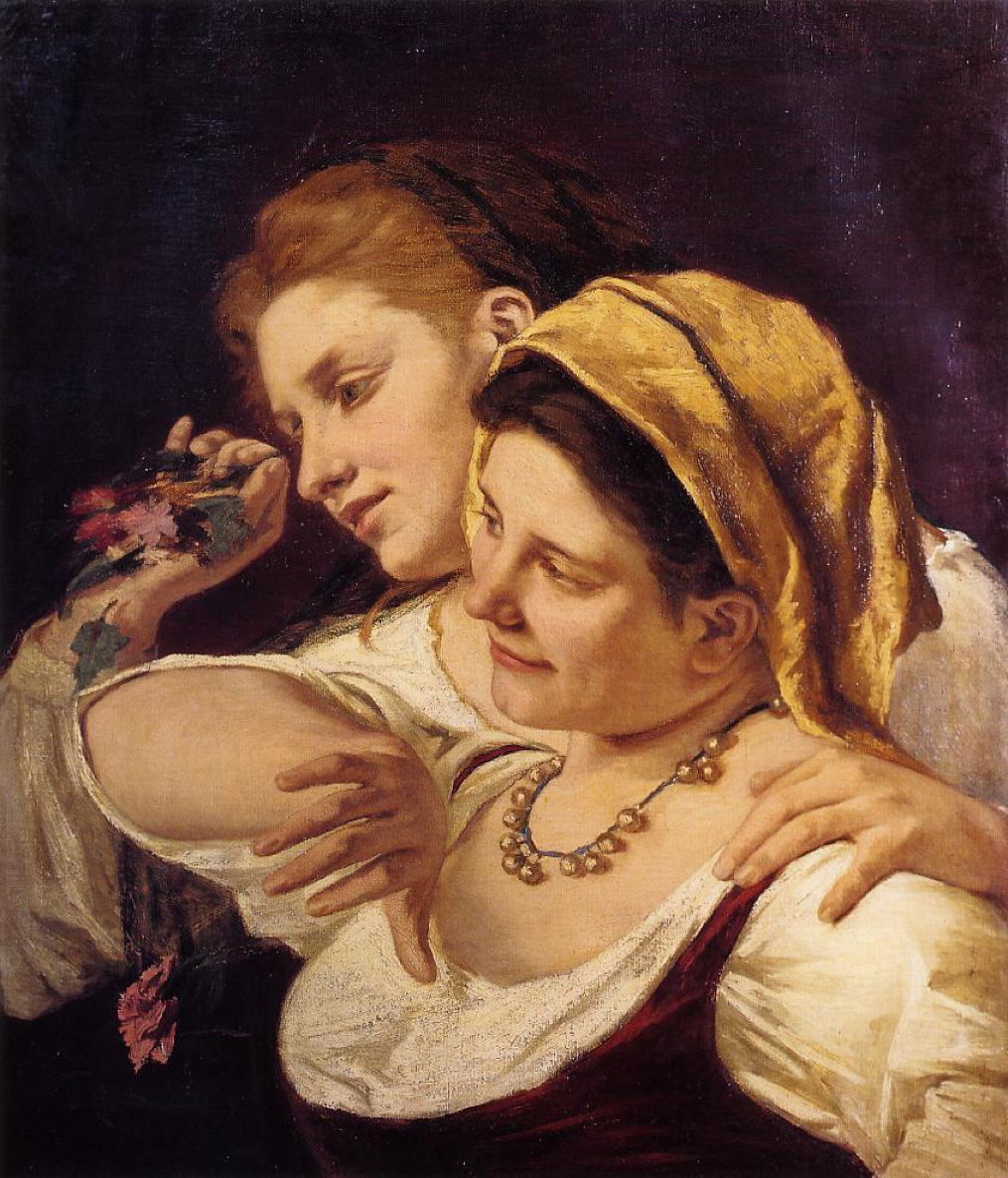
(Two Women Throwing Flowers) During Carnival was probably painted when Cassatt was copying in Parma, Italy, in 1872, and was not only accepted for the Salon of that year, but sold there as well.

Later in 1872, Cassatt travelled to Spain, where she painted The Flirtation – A Balcony in Seville (1872) and additionally visited Madrid.
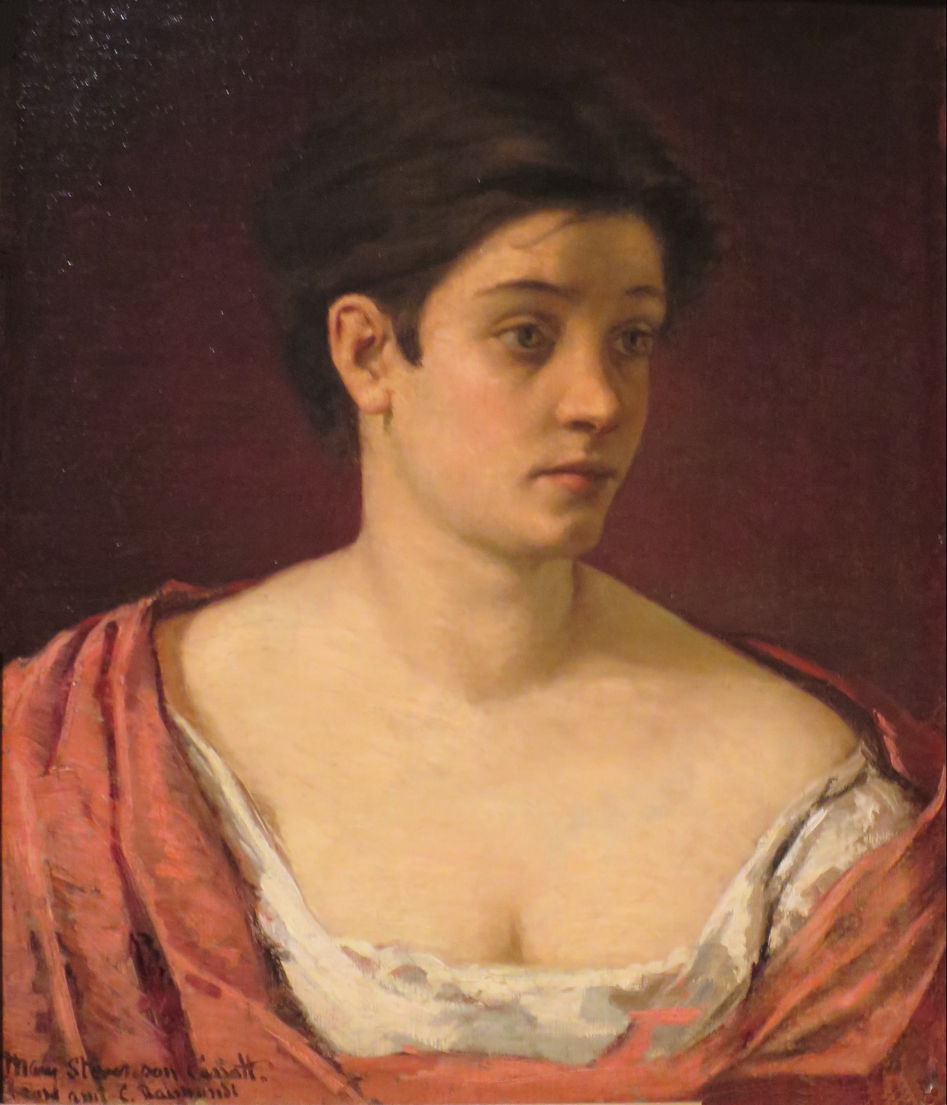
Portrait of a Woman (1872) seems to have been painted when she was in Spain.
Cassatt decided to settle in France in 1874, and shared an apartment in Paris with her sister Lydia, with whom she was close. Lydia became a favourite model for many of her paintings.

Eddy Cassatt (Edward Buchanan Cassatt) (1875) is a portrait of Mary’s young nephew (1869-1922), who became a notable American soldier and owner/breeder of racehorses.
During the late 1870s, Cassatt encountered increasing difficulties in getting her work accepted by the Salon. She disliked the work of the favoured artists of the day, including Cabanel and Bonnat, and in 1877 both her entries were rejected. She had become impressed with the work of some of the Impressionists, particularly after seeing the pastels of Edgar Degas. When he invited her to exhibit with the Impressionists at their fourth exhibition in 1878, she seized the opportunity, although that exhibition was postponed to the following year.
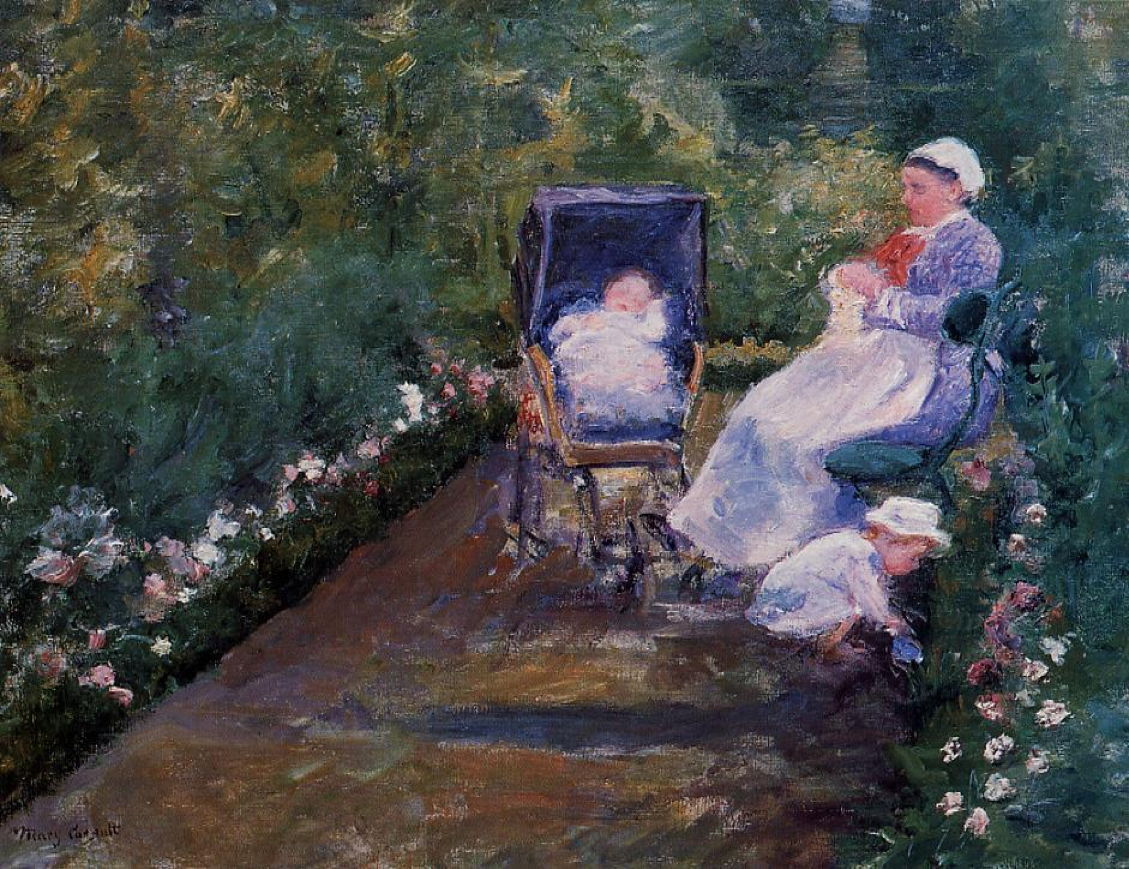
During the late 1870s, her style became overtly Impressionist, under the influence of her new friends. This is perhaps first obvious in this rather dark painting of Children in a Garden (1878), where her brushwork has loosened considerably.
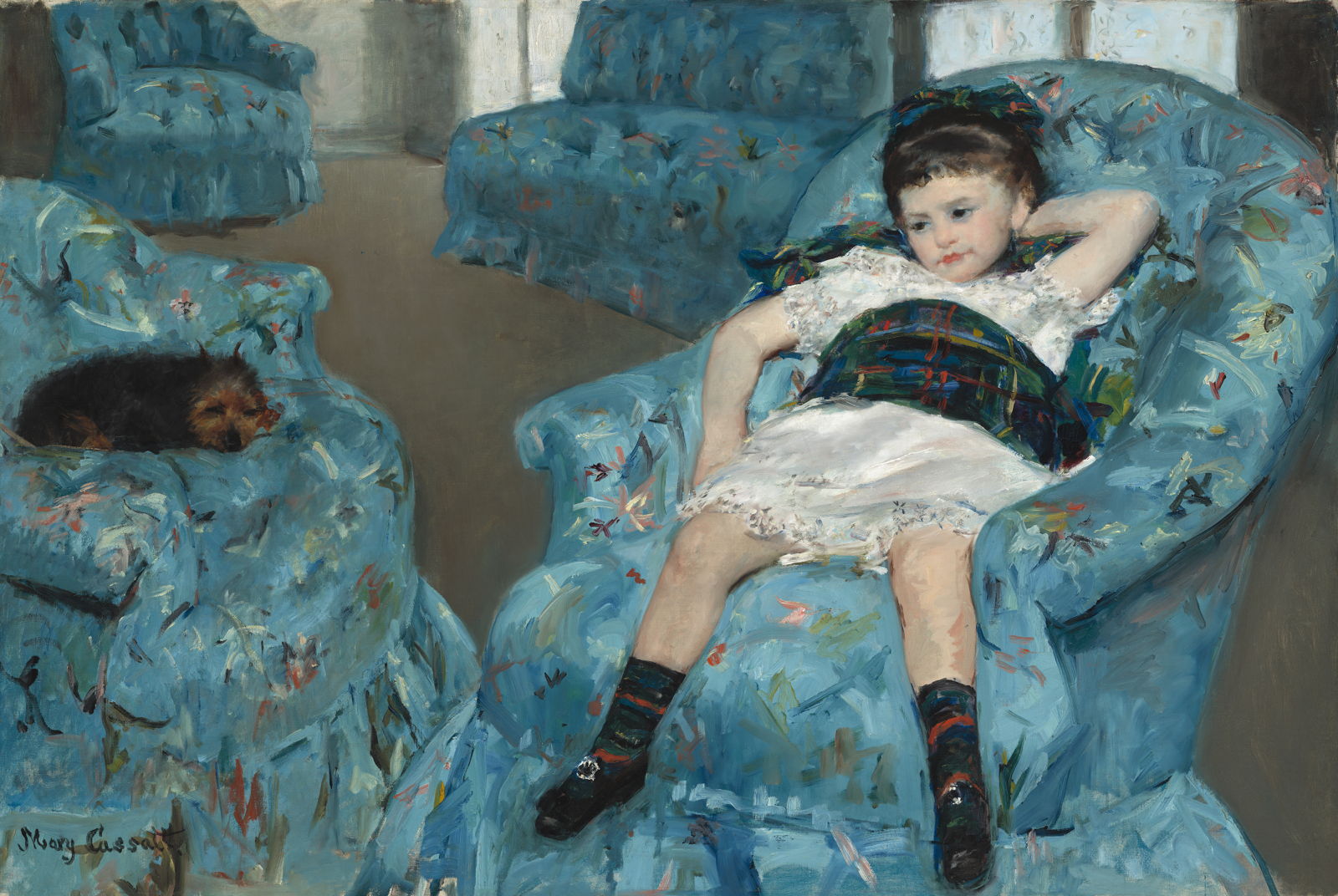
It’s thought that Cassatt’s first real masterpiece, Little Girl in a Blue Armchair (1878), was shown at the Impressionist exhibition in 1879. She had initially submitted it for the American pavilion at the 1878 World’s Fair in Paris, but it was rejected.
It shows the daughter of friends of Degas, and Cassatt acknowledged his help in its painting, as has been found consistent with examination and infra-red assessment of the work. The dog is a Brussels Griffon, probably the dog given to her by Degas, and was bred by Ludovic Lepic, another artist who had been introduced to the Impressionist group by Degas.
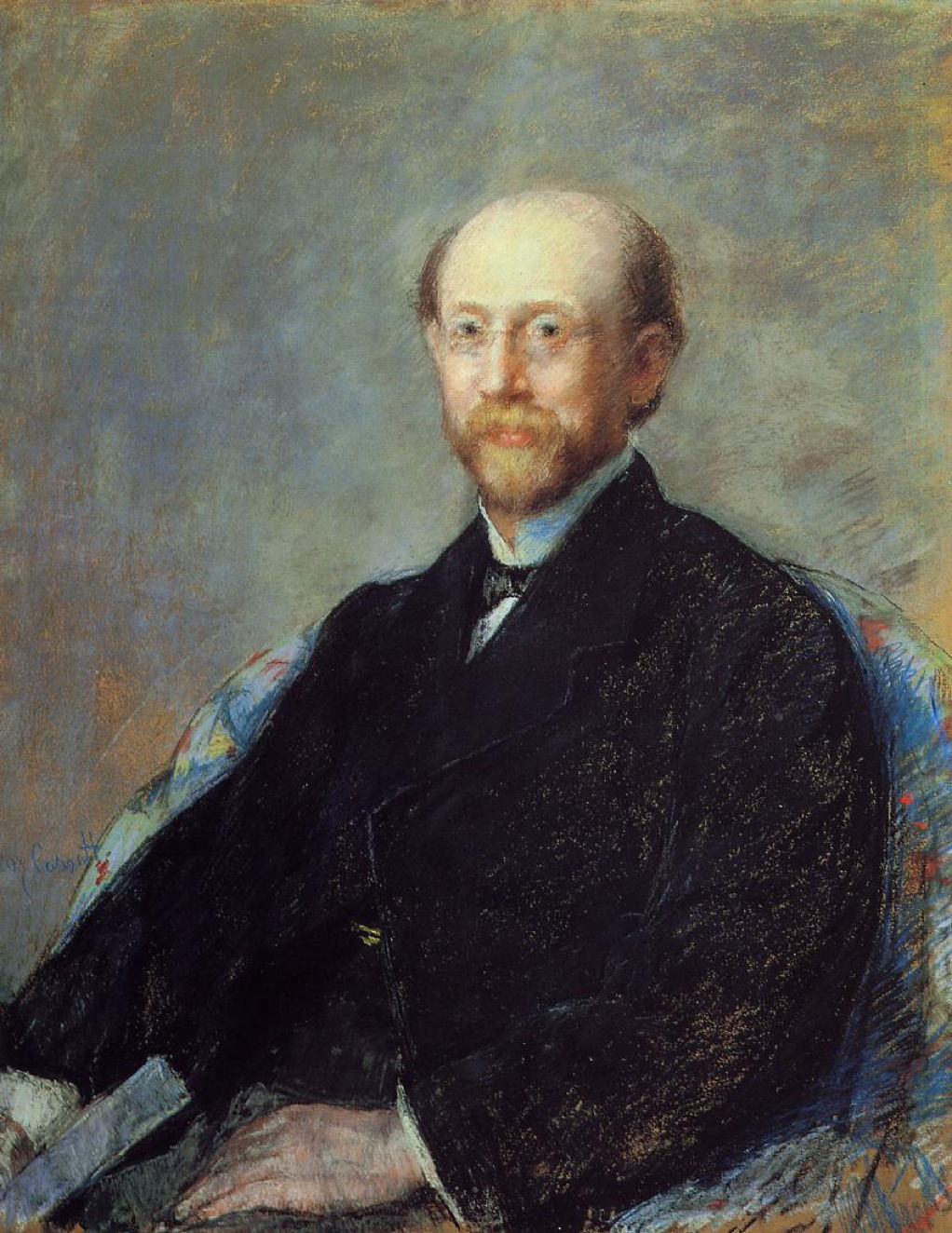
Moise Dreyfus (1879) is a pastel portrait of an art collector who became a close friend and early patron; this work was also shown at the Fourth Impressionist Exhibition. In 1894, a relative of his, Alfred Dreyfus, was accused of handing secret documents to the German military, which turned into a major national scandal, the Dreyfus Affair, accompanied by a wave of anti-Semitism.

Mother Combing Child’s Hair (1879) is another superb pastel painting that would no doubt have involved Degas, and shows her mature style, with rich mark-making in much of the painting apart from the skin.

One of a series of paintings Cassatt made of women at the theatre, Woman with a Pearl Necklace in a Loge (1879) used her sister Lydia as the model. Cassatt has here used a sophisticated composition, with extensive reflected images. The woman is seated in front of a mirror, and the whole of the background, apart from the red back of the seat, is seen in reflection. This adds depth to what would otherwise have been a very tight and close composition.
Degas and other Impressionists made numerous paintings of the theatre and similar scenes, although his interests were primarily in the orchestra and in the ballet. By contrast, Cassatt uses her paintings of the theatre to show the New Woman in idealised moments of pleasure.
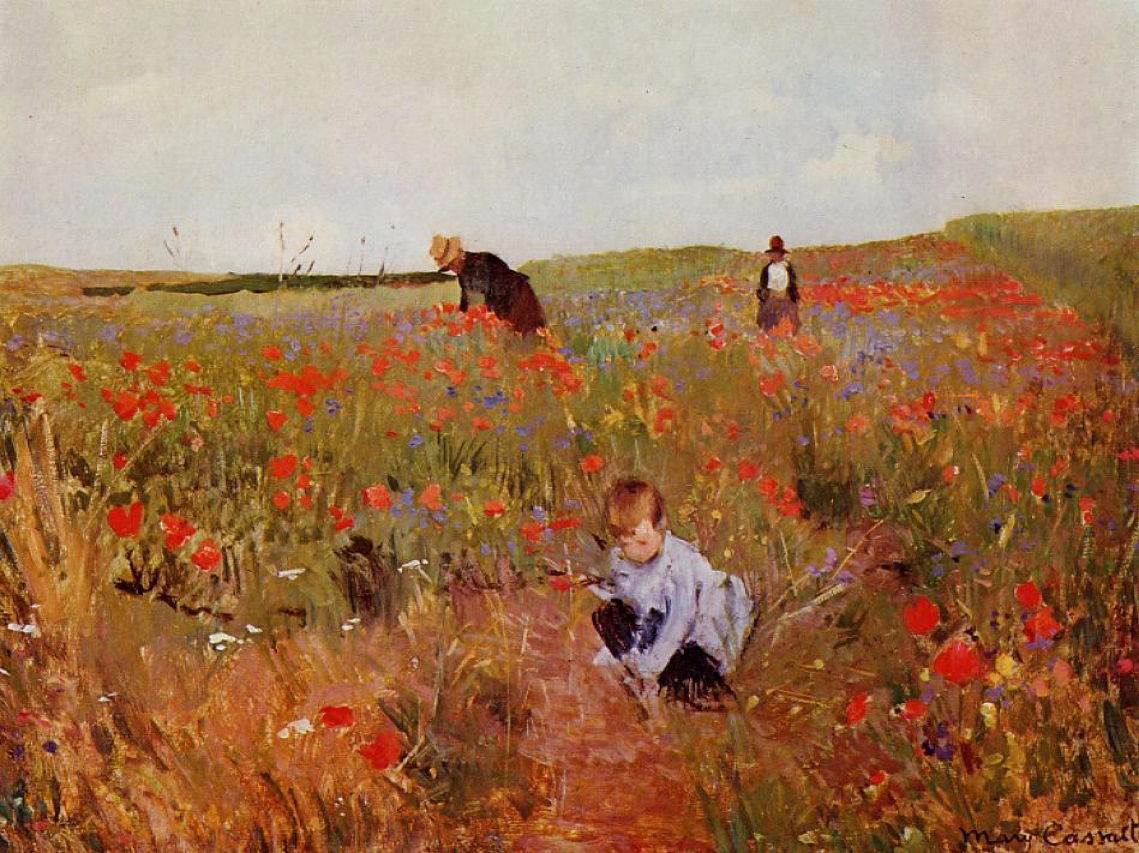
Cassatt couldn’t be considered a true Impressionist without making at least one painting of figures in a field of Red Poppies, or in French Les coquelicots (1874-1880). She chose to include two countrywomen and a child, in keeping with her career-long emphasis on the lives of women and their children.
During the late 1870s, Degas introduced Cassatt to print-making, and in the winter of 1879-80 she worked hard mastering her technique with Degas’ press. Degas, Cassatt, Pissarro, and others were collaborating enthusiastically to produce a journal of their prints.
Reference

