Normal view

There are new articles available, click to refresh the page.
Before yesterdayMain stream

The Temptation of Saint Anthony 1660-1908

By: hoakley
14 December 2025 at 20:30

In the first of these two articles tracing the history of depictions of the temptation of Saint Anthony, I had reached 1650, when the bizarre composite creatures that flourished in Hieronymus Bosch’s triptych of about 1500-10 were becoming common.

tenierstemptationstanthonylille
David Teniers the Younger (1610–1690), The Temptation of Saint Anthony (c 1660), media and dimensions not known, Palais des Beaux-Arts, Lille, France. Wikimedia Commons.

The prolific David Teniers the Younger painted several versions of the Temptation of Saint Anthony after about 1650. Most, like this painting now in Lille, show an ordinary landscape with the saint, with the addition of his own species of daemons. Some of these re-use ideas first seen in Bosch’s triptych, such as that of a single figure on the back of a flying narwhal; that figure is wearing an inverted funnel on its head.

tenierstemptationstanthonyprado
David Teniers the Younger (1610–1690), The Temptation of Saint Anthony (c 1650), oil on copper, 55 × 69 cm, Museo Nacional del Prado, Madrid. Wikimedia Commons.

Another of Teniers’ paintings, currently in the Prado, shows three fairly normal humans in a menagerie of daemons, some of which clearly have their origins in Bosch’s work. The figure flying on a fish has changed from the previous painting, but still wears its distinctive inverted funnel.

tenierstemptationstanthonytokyo
David Teniers the Younger (1610-1690), The Temptation of Saint Anthony (c 1650), oil on canvas, 80 x 110 cm, National Museum of Western Art, Tokyo. Wikimedia Commons.

This third version, now in Tokyo, repeats many of the same daemons in a different setting, retaining the figure wearing the inverted funnel in close aerial combat.

vanwijnentemptationstanthony
Domenicus van Wijnen (1661–after 1690), The Temptation of Saint Anthony (c 1685), media and dimensions not known, The National Gallery of Ireland, Dublin. Wikimedia Commons.

Almost two centuries after Bosch’s triptych, more radically different and inventive approaches appear, here in Domenicus van Wijnen’s painting of about 1685. Its daemons are much more human in form, and have proliferated in a way more common in the ‘fairie paintings’ seen around 1840, including some by Richard Dadd. Van Wijnen was a prolific painter of scenes of witchcraft and the ‘dark arts’.

tiepolotemptationstanthony
Giovanni Battista Tiepolo (1696–1770), The Temptation of Saint Anthony (c 1740), oil on canvas, 40 x 47 cm, Pinacoteca di Brera, Milan. Wikimedia Commons.

Southern European painters were more likely to keep to more traditional figurative compositions, as used by Tiepolo in about 1740. This is surprising, given the presence of Bosch’s paintings in major collections in both Madrid and Venice.

fantinlatourtemptationstanthony
Henri Fantin-Latour (1836–1904), The Temptation of Saint Anthony (c 1875), oil on canvas, 63.5 x 83.5 cm, National Museum of Western Art, Tokyo. Wikimedia Commons.

Depictions of the Temptation of Saint Anthony remained popular even through the 1800s, although by this time Bosch’s triptych seems to have become long forgotten, and painters seemed no longer to need such excuses to exercise their imagination and inventiveness. The long-awaited publication of Gustave Flaubert’s book The Temptation of Saint Anthony, written in 1874 as a script for a play, brought renewed interest, and a succession of paintings from Henri Fantin-Latour (c 1875, above), Paul Cézanne (c 1875, below), Gustave Moreau (a watercolour), and Fernand Khnopff (1883).

cezannetemptstanthony
Paul Cézanne (1839–1906), The Temptation of Saint Anthony (c 1875), oil on canvas, 47 x 56 cm, Musée d’Orsay, Paris. Wikimedia Commons.

Cézanne shows the shadowy figure of Saint Anthony slumped against a bush at the left, his arms held out to shield himself from the temptations. The devil is shown in stereotypical form, wearing red robes, with an animal head and horns, behind the saint. In front of them is the naked Queen of Sheba, her right arm held high to accentuate her form. Around her are naked children. In front of Saint Anthony is a black bag presumably containing money, and a book.

morellitemptationstanthony
Domenico Morelli (1823–1901), The Temptation of Saint Anthony (1878), oil on canvas, 137 × 225 cm, Galleria Nazionale d’Arte Moderna, Rome. Wikimedia Commons.

The influential Neapolitan realist Domenico Morelli painted this stark work in 1878, perhaps the exact antithesis of the rich imagery that had developed since the Renaissance.

ropstemptationstanthony
Félicien Rops (1833–1898), The Temptation of Saint Anthony (1878), pastel and gouache on paper, 73.8 × 54.3 cm, Cabinet des estampes, Bibliothèque Royale Albert Ier, Brussels. Wikimedia Commons.

That same year, Félicien Rops painted his satirical and irreverent version with more subtle details. Bound to the cross in Saint Anthony’s tempting vision is a visibly voluptuous woman, the word EROS replacing the normal initialism of INRI (Iēsūs/Iēsus Nazarēnus, Rēx Iūdaeōrum, meaning Jesus of Nazareth, the King of the Jews) shown above Christ’s head. Christ himself, with full stigmata, has been knocked sideways to accommodate the woman’s naked body. Behind the cross the horned devil wears scarlet robes and pulls faces. Behind him is a pig, Anthony’s attribute. The two daemonic putti are most definitely not references to Bosch.

corinthtemptationstanthony1897
Lovis Corinth (1858–1925), The Temptation of Saint Anthony (1897), oil on canvas, 88 × 107 cm, Bayerische Staatsgemäldesammlungen, Munich. Wikimedia Commons.

Lovis Corinth painted two versions of the Temptation. The earlier, from 1897, shows Anthony surrounded by beautiful and naked women, offering him fruit, other food, and their bodies. The daemons have faded into the background, and are caricatures based on humans.

corinthtemptationstanthony1908
Lovis Corinth (1858–1925), The Temptation of Saint Anthony (after Gustave Flaubert) (1908), oil on canvas, 135.3 × 200.3 cm, The Tate Gallery, London. Wikimedia Commons.

His later canvas, explicitly painted after Gustave Flaubert, in 1908, brings in the Queen of Sheba, an elephant and monkey, but is also notable for depicting Anthony as a young man. Even Salvador Dalí’s 1946 painting of the Temptation steers clear of Bosch’s imagery, although it does at least return to the concept of an individualistic and inventive vision.

The Temptation of Saint Anthony 1430-1650

By: hoakley
13 December 2025 at 20:30

Paintings of scenes from the hagiographies of Christian saints have been enduring favourites, particularly for churches dedicated to that saint, and for sponsors named after them. The lives of some saints are sufficiently complicated as to offer the artist a choice of different scenes, but in the case of Saint Anthony the Great (of Egypt, the Abbot, etc.), paintings are almost confined to his temptation by the devil.

Saint Anthony was born in 251 CE to wealthy parents in Lower Egypt. His parents died when he was 18. He then became an evangelical Christian, and gave his inheritance away to follow an ascetic life. For fifteen years he lived as a hermit. During this time the devil fought with him, afflicting him with boredom, laziness, and dreams of lustful women, before beating him unconscious.

Friends found him and brought him back to health, so he returned to the desert for another twenty years. This time the devil afflicted him with visions of wild beasts, snakes and scorpions, but again he fought back, eventually emerging serene and healthy. He went to Alexandria during the persecution of Christians there, to comfort those in prison. He returned to the desert, where he built a monastic system with his followers.

His attributes are a bell, a pig, a book, the Tau cross (like a capital T), sometimes with a bell pendant. He is commonly shown being tempted in a wilderness, often by naked women, and is associated with fire (“Saint Anthony’s Fire”).

The visionary nature of his temptation, and the temptations offered him, give a painter a wonderful opportunity to exercise their imagination, and to include content that might otherwise be excluded from places of worship. This weekend I show a selection of paintings of this unique story. This article covers paintings before 1650, and the next will cover the period from 1660 to the early twentieth century.

giovannitemptationstanthony
Stefano di Giovanni (1392–1450), St Antony Beaten by the Devils (1430-32), media and dimensions not known, Pinacoteca Nazionale di Siena, Siena, Italy. Wikimedia Commons.

Painted in 1430-32, Stefano di Giovanni’s St Antony Beaten by the Devils identifies the saint by his Tau crucifix. Three devils, clearly fallen angels by their wings, are beating him with clubs. Those devils are fairly conventional figures, part animal and part man, with horns.

michelangelotemptationstanthony
Michelangelo (1475–1564), The Torment of Saint Anthony (c 1487–88), tempera and oil on panel, 47 x 34.9 cm, Kimbell Art Museum, Fort Worth, TX. Wikimedia Commons.

Michelangelo’s The Torment of Saint Anthony (c 1487–88) continues the theme. Saint Anthony is now being held aloft by ten or so devils, including a weird fish with many spines and a trunk-like snout. The devil at the lower left of the group has breasts and a face in its perineum, which almost makes it double-ended.

We then reach a watershed in the unique paintings of Hieronymus Bosch. Records make it clear that he painted several different versions of the Temptation of Saint Anthony, of which it appears that the Lisbon triptych from about 1500-10 is the sole complete survivor, and there’s also the remains of another in a fragment in Kansas City.

boschtemptationstanthony
Hieronymus Bosch (c 1450–1516), The Temptation of Saint Anthony (Lisbon) (c 1500-10), oil on oak panel, left wing 144.8 x 66.5 cm, central panel 145.1 × 132.8 cm, right wing 144.8 × 66.7 cm, Museu Nacional de Arte Antiga, Lisbon. Wikimedia Commons.

Inside the triptych now in Lisbon, the left panel shows Saint Anthony being assisted by three others, as he crosses a small wooden bridge, in a state of complete exhaustion, perhaps after being beaten unconscious by the devil. In the countryside around that group are weird human and portmanteau animal figures. In the sky above, Saint Anthony is seen again, being flown around on the back of another invented animal.

The centre panel shows Saint Anthony in the middle, kneeling in prayer and surrounded by bizarre figures, creatures, and objects, as if in a vision of temptation. In the background a town is burning.

The foreground shows more scenes involving bizarre figures, creatures, and objects. At the left, a jumble of them emerges from the huge shell of a strawberry-like fruit. One of those figures is astride a goose, and playing a harp. In the middle is a small pond, in which a hybrid between a fish and a boat is floating, and a man is seen inside another strange creature.

The right panel shows Saint Anthony seated, with a book open in front of him. He is again surrounded by strange figures and creatures from a vision of temptation. The background shows a prominent windmill and towers, behind which is a wintry landscape with snow on the ground.

In the foreground, in front of the saint, is a circular table, half-covered with a white tablecloth. The table is supported by naked human figures, one of whom has his left foot in a large pot. Another wears an armoured glove brandishing a heavy scimitar, but a creature has passed a thin-bladed sword through its neck. At the left edge of the table, another naked human is blowing a curiously curved trumpet. To the right an abdomen with ears and legs, wrapped in a red cloth hat, has a sword stuck into it.

grunewaldstanthonydiptych
Matthias Grünewald (1470-1528), Visit of St Anthony to St Paul and Temptation of St Anthony (c 1515), oil on panel, each panel 265 x 141 cm, Musée Unterlinden, Colmar, France. Wikimedia Commons.

Matthias Grünewald’s slightly later diptych provides useful contrast between the conventional Visit of St Anthony to St Paul on the left, and his Temptation of St Anthony (c 1515) on the right. These daemons are different from Bosch’s, but are nevertheless highly imaginative in their appearance.

manueltemptationstanthony
Niklaus Manuel (1484–1530), The Temptation of Saint Anthony (Antonius altar, left wing outside: Demons Tormenting St. Anthony) (1520), oil on panel, width 135 cm, Kunstmuseum Bern, Bern, Switzerland. Wikimedia Commons.

The outside of the left panel of Niklaus Manuel’s Antonius altar shows Demons Tormenting St. Anthony (1520). Its daemons, and the wooden clubs with which they attack the saint, are inventive, but still rooted in Stefano di Giovanni’s of a century before.

vanleydentemptationstanthony
Lucas van Leyden (1494–1533), The Temptation of Saint Anthony (c 1530), oil on panel, 66 x 71 cm, Koninklijke Musea voor Schone Kunsten van België, Brussels. Wikimedia Commons.

Lucas van Leyden’s painting of about 1530 appears to have been directly influenced by Bosch. Leading its small procession of strange creatures is a man with a bird’s head, and a long bill, wearing ice-skates, clearly derived from the creature bearing a note in the foreground of the left wing of Bosch’s triptych. There are several other familiar features in those creatures, but the rest of the painting is more conventional.

massijstemptationstanthony
Cornelis Massijs (c 1510/1511–1556/1557), The Temptation of Saint Anthony (c 1540), oil on canvas, Koninklijke Musea voor Schone Kunsten van België, Brussels. Wikimedia Commons.

By about 1540, Cornelis Massijs was still content to paint an almost completely realist image, showing Saint Anthony with two naked women, and another who may be their procuress. But once again there are some small decorations – a pot-bellied man, a creature with an inverted funnel on its head, and a little group at the right – that seem to have invaded from the mind of Bosch.

vanaelsttemptationstanthony
Pieter Coecke van Aelst (1502–1550), The Temptation of Saint Anthony (1543-1550), oil on panel, 41 x 53 cm, Museo Nacional del Prado, Madrid. Wikimedia Commons.

When we reach Pieter Coecke van Aelst in 1543-1550, the emphasis has changed completely. There are still three normal human figures, of the saint, a tempting nude, and her procuress behind, but the rest of the painting is filled with Bosch derivatives, such as the nun with wings biting someone’s leg, in the foreground. The burning town also makes an appearance in the left distance.

veronesetemptationstanthony
Paolo Veronese (1528–1588), The Temptation of Saint Anthony (1552-3), oil on canvas, 198 x 151 cm, Musée des Beaux-Arts, Caen, France. Wikimedia Commons.

Paolo Veronese’s interpretation from 1552-53 is difficult to read, but the saint is almost completely obscured under a well-muscled devil and a woman whose left breast is exposed. Anthony is sprawled on his back, in his brown habit, his left hand fending off the woman’s hand, his right clutching a book. The devil is holding him down with his left hand, and about to strike him with a club held in his right.

huystemptationstanthony
Pieter Huys (c 1519–1584), The Temptation of Saint Anthony (1577), color on wood, 76 × 94 cm, Museum Mayer van den Bergh, Antwerp. Wikimedia Commons.

Pieter Huys’s painting of 1577 is more obviously a derivative from Bosch. Saint Anthony could almost have been copied from one of the earlier paintings, and most of the strange figures and creatures have been borrowed and re-interpreted. Musical instruments such as the lute and harp make an appearance, but many of the symbols have been changed. For example, where Bosch’s triptych features round tables with a white cloth, Huys opts for a rectangular table, and the background has a town burning even more violently.

devostemptationstanthony
Maerten de Vos (1532–1603), The Temptation of Saint Anthony (1591-4), oil on panel, 280 x 212 cm, Koninklijk Museum voor Schone Kunsten, Antwerp, Belgium. Wikimedia Commons.

Maerten de Vos’s vision of 1591-4 follows a more traditional line again, although it contains some strange elements that appear more personal. He shows one Saint Anthony apparently carrying another, unconscious Saint Anthony in his arms, rather than the saint supported by friends. There’s a third version of the saint flying in the air, surrounded by daemons, too. That unconscious saint points to a pig, a recognised attribute, but nearby is a pair of lions. One of the more Bosch-like creatures in the right foreground is a portmanteau of human and bird, wears an inverted funnel on its head, and is reading sheet music.

bruegheltemptationstanthony
Jan Brueghel the Elder (1568–1625), The Temptation of Saint Anthony (c 1610), oil on canvas, 148 x 230 cm, Museo Nacional de San Gregorio, Valladolid, Spain. Wikimedia Commons.

Just a century after Bosch painted his triptych, Jan Brueghel the Elder combines a cavalcade of more traditional figures with a foreground of more bizarre ones derived from Bosch, including an old person’s head with four human legs, and a bird with two heads, one of a cockerel and the other a duck with a clarinet-like bill. A second image of the saint appears in the sky, surrounded by daemons, and a church is on fire in the background.

vancraesbeecktemptationstanthony
Joos van Craesbeeck (c 1605–1654/1661), The Temptation of Saint Anthony (c 1650), oil on canvas, 78 x 116 cm, Staatliche Kunsthalle, Karlsruhe, Germany. Wikimedia Commons.

By about 1650, Joos van Craesbeeck was using some of Bosch’s iconography with his own developments. The use of a human head as a container is probably derived from Bosch’s tree-man and similar devices, but here has become even more realistic. To the right of that, a naked man sits facing backwards on a duck-horse: he is playing a stringed musical instrument, and wearing an inverted funnel on his head. Van Craesbeeck’s humans seem to have grown small red tails too. Oddly, van Craesbeeck doesn’t place the Greek letter Tau on the saint’s robes, but the Roman letter A, perhaps monogrammed with Tau. That appears unique to this painting.

湄洲天后宫

By: fivestone
13 July 2024 at 16:39

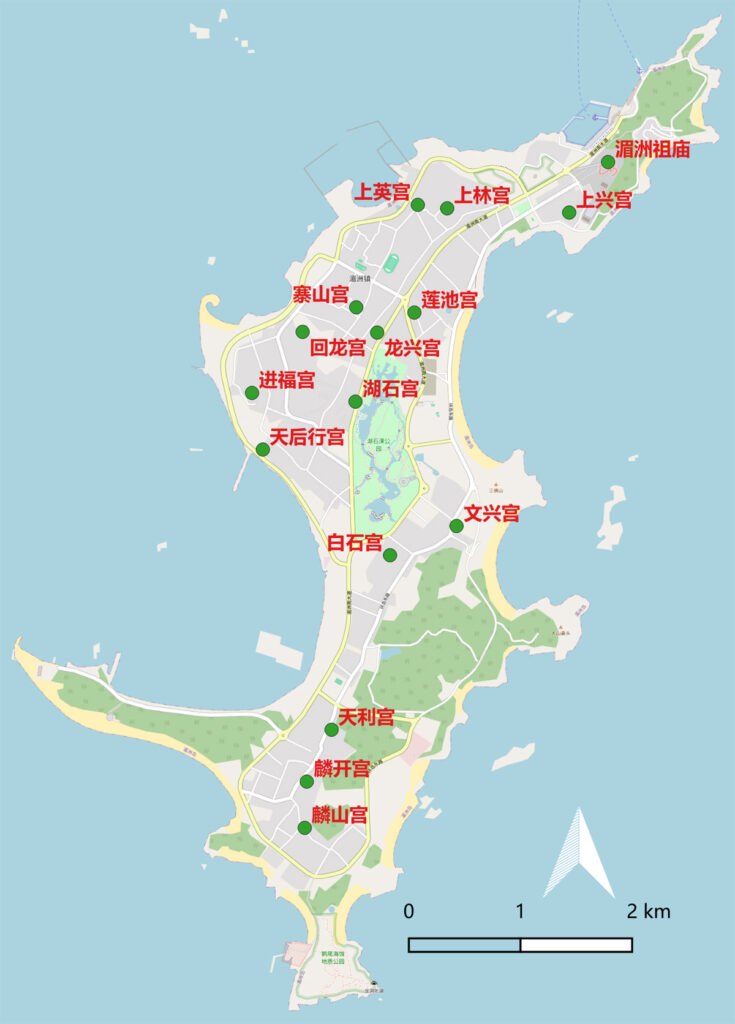
湄洲岛,传说是妈祖林默的故乡。北宋年间,岛上出现了最早的妈祖庙(灵女祠),经历朝扩建为大片宫殿,文革期间全毁,1980 年代后,由散落到各地的香火信徒集资重建的仿宋建筑群。被妈祖信徒们戏称为「东方麦加」……

除了在码头附近的大型祖庙外,湄洲岛上的几乎每个村落,都有各自的妈祖庙,盖的都不小。去不同的堂口进香,也是信仰和交流体系的一部分;尤其是在一些祭日,人们会扛着妈祖像,把所有的庙都逛一遍。

但其中一些庙,路不熟的话,并不好找。于是我上岛时,被唤醒了踩地图之魂,骑着电动车,把所有妈祖庙都找了一遍,标上准确的 GPS 位置。

每座庙的 GPS 位置(WGS 84),由北向南:

地点纬度 °N经度 °E
湄洲祖庙25.09379119.14317
上英宫25.09035119.12628
上林宫25.09007119.12889
上兴宫25.08973119.13972
寨山宫25.08211119.12082
莲池宫25.08169119.12598
回龙宫25.08014119.11606
龙兴宫25.08008119.12268
进福宫25.07523119.11157
湖石宫25.07453119.12075
天后行宫25.07068119.11253
文兴宫25.06453119.12972
白石宫25.06218119.12382
天利宫25.04815119.11863
麟开宫25.04398119.11643
麟山宫25.04026119.11625

大约有一半的妈祖庙,是比较好找的,就在主路的边上,甚至在高德地图就能搜到。但其中也有坑,譬如,我第一个去的是「莲池宫」,按地图上搜到的位置,找过去,却关了门。因为是第一家,我并不知道岛上的庙,是什么样子的,于是以为自己不走运,很多庙不在祭日都会关门;正在遗憾,看到里面仿佛有人,敲门问了问,才发现,这家莲池堂,其实是个耶稣教会………

真正的莲池宫,藏在另一个方向的村子里,穿过几条土路才会看到。所有的妈祖庙,其实都是这种金碧堂皇的样子,平日一直开着门。

岛上还有很多其它的庙:有耶稣教会、有完全不供奉妈祖的佛寺、有很小只的土地庙、关帝庙、海神庙、有家族私姓的祠堂、有看着很像妈祖庙,但不知是做什么的「三一教」……海边的「天后行宫」,在妈祖庙背后,修了个更大一号的如来大雄宝殿,于是感觉并不是很靠谱,有人介绍岛上除了祖庙,有 15 家妈祖庙,就没有把天后行宫算在里面。

但有些神灵,是可以放在妈祖庙的侧位一起供的,譬如,齐天大圣……

有的庙正在修葺,就让妈祖像暂居到村子的土地庙/城隍庙里,因为妈祖更大牌,所以城隍要把中间的位子让出来~

有的已经建好了新庙,于是旧庙广场上,用来晒鱼干。

所有的庙旁边都有戏台,还有很多社区的老年中心,也挂牌建在庙场旁边。但大家也经常直接在庙里活动:织网、打牌……赌金还不小。

庙修的都很精美,但赞助者的签名,就磕碜了点儿。

希望小朋友考出好成绩。

路过其它小庙在举行仪式,搭台唱戏。但感觉不同信徒之间,是有些隔绝的。很多时候问路,几百米外的妈祖庙,对方并不知道在哪里,甚至没听说过。

岛上有很多游客、有夜市、很漂亮的画了彩虹线的海边公路。游客们穿着小清新的样子,打卡拍照。但似乎很少有人会去这些庙里逛逛。似乎是两个世界。

New Work in an Old City

21 June 2024 at 02:01

For the past three years I’ve been a fellow at the Council on Foreign Relations in New York, where I finished my book Sparks on dissent in today’s China, while also working on policy issues. It’s been a great experience: I got the chance to work with collegial, interesting thinkers; I moved back to the United States for the first sustained period of time in nearly 30 years; and our family had stability after I was turfed out of China in 2020 and we faced the uncertainties of the Covid era.  For these and many other reasons I’ll always be thankful to the Council for providing me with an intellectual home and a great place to work. 

We would have enjoyed staying on at the Council and in New York but a variety of reasons call us back to Europe and so–to bury the lede–we are leaving New York on July 1 for Berlin (via a summer in Southeast Asia).

Why? Emotionally, I love New York but I have felt what the Chinese call yuanfen (affinity) with Berlin ever since I went there before the Wall fell. After leaving Montreal as a teenager, I didn’t feel at home in many places but Berlin–as messed up as it was and is–immediately felt like home. I spent more than a decade there and it was my base for all the years I spent in China. 

Now we have a great chance to return to Berlin. I’ll be a fellow at the Wissenschaftskolleg zu Berlin. This is modeled on (and in fact its official English name is) the Institute for Advanced Studies, the Princeton-based center for natural and social scientists. I’ll work on my next book there, on religious life in Xi’s China–hint, it has to do with folk religion, pilgrimages, and stick fighting.

Meanwhile, while my wife Sim Chi Yin can be a bit closer to her artistic practice–she’s represented by a gallery there and often works in Europe’s colonial archives. 

In fact, we aren’t flying straight to Berlin because she has a performance in Singapore at the end of August. It’s a one-woman show where she uses her photos, videos, and storytelling to look at memory and forgetting. The show premieres at the national theater, the Esplanade on Aug. 30 . (I’d be remiss if I didn’t mention TICKETS.)

So we’ll go in July, spend some time in Penang, and then she has rehearsals for most of the month. Then in early September off to Berlin for a new chapter in our lives.


The post New Work in an Old City appeared first on Ian Johnson.

Transcendence and death — The Chinese perspective

By: Elsa Zhou
5 March 2023 at 03:50

Transcendence and death — The Chinese perspective

Disclaimer: This contains my personal views on religious beliefs (not necessarily formal religions) as an ex-Christian and therefore might cause offense to others, viewer discretion advised

Everyone dies.

The irony is, most humans live as if they are immortal, my explanation is because no one’s conscious mind has experienced unconsciousness, and thus death. It is surprisingly easy to forget that you will, and everyone around you, will one day die. Everyone we see on the streets are typically, not dead. Everyone reading this sentence is definitely not dead. So you walk through you daily life without ever thinking about this one great certainty.

I have an app called WeCroak remind this to myself five times a day. This made me appreciate the things I have much more, but also has created a great fear in me. Will I still be here tomorrow? What if I go to bed and never wake up? Obviousy the logical conclusion is, you won’t have to worry about that if it does happen anyways so don’t worry about it now.

But this wasn’t enough for me. Naturally, I started exploring religious beliefs. Turns out, in some religions, depending on who you are, what you did, and many other things, after you die you go live in a place, either good or bad, that we cannot experience while we are still living. In some other religions, you come back to this world, in some shape or another, also depending on who you are, what you did etc. In some others, you simply die and there is no afterlife.

All of this sounded insane to me. I cannot possibly convince myself to believe that there will be something waiting for me on the other side after I close my eyes for the last time, either that something is good or bad, because no one has ever seen it. I’ve read a couple dozen Christian books of visions of heaven and hell, back when I was still one. They offered many contradictory accounts. Buddhism’s version of coming back to this world, in one form or another did not make much sense to me either, how to we account for the population boom?

I was in a valley of despair. I was going through life without any meaning. What awaits me at the end is unknowable. I cannot choose a religion to believe in to convince me that there is something beyond the end of my life.

All of this fell on me about 2 weeks ago. I fainted, for the first time in my life, at my desk due to overworking. My head smashed against the keyboard. I was typing right before I felt my entire body was disconnected from my head, and I could not feel anything that is beneath my head, not even my neck muscles. It felt like a guillotine experience. I started falling towards the keyboard, without any control over any part of my body, but remained conscious even if I was extremely dizzy. The world started rotating in my eyes. I laid on the keyboard for 15 seconds before I started feeling my body again.

As I was falling, I thought, this is it. I’ve worked myself to death. If only I had more time to figure out more stuff and enjoy life more. Surprisingly, I was still alive. I took a few days off to recover and have a much better work-life balance now.

But what if I really died that day? Did I have any regrets (other than dying this early)? Did I have a good run? Was everything worth it?

In retrospect, I can say that everything has been worth it. 2 weeks after it, I finally figured it out via some very unexpected events.

It was late, I stumbled on a new (only to me) song called 兰亭序. For those not into Chinese culture, Lantingxu is one of the most important calligraphy in Chinese history written in the year 353. That is more than 1600 years ago. The modern song version is by Jay Chou, a Taiwanese singer.

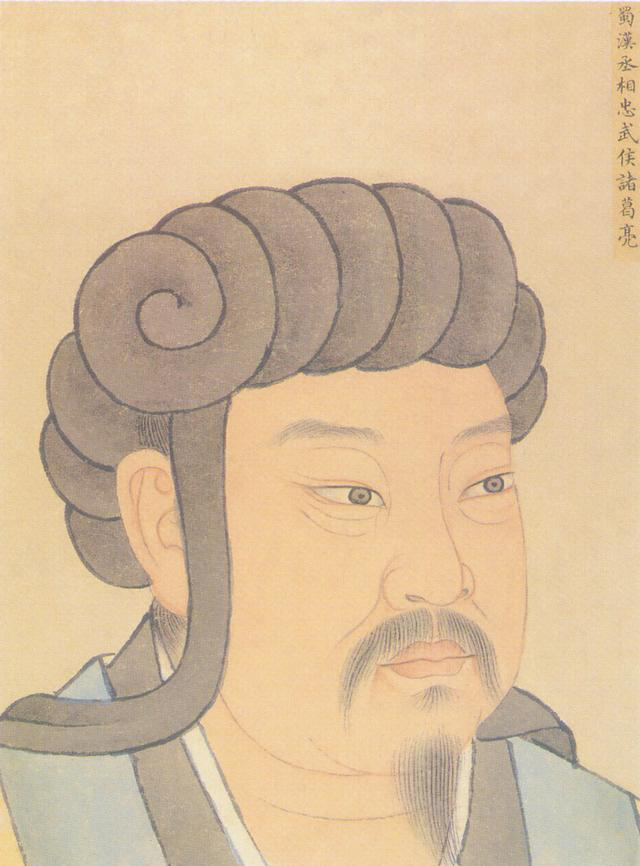
I was in love with the song, particularly a slowed version of it, which made me very emotional. I went on to search for other versions of it, and stumbled on a version that used it as the BGM with edited scenes from the Three Kingdoms tv series showing Zhuge Liang, the chancellor and later regent of the state of Shu Han in that era. He is regarded as one of the most capable and accomplished strategist & statesperson in Chinese history. He died trying to achieve his goals, but he never gave up against overwhelming odds. The video I watched that portrayed his story was extremely moving, and I started crying. The comments show that many felt the same way.

Portrait of Zhuge Liang

Sound familiar? A great historical figure that inspires many across 2 millennia. Someone called Jesus is also someone who inspires many across 2 millennia.

Except there is one key difference.

No one believes Zhuge Liang came back from the dead. A lot of people believe Jesus did.

And that is where the key difference between the religion of the Chinese and other more formal and established religious beliefs lie.

Chinese people believe in a myriad of things. Many contradictory. However one thing remains constant. No one believes with all their heart that there is an after-life. Even if there are made up stories, many even written in history books, about how when an emperor was born, some magical supernatural things happened. Everyone knows they are made up, often at the command of the emperor themselves.

There is no one that can turn water into wine by just snapping a finger. There is no one that can create a road in the ocean without building a bridge or filling in the ocean with earth and sand.

So, does the Chinese believe in gods? No, but yes.

The Chinese believe that mortals who die can do godly things.

Yes, there is nothing after death. Yes, there is no way to avoid it. But no matter who you are born as, it does not necessarily preclude you from becoming anything. 王侯将相宁有种乎 (No one is nobler simply by their birth) was the spirit of the first peasant uprising in China in 208 B.C. Even as a deeply patriarchal society, there has been Wu Zetian(https://en.wikipedia.org/wiki/Wu_Zetian), the first and only female emperor who ruled China. No one needs to be given birth by a virgin mother to achieve greatness. No one needs to have riden flying horses to be impactful.

This belief is not regarded as religious belief by many as it lack the structures of a formal religion that the West is more familiar with, but that is the beauty of it. No one needs to communicate with the originator of this belief through a special class of people who interprets ancient texts. This belief is universal, yet personal. It is held in the subsconsciouness.

It is a belief in humankind. In ourselves.

No one will get an after-life? That is ok, just make sure you are using your life for a cause worthwhile.

I don’t know about you, but this feels oddly comforting. As a mortal, I know I do not have the ability to go 40 days without food and water. If that is the only way to transcend death, then I would be out of luck.

But if people who have died, remain dead, have been able to use their human ingenuity against all odds to do things that are so great that their writings are still taught in schools, their stories still make people drop tears, then as long as you are a human, there is hope.

The Chinese does not believe in immortal gods.

Instead, we believe in mortal, fragile, weak humans, who do godly things.

They transcend death by accepting it as their destiny, and fight for a cause worth living for.

Glory to the Godly mortals.

Hell, Politics, and Religion

21 February 2023 at 00:19

Some forthcoming talks are helping me think through a new book, which I want to start writing in 2023 once Sparks: China’s Underground Historians and their Battle for the Future is out in September 2023 (more on that in a post coming soon).

One of the talks is at the Asia Society on March 1 and has to do with concepts of hell and the afterlife in China–especially how this played out after the Communist Party tried to destroy most values. Details here.

The second, and more relevant talk to my new book is on the idea of Civil Religion in China. I took a stab at this in early 2023 at a talk at Fordham University and will do so in a more systematic way in March at the Wissenschaftskolleg zu Berlin, aka Germany’s Institute for Advanced Studies.

I’ll be on a podium with Franciscus Verellen, a distinguished historian of religious life in middle-period China (and along with Kristofer Schipper the editor of one of the great recent works of sinological study, The Taoist Canon, which is a magically written and illustrated two-volume companion to the canon, which is essentially an encyclopedia of Taoist thought).

Prof. Verellen will talk about state and religion in classical China and I’ll talk about the concept in the country today, especially as the Communist Party uses it to cement legitimacy.

You can see details of both talks on this site’s “Talks and Media Appearances” page. The German talk will be in German. Both will be posted to YouTube, and I think the German talk will have subtitles.

If you get a chance to hear these and have feedback, please do send me an email at ij@ian-johnson.com I’d appreciate any feedback.

Thanks!

The post Hell, Politics, and Religion appeared first on Ian Johnson.

❌
❌