
 Login
Login
The Dutch Golden Age: Historical context 1644-1674
This is the second article setting some of the finest paintings of the Golden Age in the context of major events in the history of the Dutch Republic, and resumes the account in 1644, shortly before the end of the Thirty Years’ War.

Constituents of the Dutch Republic are shown in red, orange and yellow in this map. Its centres of art included The Hague, its de facto capital, Utrecht, Leiden, Delft, Harlem, and Amsterdam. To the south were the lands composing the Spanish Netherlands, notably Flanders and Brabant, including the cities of Antwerp and Brussels.
1644-1659
1648 The Peace of Munster was ratified, ending the Thirty Years’ War and formally establishing the Dutch Republic as an independent country (see below).
1652 The United East India Company started settling Cape Colony, later known as the Cape of Good Hope, in South Africa.
1652-54 The First Anglo-Dutch War, ended with the Treaty of Westminster.

Dutch landscape artists quickly realised that, even if they had relatively little earth and water to depict, the heavens above could be equally interesting. Horizons fell rapidly down their paintings, as seen in Jan van Goyen’s View of Dordrecht with the Grote Kirk Across the Maas from 1644.
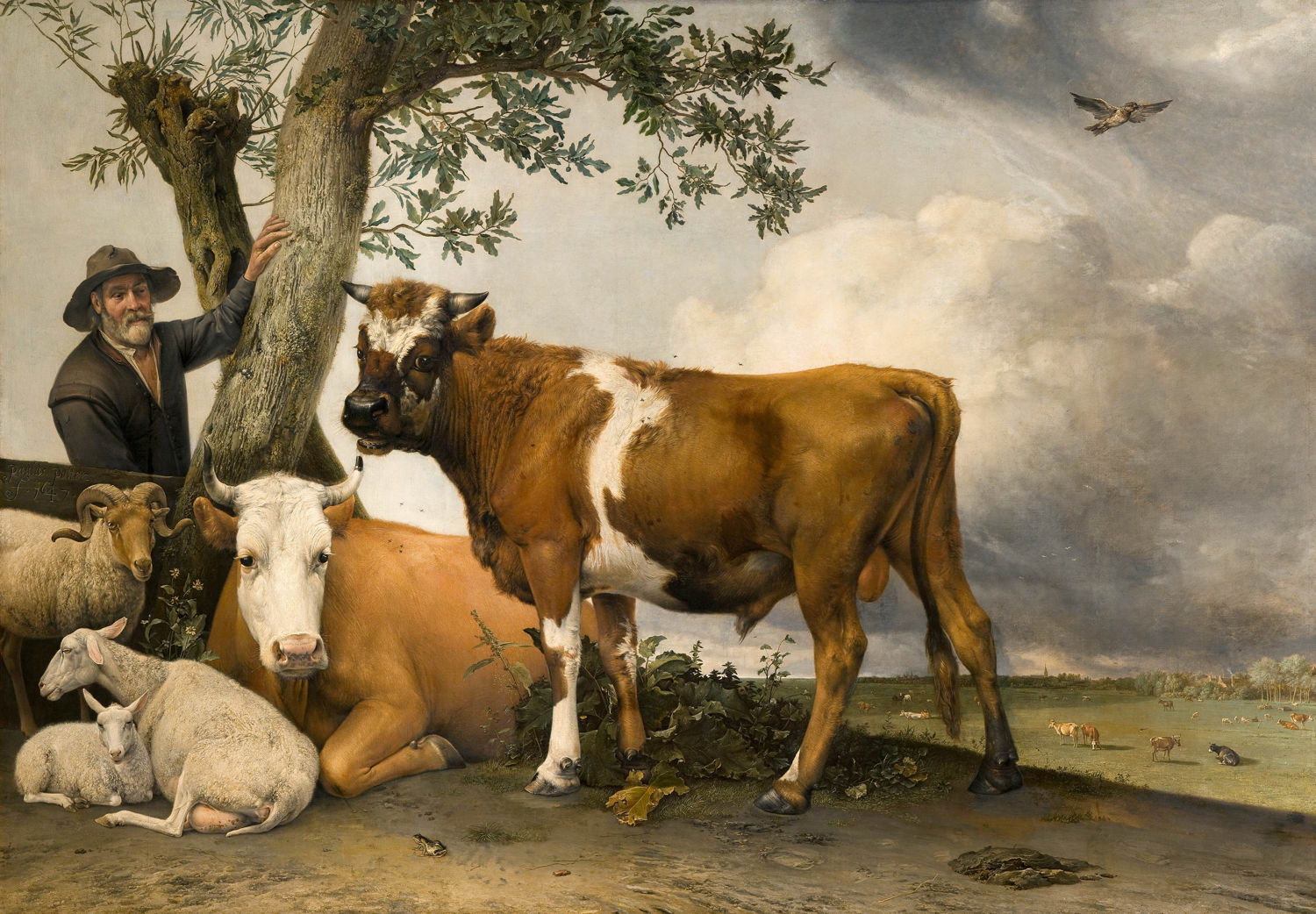
Paulus Potter, who became a member of the Guild of Saint Luke in Delft in 1646, founded the new genre of animal painting in 1647 with his almost life-size portrait of The Bull (also widely known as The Young Bull). Originally intended as a portrait of just the central bull, Potter enlarged the canvas to accommodate (from the left) a ram, lamb, ewe, herdsman, cow, and above them a bird of prey, possibly a buzzard. Beyond them are more cattle in the meadows receding to the church of Rijswijk, between Delft and The Hague.

For the thirty years between 1618-1648, central Europe had been engulfed in a bitter war between the Habsburg states, including the Holy Roman Empire and Spain, and their enemies, including the Dutch Republic. Gerard ter Borch’s magnificent painting of The Ratification of the Treaty of Münster, 15 May 1648 (1648) recorded the moment that the Thirty Years’ War ended, with the ratification of this treaty between the Dutch Republic and Spain.

The son a of Flemish immigrant, David Bailly, who lived and worked in Leiden, painted this Self-Portrait with Vanitas Symbols in 1651, with its multiple portraits referring to the past. The figure shows him as a much younger man, holding the maulstick he used in painting. His actual self-portrait at the time is in the painting he is holding with his left hand. Next to that is a painting of his wife, who had already died, and a ghostly image of her is projected onto the wall behind the wine glass.

Long before its value in preventing scurvy was realised (in 1747), or it was carbonated even later, still cloudy lemonade had become a popular soft drink. The extensive trade links of the Dutch Republic made the drink available to the middle classes, as celebrated in Gerard ter Borch’s The Glass of Lemonade (1655-60).

In Vermeer’s celebrated The Milkmaid (c 1658-1661) the maid is pouring milk from a jug, beside a tabletop with bread. In the left foreground the bread and pots rest on a folded Dutch octagonal table, covered with a mid-blue cloth. A wicker basket of bread is nearest the viewer, broken and smaller pieces of different types of bread behind and towards the woman, in the centre. Behind the bread is a dark blue studded mug with pewter lid, and just in front of the woman a brown earthenware ‘Dutch oven’ pot into which she is pouring milk.
1660-1672
1664-71 The Second Anglo-Dutch War.
1669 The United East India Company was the largest and richest private company in the world, with more than 150 merchant ships, 40 warships, 50,000 employees, and its own private army of 10,000.
1672 The Third Anglo-Dutch War; the Dutch Republic was invaded by France and others, following which its economy went into decline and the art market collapsed.
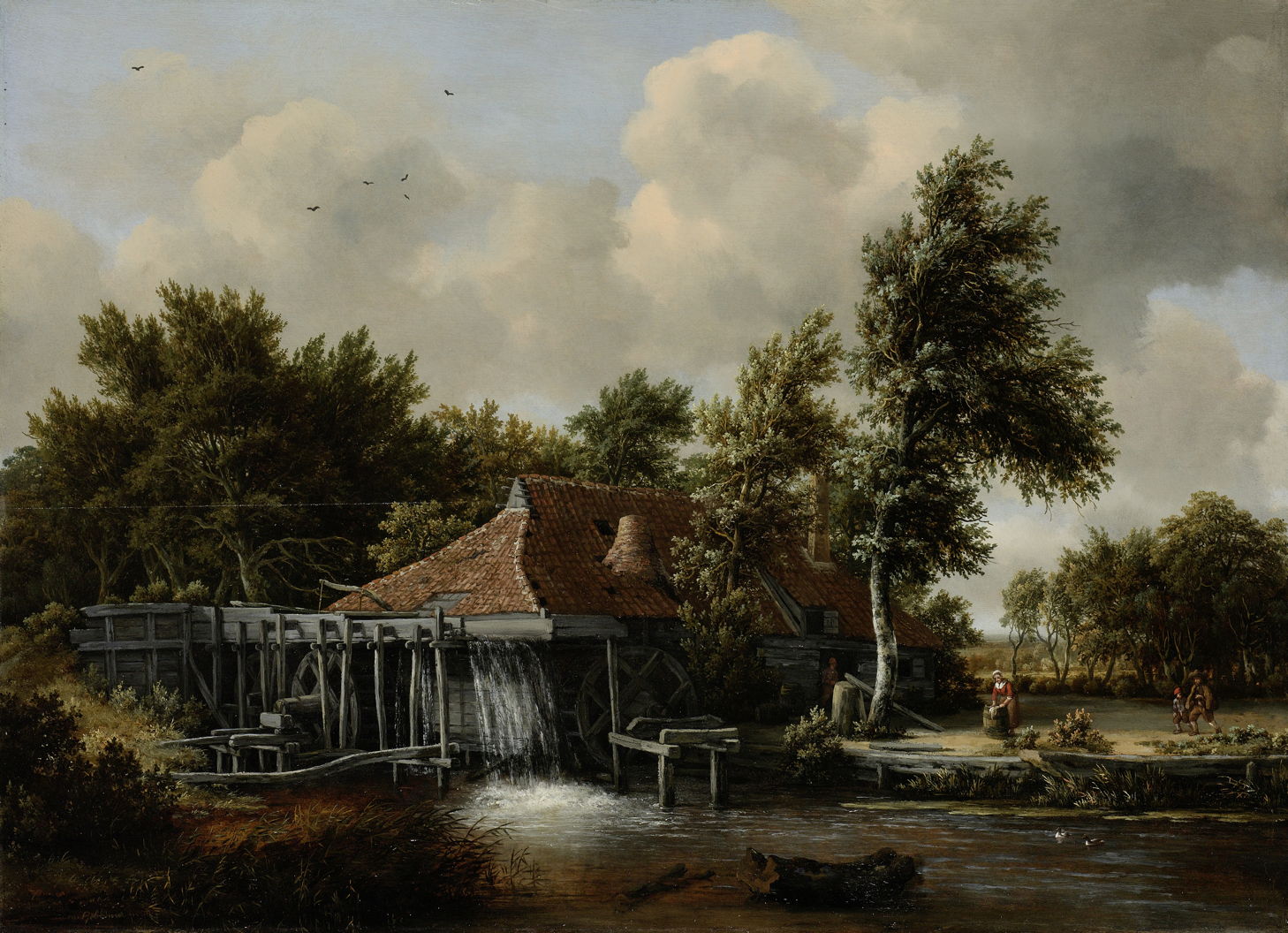
Meindert Hobbema’s magnificent Watermill from about 1664 accommodates a family: the wife is out doing the washing in a barrel, while the husband and son walk through their garden. It’s also relatively unusual in that the water here is fed through the elevated wooden aqueducts, making this watermill overshot, so capable of generating more power with a lower flow of water, because it uses the weight of water falling against the blades of the waterwheel.

Some painters, including Jacob van Ruisdael, turned their canvases to make portraits of towering clouds, as in his View of Haarlem with Bleaching Fields from about 1665. The distant town of Haarlem with its monumentally large church of Saint Bavo – works of man – is dwarfed by these high cumulus clouds, the works of God. This motif proved so popular that Van Ruisdael painted many variants of the same view, making it now one of the most widespread landscapes across the galleries of Europe.

Johannes Vermeer experimented with optical effects in his late The Art of Painting from about 1666-68, where greatest sharpness is slightly away from the geometrical centre of the canvas, in the woman holding a wind instrument. The high tonal contrast between the marble tiles on the floor is softened in the foreground, and sharpens as they recede deeper into the picture, as would be expected in a depth of field effect.

Rembrandt continued to develop his mark-making right up to his death. It’s often at its most florid when he painted fabrics, such as the clothing of the couple shown in The Jewish Bride of about 1665. The Dutch Republic had long been a safe harbour for Jews fleeing from oppression in other European countries, and Rembrandt had cultivated close relationships with members of the large Jewish community in Amsterdam, some of whom had modelled for his depictions of Old Testament stories.

One of Jacob van Ruisdael’s best-known paintings of windmills is this view of The Windmill at Wijk bij Duurstede from about 1670. This small town, now a city, is on the bank of the River Rhine, an ideal location for delivering grain by barge, and shipping the resulting flour.
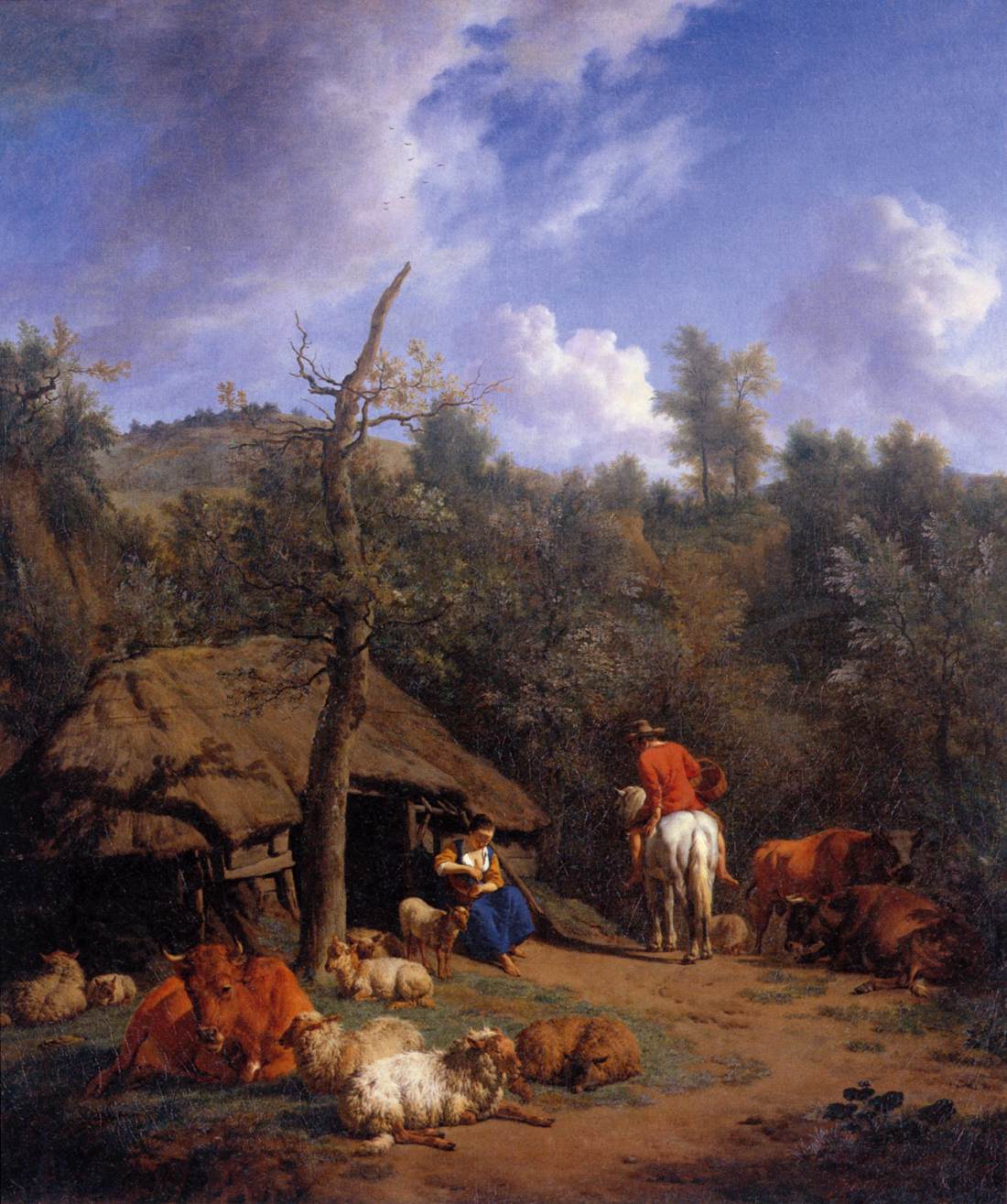
The Hut (1671) was one of Adriaen van de Velde’s last paintings, and has long been esteemed in the Netherlands. It’s one of his most natural compositions, sparkling with bright colour in the clothing and animals. The artist even adds the reality, perhaps as a touch of humour, of some fresh cowpats.

Gerrit Berckheyde’s view of Groote Market in Haarlem from 1673 shows one the largest of the city’s marketplaces at the end of the Golden Age.

